

Creatures
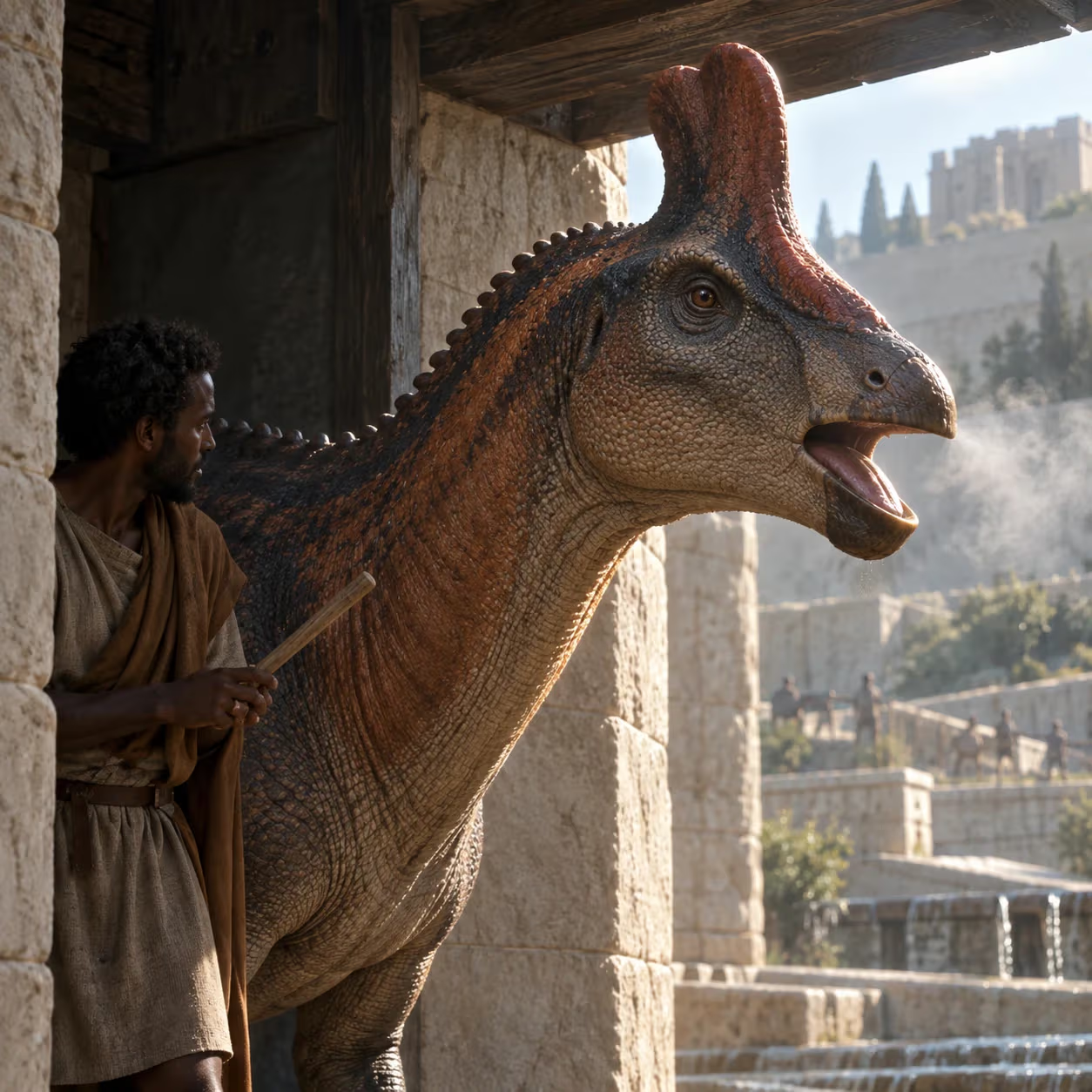
Hadrosaurs
The duck-billed dinosaurs of farms, relays, convoys and heavy riding: the second pillar of Urnokian life.
Urnok’s second pillar
Together with iguanodons, hadrosaurs are the second pillar of Urnokian life. Farms, relays, light loads, resins, haulage, patrols and river transport rely on them; Lambeosaurus, Edmontosaurus and Saurolophus are among the domestic lineages. In this world, drawing carts and towing barges is the work of hadrosaurs and iguanodons.
Observe gestures and materials · 2 images
Un hadrosaure de trait attelé à une charrette de sacs.
Un hadrosaure de trait attelé à une charrette de sacs.
Deux gardiens contrôlent les points d’appui du harnais d’un hadrosaure à crête au repos dans une baie de service.
Equipment changes with the task: a pack for goods, a towing harness and a military saddle do not spread the load in the same way. Harness-makers prepare pieces suited to the body and the use, and the supplier’s name stays attached to every registered piece.
From duchy to duchy
Calaron keeps ceremonial hadrosaurs, and House Calaris has made one its emblem. In Sarnor, convoy hadrosaurs tie the duchy’s reputation to the movement of stocks. In Bralnor, pack hadrosaurs work alongside the construction brachiosaurs. On the waterways, hadrosaurs help tow barges, without replacing human watch over basins and loads. Velmor breeds black lineages of hadrosaurs and iguanodons, tied to its draught trades and its military strength.
De nuit, sous la pluie, un troupeau de lambéosaures chargés traverse une cour éclairée de lanternes, vu depuis un magasin à grain.
Heavy riding
In the imperial army, heavy riding keeps up the shock capacity of hadrosaurs and iguanodons. At the Three Waves, hadrosaurs exploited the openings made by the Diplodocus’ tails; Marjory then brought them back, with the guards and short pikes, to rebuild the protection around her titans’ feet.
In Volonia’s harbours
Volonia’s harbours know small hadrosaurs used with ferries and markets; these are true dinosaurs, unlike plesiosaurs and ichthyosaurs. Volonia also uses imported pack hadrosaurs.
Breeds and uses in the bestiary
The barge hadrosaur, its broad back harnessed with floats, carries troops and freight on rivers, deltas and lagoons, from Sarnor to Velasar; it needs fresh or brackish water. The signal parasaurolophus, with a deep-voiced trumpet crest, coordinates convoys and raises the alarm in the fog, on the roads and at Port Volon, where it is called Bruro-Mar. The silo lambeosaur of Bralnor carries grain and sounds the alarm with its crest. The market hadrosaur, the Porte-Foire, less prestigious but everywhere, carries its side baskets through the crowds of the farming plains. The shantungosaur, an immense hadrosaur, ploughs and hauls; it can also serve as a living wall and an infantry carrier, in Bralnor as in the Terrasses d’Auréon.
In N’Goro, amphibious hadrosaurs live in the marshes. The Murmure-Roseau, with a misty, sounding crest, carries loads in wet country, sings and warns; outside the marshes it is vulnerable. The basin hadrosaur, with muddy legs and floating straps, serves as a platform and carries the wounded along the canals. A sturdy hadrosaur marked with quarantine signs handles controlled transport between N’Goro and Volonia around the Quarantine of Vaesh.
Laying many, growing fast
Hadrosaurs are the most numerous dinosaurs in the Empire, and their biology explains it. A female lays twelve to twenty eggs, which hatch in about three months; the young grow quickly and are adult at about four. The commonest civil lineages weigh a little under three tonnes, the great edmontosaurs of the heavy mounted corps up to six, and all browse on the ground as well as high up thanks to their broad beaks and batteries of close-packed teeth, which grind the toughest stalks.
In the studs the females lay in colonies, in nests dug side by side, and watch over their clutches together; breeders say the hadrosaur is the best mother in imperial husbandry, and the keepers are often content just to watch. A hadrosaur lives twenty to thirty years, sometimes forty for the great edmontosaurs, and serves for most of that life. It is the animal Urnokians know best, because they meet it every day.
The draught studs
The draught lineages are born largely in Sarnor, in the studs of the Ulmen Line, which holds both the duchy’s seed grain and its draught lineages: in Urnok a good breeding female and a good seed grain belong to the same trade, that of things not to be eaten. The studs train the young at two or three and then send them on rounds: teams go from farm to farm in the heavy ploughing season, and each family pays for their days instead of feeding all year an animal it would use for a month.
The Empire also sells its hadrosaurs. Convoy animals leave by the thousand for the other duchies and for abroad, Volonia first, which does not breed enough for its quays. Every animal sold wears at its neck a bronze token engraved with its name and register number, and the buyer receives a copy of its entry with it. Foreign merchants are sometimes amused; they soon understand that without this paper the animal will pass neither a quarantine gate nor an imperial relay.
The hadrosaur wheel
Every county’s mill turns at a hadrosaur’s pace. Inside a great wooden wheel eight to ten metres across, a trained saurolophus walks straight ahead without ever advancing, and the wheel turns a long wooden shaft whose cams lift the mill’s pestles, or which drives a pump or a saw by leather belts. A good wheel saurolophus keeps four hours in harness without changing pace; it is then relieved by another animal, and the miller sets his work by these reliefs as others set theirs by the bells.
It is the cheapest power in the Empire, which is why Urnok puts hadrosaurs everywhere. The great sauropods only work where a great deal of force is needed at a single point, a block to raise or an exceptional load; everything else turns at a hadrosaur’s pace. Village children recognise the creak of the wheel from afar, and a steady, tireless man is said to “walk like a wheel saurolophus”, which is a compliment among millers and a jibe among the young.
An animal that serves three times
When a draught hadrosaur reaches the end of its service, or an accident makes it unfit, it goes to the cull slaughterhouse on certificate, after a last reading of its name and years. Nothing is wasted. Its meat, salted with green salt from the southern marshes, becomes cull salt meat, the only meat that moves freely from one duchy to another; its tendons, especially those of the hind legs, serve as the standard for every tendon in the known world; its hide becomes leather, its bones tools, handles and pulleys.
Hadrosaur tendon is the measure against which merchants of every nation compare all others, and Urnokian breeders take a quiet pride in the fact that the Empire’s most ordinary animal sets the price of a material the whole world buys. The countryside sums up this career in a saying repeated when an old animal leaves: “A hadrosaur serves three times: on the road, in the salt and in the bow.”
Gallery2 images
Training a young pack hadrosaur in a pen.