

Creatures
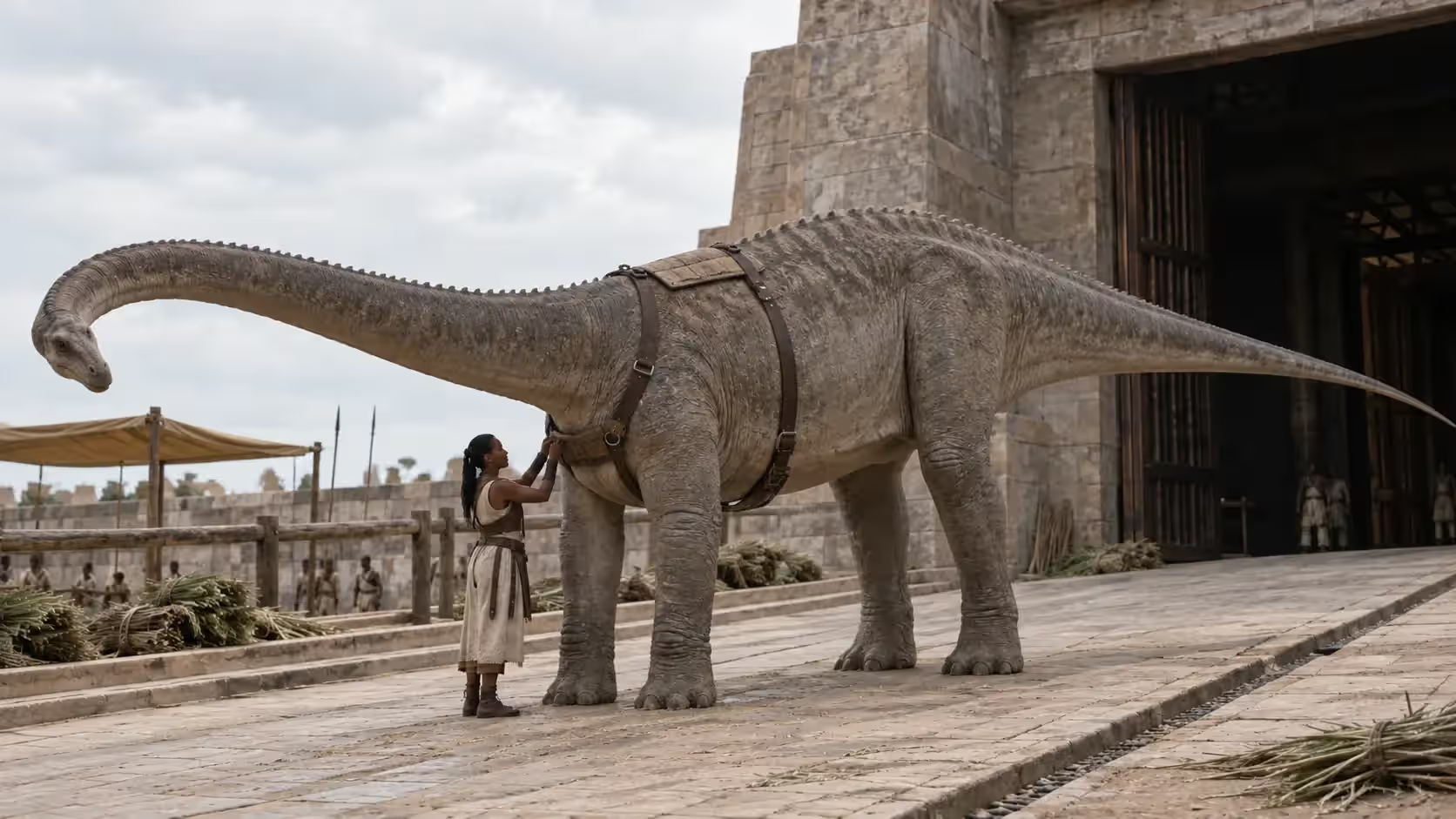
The first great domestication
Urnok’s tradition makes a female Diplodocus the first sauropod domesticated on a large scale. The bond is said to have grown from several generations of habit, food and repetition, until humans became predictable to the animal. Today’s handlers still work through breath, posture and signals.
The Order of the Diplodocus
The Order of the Diplodocus was founded by Marjory; Sahina is associated with it. It is distinct from the Imperial Order of Orûs, the emperor’s heavy guard. People nickname it the Ivory Whips, after the animal’s tail. Its sauropods serve for deterrence, closing off an area, breaking formations, mobile command and the living wall.
The mass handlers move these bodies through towns and on campaign. Their captain, Tigist, carries a whip she never unrolls: two cracks give the axis, a bone note the distance, an open palm forbids the tail’s radius. The order’s veterinarians name every titan they treat.
Riding a Diplodocus
The Great Dance of the Three Waves
At the battle of the Three Waves, fifteen Diplodocus opened Urnok’s centre with sequences of tail strikes. They worked as a synchronised order, probably in sub-groups: one tail opened a zone, the next struck in the interval, then infantry and hadrosaurs exploited the openings. A few seconds’ error could kill allies. Ridden by Marjory, Nahara’s mother let the whole group change angle without breaking the manoeuvre.
Des fantassins urnokiens avancent dans un intervalle ouvert, des sauropodes en arrière-plan dans la poussière.
The road Diplodocus
On the great plain roads the Diplodocus also serves for towing and convoys: it is then called Longue-Route, and its long tail traces the line of the haul. It does poorly in dry country.
A body made of length
The Diplodocus is the longest sauropod in the Empire and one of the lightest for its size. An adult measures about thirty metres, nearly half of it tail, and weighs only some fifteen tonnes, three or four times less than a Dreadnoughtus. Its neck is carried horizontally, out in front of the body, and sweeps the low and middle vegetation in a fan: the animal browses a wide circle without moving its feet, stripping leaves with teeth as slender as pegs. It eats some four hundred and fifty kilos of fodder a day.
It reaches adulthood at about eighteen and then serves for decades. A female lays five to ten eggs, brooded for more than nine months. Its relative lightness is its value: a diplodocus wears the load-bearing roads less than a heavy titan, turns more easily and copes with longer days of marching. It needs water, on the other hand, and a great deal of it: it does poorly in dry country and is hardly seen in the desert of Qor Zaï, where the amargasaur and the iguanodon take its place.
The whip tail
The Diplodocus’s tail tapers over its last metres to a thin lash, almost a thong. Flung by a movement of the hips, it cracks like a whip, with a sharp report that carries several hundred paces; it is this crack that the mass drivers imitate with their own whips, and that the Order’s animals know as a signal. A blow from the heavy part, near the base, knocks over a man and his mount; a blow from the lash cuts a raptor’s hide through its scales.
The tail is fragile too. The lash breaks and becomes infected, and the Order’s veterinarians often mend its tip with wooden splints and fibre bands coated with glue. For exercise it is sheathed in padded bands that a tail armourer sews and checks; in war the same armourer removes those bands and leaves only a sheath of thick leather at the base, where enemy blows are aimed. Tail radii are marked on the ground in every yard where diplodocus work, and the drivers’ open palm, which forbids that radius, is one of the first signs the capital’s children learn.
The draught diplodocus
Outside the Order, the Diplodocus is first of all a draught animal. On the roads reserved for it, a Long-Road hauls a train of wagons weighing thirty to forty tonnes at a man’s walking pace, covering a day’s road from one relay to the next. Its handlers guide it from a small platform at the base of the neck, and helpers walk alongside the train to watch the wheels and couplings. The Empire’s canals also use it to tow heavy barges, wherever the towpaths are wide enough for its tail.
The diplodocus is also used for clearing land. Woodcutters first cut the roots of the trees to be felled; the animal then pushes over the loosened trunks with a chest shield of wood and leather, never with its head, and so opens a third to half a hectare of scrub a day for new roads and new fields. It is never sent into the great forest, where its length keeps it from turning: Orlantis’s forests remain the stegosaurids’ domain.
The First
The tradition of the first domestication is told to children in a simple form. A herd of diplodocus came back every dry season to drink at the same river; the people who lived there took to cutting high branches for them and leaving them at the water’s edge. Over generations the animals learned that these humans did not hunt them, and the humans learned to make themselves predictable. One day a female allowed someone to walk beside her. No name is known for her: storytellers call her the First.
The tale celebrates neither a hero nor a conquest, and that is what Urnokians take from it. In the yards of the Order of the Diplodocus, an apprentice approaching one of the Order’s animals for the first time holds out a branch from his own hand before touching its harness, in memory of those people by the river. The diplodocus statues on the capital’s squares often have a carved bundle of branches at their feet, and families lay fresh foliage there on feast days.
Part of this article covers events of season 1. Turn spoilers on in the menu to read it.