

Materials and resources
Sinew: the invisible force
A tensile material connects bows, cables, bindings and biocomposite workshops.
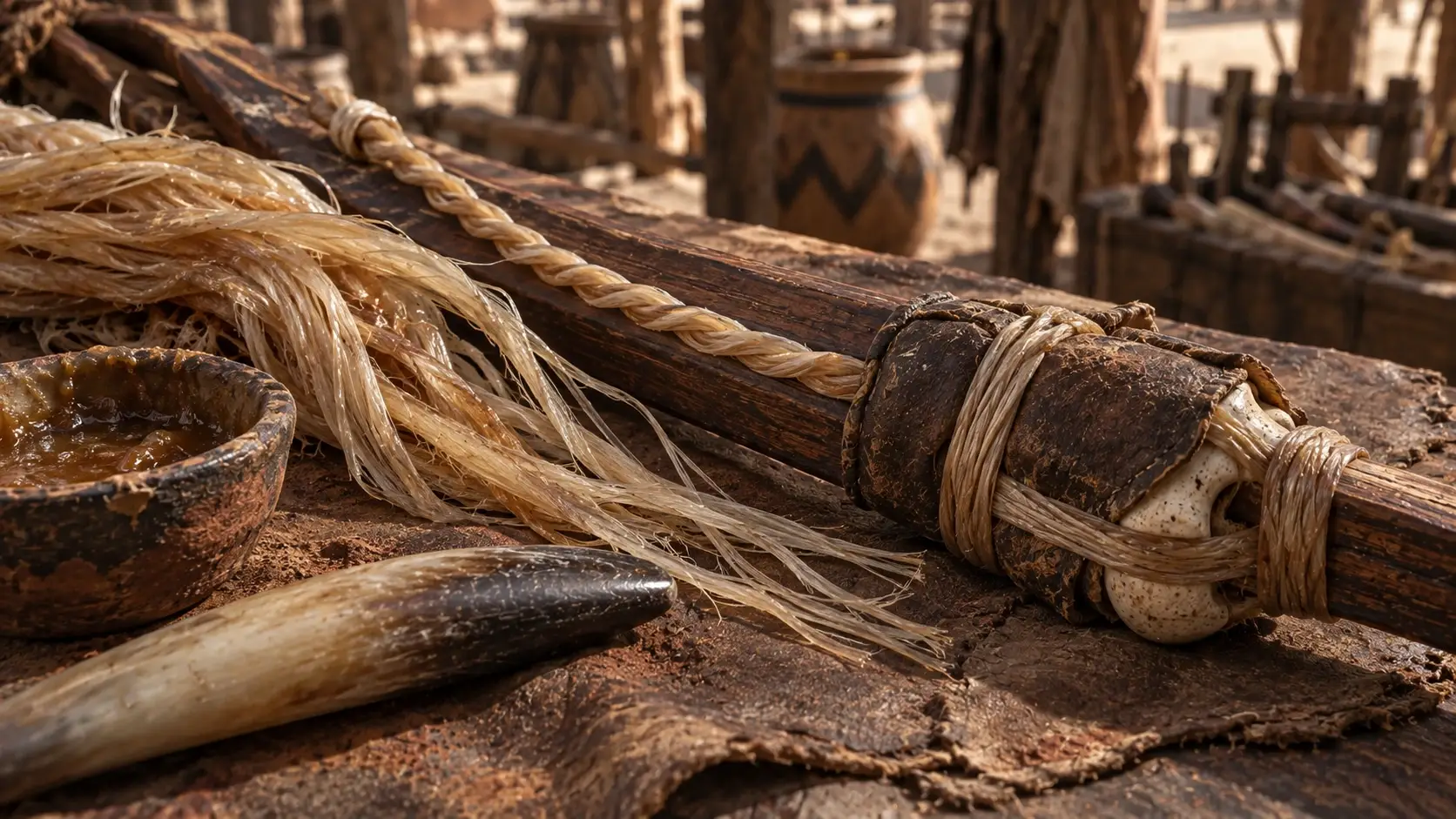
A material that pulls
Sinew serves in bows, ballistae, cables, harnesses, traps and cliff ropes. Its fineness, volume and strength are graded by animal origin, though this grading does not guarantee the performance of every piece. Sinew is worked according to its intended use and load.
An armourer joins several materials
A biocomposite armourer works in the Stone Teeth sphere: bone, leather, sinew, resins and metal enter his armour. Sinew is not an isolated curiosity but a component within workshops and an animal-recovery economy. Expertise concerns assembly; bone is not forged like iron.
Tensile work needs maintenance
Moisture, decay and fatigue limit sinew. Adhesives and anti-rot treatments contribute to its durability. It is exported to Korath workshops, and these purchases depend on roads and suppliers. A precision weapon thus depends on organic material remaining usable from animal to workshop to service.
Taking a tendon
Tendon is taken from the freshly dead beast, on the same day. The best come from the hind legs and tails of raptors, long, even and fine; hadrosaurs and the great herbivores give thicker tendons, good for cables and ropes. They are cut free with a tooth knife, scraped to remove flesh and fat, then dried in the shade, never in the sun, which makes them brittle.
Once dry, the tendons are beaten with a wooden mallet on a flat stone until they separate into fibres. The old women of the camp then soften them between their fingers and their teeth, slow work done in the evening, by the fire, while talking. A well-prepared handful of fibres can be recognised by its light amber colour and by the fact that it does not break when twisted on itself.
The sinew works
In the sinew works of the trails, the fibres become products. They are twisted into fine-sinew bundles for ballistae, into bowstrings, saddle cords, sandal laces and the springs of trail traps, those snares that hold a small beast by the leg until morning. The Wind Walkers are the great specialists, but every city has its sinew-workers, and every camp its hands that know how to twist a cord.
Tendons are graded by origin. Fine raptor tendon is the ordinary material of bows and traps. Vur-vaa tendon, with a very even fibre, about twice as strong as common tendon, goes to saddles, critical straps and noble bows. The tendon of the very-great beasts, rare, is reserved for ritual uses, sacred ballistae and chiefs’ bows; smoked and oiled until it turns black, it gives the black sinew that binds champions’ weapons.
Korath’s sinews
Arkhan’s best foreign customer is a people that despises it. Korath arms its pass ballistae with torsion bundles that combine Urnok siege tendons, Arkhan fine sinew and tail cable, sealed with anti-rot. The fine sinew goes through the gate of Vrakhor, where a calibration works sorts and measures it before the Korath Defile, and comes back as iron, steel and rivets.
Both peoples know it and do not speak of it. The Korathians say they buy material, not knowledge; the Arkhan sinew-workers answer that no forge knows how to twist a sinew, and that the Mountain’s ballistae shoot with fibres that old women of the trails softened by the fireside. When relations grow tense, the price of fine sinew rises before the lances come out.
Keeping a tendon
Tendon remains a living material, which fears damp, rot and fatigue. It is kept dry, in closed leather bags, and coated with N’Goro’s anti-rot glues, without which Arkhan’s bows, ropes and leathers would rot within a rainy season. A sinew-worker smells a store before opening it: a sweet, heavy smell announces rot, and a whole bag is lost in a few days.
A bowstring is changed every season, a saddle strap as soon as it frays. Camps always have a little tendon in reserve, and a khan setting out on campaign checks his stores of sinew as he checks his water. A season without N’Goro glue shows in every workshop, and that is when the Confederation remembers that it depends on a people it cannot subdue.