

Religion and rites
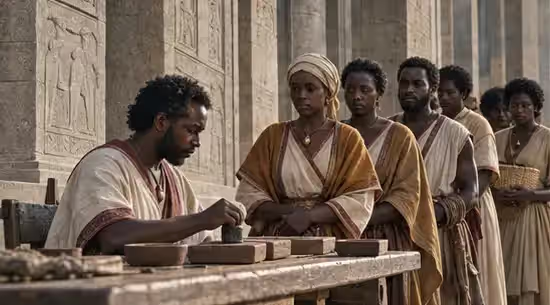
The Reading of the Annals
Urnok’s annual ritual census: births, debts and newly opened roads are recorded, then the year’s register is sealed.
A census that carries proof
The Reading of the Annals (Relevé des Annales) is a yearly ritual census. The year’s births, debts and newly opened roads are entered on durable tablets. Families declare their changes, trainers present their animals for certification, brokers and officials have their commitments recorded. The saying attached to the festival sums up Urnok’s trust in preserved proof: “Truth is what is recorded.”
The seal of the year
Rows of scribes engrave the tablets while the crowd waits in orderly lines, ring by ring: officials, families, brokers, animal drivers. Little can be heard but a murmur of figures. The central moment is a single gesture: the Master of the Annals seals the year’s register with one stroke of the seal. In the capital the scene takes place in a House of Proof dressed in white, the colour of proof, or on the forecourt of one of Calaron’s cathedral silos.
Why the register is sacred
A name or a debt does not exist only in the memory of whoever speaks it: others must be able to find the act and examine what it commits. The Reading gives this work of writing the value of a ceremony of continuity. It hands common memory on beyond the life of a scribe or the reign of a sovereign.
The days of declaration
The Reading does not fit into a single day. During the weeks before it, registries, Houses of Proof and duchy offices receive declarations: the year’s births and deaths, marriages, entries into and departures from Lines, animals born, sold or dead, debts contracted or settled. Public scribes set up their tables in the courtyards, and those who cannot write dictate to them what they have to declare. Each declaration is read back to the declarant, who signs it or puts a mark on it.
These weeks are also the weeks of corrections. A birth declared late, a debt wrongly entered, a misspelt name can still be put right before the seal; afterwards a correction deed will be needed, slower and more expensive. So every year the same scenes recur: queues outside the registries, families looking for a witness, merchants checking their accounts up to the last hour.
What the year’s register holds
The year’s register gathers what the Empire wants to be able to find again. Births and deaths sit beside roads opened and relays certified by the Chancellery, animals presented for certification, Lines opened or closed, the great public and private debts. Trainers present their animals there: an animal certified at the Reading carries in the register the mark of what is recorded, and its value on the markets shows it.
Each duchy holds its own Reading in its capital before sending a sealed copy to the centre. The imperial register, once sealed by the Master of the Annals, joins the terraced archives of the capital, where it is kept in several copies. It is reopened only by a deed, and the name of whoever consulted it is noted.
The Reading in the villages
In the countryside the Reading arrives with the travelling registrar, who tours the villages on an iguanodon, his tablets in a leather case. His coming is a market day: births are declared, boundary quarrels are settled before witnesses, the year’s young hadrosaurs and clutches are entered. In Sarnor the day of the Reading often coincides with the public reading of the village’s reserves; in Bralnor the quarry accidents are entered as well.
The elders say a good year can be recognised by how long the registrar takes to leave: the more births and animals there are to enter, the longer he stays. In bad years he is gone before noon.
A sealed year
The stroke of the Master of the Annals’ seal closes the year in the literal sense. What has been recorded is binding; what has not will have to be proved some other way, before a judge, with witnesses. For many Urnokians the night that follows is a night of relief: recorded debts are known, births acknowledged, and the next year can begin on clean accounts.
The Reading has its mockers too. Volonians passing through are amazed that an empire celebrates its registries, and Arkhans, who keep their memory in knots and songs, see it as proof that Urnokians believe only what they can touch. Urnokians reply that they are celebrating the only thing that does not die with them.