

Institutions
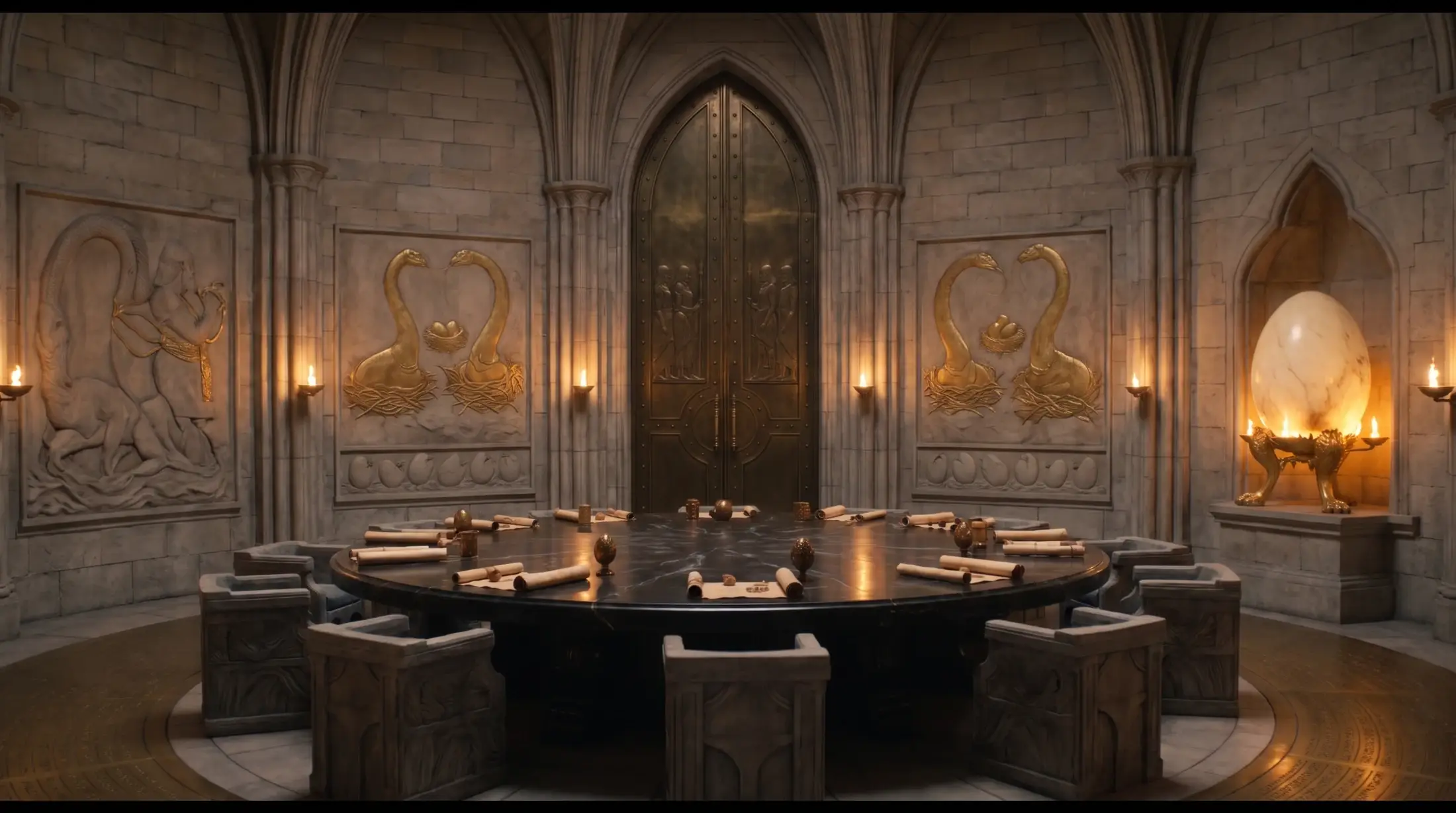
The Fodder-Counters
Born of the logistics of great animals, the Fodder-Counters turn accounting into a weapon; the Empire, born of a famine, holds them to be half-sacred.
Heirs of the famine
The Empire of Urnok was born of a famine: its first inhabitants were starving people who swore “never again”. From that oath descend the cathedral granaries, the fodder oasis-posts, the Scale backed by stocks, the Great Treasury of the Granaries and the Fodder-Counters, held to be half-sacred.
Counting in order to govern
The Fodder-Counters were born of the logistics of great animals — colossal granaries, taxation, storage — and of the immense needs that drove it. Their real power is accounting, wielded as a weapon. Their aim is to impose a universal standard of measure for weight, ration and tax; they are described as a cross-border bureaucracy.
They are not one of the Empire’s great institutions. The moral certification of reserves belongs to the Diet of Great Silos, whose Grand Keeper is elected by the vote of the heads of granaries: the Diet blesses or condemns the state of the reserves, and its verdict creates confidence or panic.
The Tithe of Orlantis’s roads
On the back roads of Orlantis roams a wild predator known as the Tithe. It takes one beast from every herd that crosses, never two. Caravan drivers “pay” it willingly, and it has become a rite of the road; the Counters turn a blind eye.
Weighing at the frontiers
A Fodder-Counter’s work is first seen on a weighing floor. At the gates of the great cities, on transhipment quays and at frontier posts, he has a lot of fodder unloaded, counts the bales, weighs one in ten and probes the silage to check that no straw has been hidden under the fern. He then writes out a weighing note giving the weight, the kind of fodder, its grade and the number of day-rations it represents for each species. The note is written in register ink of blood and iron, which blackens as it dries and cannot be scraped off: the only ink that debt clerks and counters accept.
Their cross-border character rests on that note. A Volonian merchant buying fodder in Sarnor, a Korathi carter reselling it in a pass, a march broker dealing with the caravans all accept a Counter’s weighing because it will be recognised on the other side. The Counters serve no prince but a measure, which is why they are let through where the Crown’s inspectors would be turned back.
Weight, ration, tax
Their ambition of a universal standard concerns three things. Weight first: every Counters’ office keeps a copy of the standards certified by the Synod of Living Measures, rules, weights and gauges stored in a sealed case, and checks it regularly against the original. Ration next: the Counters have fixed what an animal eats per working day, about a hundred and twenty-five kilos of fodder for a draught hadrosaur, five hundred for a silo camarasaur, more than a tonne for a Dreadnoughtus of the Silos. A convoy is prepared from these figures, and a halt is judged by its ability to serve them.
Tax, finally: the fodder tithe, paid in kind, exists only through their accounts. The standard advances slowly, because the old Crowns had their own measures and some halls in Velmor or Orlantis still count the old way for their local markets. The Counters do not forbid them: they publish conversion tables and wait for merchants to choose of their own accord the measure that travels.
Why they are called half-sacred
The Empire was born of a famine, and the first Urnokians who survived were those who had known how to count what was left. Tradition keeps a gesture from it: before the first sack of a harvest is opened, a Counter states aloud the expected weight, and it is then checked in front of him. In the villages of Sarnor his presence at the first weighing of the year is still requested, even when a plain scale would do.
Nobody jostles a Counter in a market, and nobody touches his tablet. He wears a bronze gauge at his belt, and his word on a weight passes for a word given before the hunger of the ancestors. The respect stops at the measure, however. Not being a great institution, the Counters have no court and no escort of their own, and they depend on the local authorities to enforce a disputed note. A saying of the market halls puts it in its own way: “You do not argue with the scale, you argue with the one holding it.”
Accounting as a weapon
In war, the Counters see before the generals. A massive purchase of fodder in a march, a halt ordering three times its usual ration, a duchy holding back its bales instead of selling them: their records announce a mobilisation weeks before it is declared. The silo counter, a neighbouring trade, reads war in the same way in the level of the reserves. Urnok’s staffs therefore ask for their tables before fixing the length of a campaign.
Their weapon cuts both ways. A falsified count can starve an army on the march as surely as a cut bridge, and an enemy who knows a convoy’s rations knows the date on which it will have to stop. For this reason the Counters’ registers are kept as military secrets in the marches, and raiders who set fire to a frontier relay go first for its accounts.