

Creatures
Plesiosaurs
Four-flippered marine reptiles, Volonia’s main working animals: towing, shipyards, fishing, rescue and coastal war.
The animal that made Volonia possible
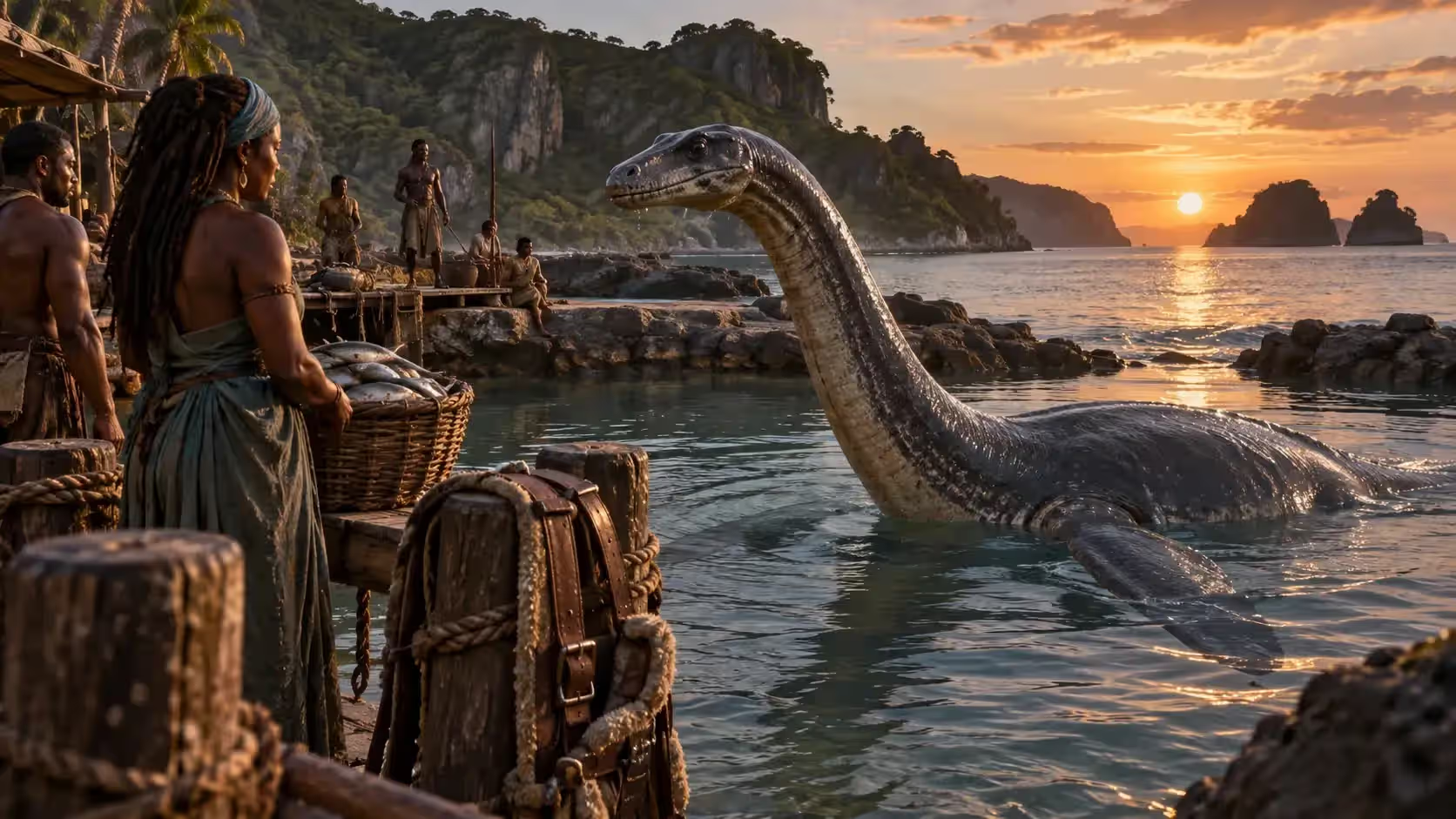
Plesiosaurs are Volonia’s main working animals. They are four-flippered marine reptiles, not dinosaurs adapted to water. Their breeding, selection and training sustain towing, shipyards, fishing, rescue, transport, the open sea, racing, coastal warfare and links with the undersea cities. House Velasar runs industrial breeding stations for them.
The saying “the mosasaur protects Volonia; the plesiosaur made it possible” sums up this hierarchy: the great predator defends, but it is the working beast that built the maritime power.
Long necks and short necks
The lagoon long-necks, including the elasmosaurs called Voilecous, guide barges, lead processions and link nearby ports; harnesses, lanterns and flags make their passage visible. Short-necked lagoon mounts, such as the Dolichorhynchops called Flèche-mer, serve for mail, patrols and sport. Races show off the pilot, the harness and the animal’s training.
In the fleet
Towing teams pull through side harnesses and take turns during the voyage. Volonia’s largest ship, about one hundred and fifty metres long, combines sails, oars and several towing plesiosaurs. Combat variants carry two platforms near the trunk for archers or light ballistae.
Dans un bassin de construction de Velasar, deux plésiosaures tirent un radeau près d’une immense coque en chantier.
Support ships, the Maisons des Plésiosaures, are dedicated to the animals’ rest, care, harnesses and rations. A channel mount and an animal prepared for a long crossing do not perform the same service.
Voilecous, Okumaros and bay plesiosaurs
The Voilecou, a long-necked lagoon plesiosaur hung with lanterns and also called Okumaro, pulls barges, screens convoys and enlivens festivals. The armoured Voilecou, loaded with multiple harnesses and ballistae, tows flagships along the sea routes; it remains vulnerable without a fast escort. The long-voyage Okumaro pulls merchant ships to the trading posts, as far as the routes to Arkhan. The bay Serpentine, with a snake-like neck decked with ribbons, commands the lagoons of Port Volon and the Bay of a Thousand Masts and draws visitors; the festival Voilecou pulls the floating salons of Séloris.
The ports also have their quay nothosaurs, small, popular marine reptiles that guard the docks and fish. The pirates of the Broken Isles, finally, harness to their black boats plesiosaurs in makeshift tack, the black Voilecous, for harassment and boarding.
Swimming like flying
The plesiosaur swims with its four long, stiff flippers, which it beats in pairs like wings under water; its short tail serves mainly as a rudder. This way of swimming gives it great towing power and fine manoeuvrability, but little straight-line speed compared with an ichthyosaur. It breathes air through nostrils set high on the head and surfaces at regular intervals; a team that stays under too long pulls less well.
The Volonian working plesiosaur weighs nearly six tonnes, the lagoon Voilecou about seven, the racing flèche-mer less than one. All have a small head with fine teeth, made for seizing fish rather than cutting; they shed and replace them regularly, and the moulted teeth that fall to the bottom of the basins are used for points, fish-hooks and small saws. They also swallow stones that ballast them and grind their food, and which are found polished after their death.
Born in the water
The plesiosaur lays no eggs: it gives birth in the water to a single young, already large, which swims from its first hour. This trait, which it shares with the ichthyosaur and the mosasaur, has consequences that are poorly understood outside Volonia. The laws of the egg, which elsewhere govern the laying, brooding and export of the eggs of great living beasts, have no grip here: there is no egg to declare, protect or forbid. Mastery of a lineage passes through the living animal itself, and through the registers that follow it.
A female gives birth only every few years, and the young stays with her for a long time. The sea studs of Velasar built their fortune on this slowness: they keep the register of lineages, choose the matings, and know that a good lineage cannot be rebuilt in a generation. A plesiosaur of lineage sells for more than an average hull, and its mother is worth more still. Selling a female abroad requires the League’s consent, which nobody has ever seen granted.
Training by ear
In Volonia it is said that a plesiosaur is trained by ear. Under water, sound carries far, and traction masters speak to their animals with bronze whistles, swimming drums beaten against the hull and horn calls; at the surface there are flags as well, and in the water, coded pulls on the traces. Each team has its signals, which the young learn from the older animals. Training rests on repetition and reward, never on force: a six-tonne animal that is mistreated simply stops working.
Plesiosaurs are social animals, and that counts as much as the signal. A towing team that has swum together for a long time pulls better than a team of stronger animals put together the day before; masters therefore avoid separating animals used to each other, and an animal that loses its team partner may refuse the harness for weeks. The studs place the young beside a calm older animal, known in the basins as the “godmother”.
Wild plesiosaurs and other peoples
Not all plesiosaurs are domestic. Wild bands range across the Great Ocean and some archipelago waters in the shoal season, and breeders long drew on them to renew their lineages; a wild capture remains more restive than a basin-born animal and needs several more years. Medium-sized wild sea reptiles are also hunted for their leather, tendons and oil.
Outside Volonia, plesiosaurs serve mostly the sea peoples who inherited the knowledge. The Broken Isles still sew towing harnesses to the old island pattern, older than their break with Volonia, and their pirates harness black Voilecous to their boats. The Northern Pirates take or buy racing flèches-mer to tow their boarding yawls. The great land powers hardly breed any: they hire Volonian tugs when their ships need them, and it is one of the services Volonia sells best.
The plesiosaur in Volonian life
The plesiosaur is everywhere in Volonian life. The towing plesiosaur appears on Velasar’s emblem; Voilecous open the processions, and the Procession of the Voilecous lights up the lagoon once a year; plesiosaur and flèche-mer races fill the Sea Hippodromes. The sea theatres have their long-neck ballets, and the children of the quays learn to swim beside the working animals, keeping clear of the towing lanes.
The language keeps the trace of it. A reliable man is said to “pull straight”, a partner who abandons a deal to “cast off the team”, and a project too heavy to move is said to need “a Velasar team”. Foreign sailors, who notice the mosasaurs first, take a long time to understand that Volonia’s real pride swims more slowly.