
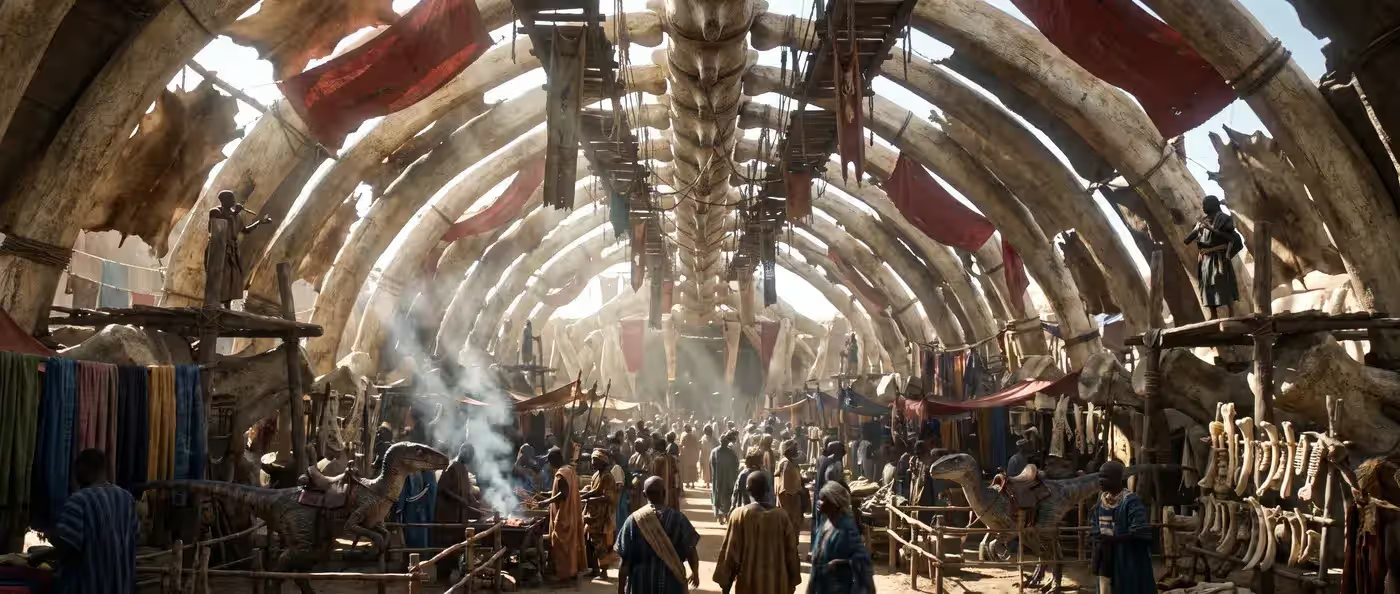
The price of living animals
Feeding a working animal for a week costs more than feeding a person. Rations, care, licences, materials and rare animals have their rates in Draco; bloodline eggs are handled like securities, and the rarest are sold only on the black market.
Feeding an animal
Fodder and animal upkeep are the largest item in the price index, at 26% of the basket. At the average rate, a week’s ration costs 8 Dracos for a barge hadrosaur, 12 for a ploughing or draught triceratops, 16 for a heavy-traction ankylosaur, 22 for a ridden raptor fed on meat, 55 for a garrison great theropod and 180 for a construction sauropod. The same week costs 1.70 Dracos for a person on siege rations.
Retail: bale of hay (20 kg): 0.95; silage (30 kg): 1.20; mineral supplement powder (5 kg): 0.80; endurance balls (batch of 10): 0.55; straw litter (50 kg): 0.62.
Care and restraint
Vet’s visit: 0.95; sedatives, heavy dose: 1.30; anti-parasite oil (250 ml): 0.24; “scale” leather brush: 0.18; claw filing and care (the service): 0.40; muzzle kit for a small predator: 0.75; night chain (3 m): 1.60. Insuring a public animal, owned by the State, costs 28 Dracos a year.
Keeping a great predator
In Arkhan, an Apex of the tyrant line, mount of a great khan, costs 2,200 to 4,200 Dracos a year to keep. It needs forty-five handlers, and its cost is multiplied by two and a half when it goes on campaign. A chief who feeds such an animal must run a carcass economy: controlled hunts, tribute meat, prepared stores, clans of handlers.
These lines are rarely sold. What is sold instead is what they produce: teeth, shed claws, trainers, harness designs.
Eggs and bloodlines
Egg law decides what can be sold. Table eggs, unfertilised or from the surplus clutches of small farmed species, are lawful and part of daily life: they are sold at market for 0.19 Dracos a dozen. A seed egg, fertilised and viable, is capital: it passes through contracts, bloodlines and inheritances. Among the very-large animals, it is handled like a security — shares, bonds, dynastic inheritance — and serving it at table is a crime.
Breeding a very-large animal is a privilege of the great Houses approved by the State. For other animals, a breeding licence valid for one breeding season costs 14 Dracos on average. The same animal never has the same value depending on its bloodline and the jurisdiction that covers it, and the theft of a clutch, depending on the bloodline’s legal status, is settled by a fine in Draco or becomes a capital crime.
The rarest eggs have no written price: their value is spoken of as “a kingdom’s fortune” or “an estate”, and whispered in Draco. Around the clutches, licences, guarantees and hatching insurance form a secondary market.
Hides, bones, tendons and teeth
At the average rate: common leather (1 m²): 0.82; top-grade “cold scale” leather (1 m²): 2.70; tendons (batch of lashings): 0.46; bone glue (the pot): 0.32; fat or tallow (1 litre): 0.28; cut long bone (rough piece): 0.40; theropod tooth (rough): 1.80; carved raptor claw, worn as a status sign: 4.50; chitin plate (the panel): 1.60; peat-black pigment (the flask): 0.22.
Prestige materials are compared on a value scale whose benchmark is utility hadrosaur tendon, stable and mass-produced, rated 100 per kilo. On that scale, raw sauropod tendon is worth 80, sauropod tendon calibrated for siege work 220, fine raptor tendon 450, Vur-vaa tendon 1,200 and Apex tendon 3,000. Common long bone is worth 30 per kilo, treated long bone from a very-large animal 300 and purified bone lime 250. By the piece, a raptor tooth is worth 160, a Vur-vaa claw 3,000, a carcharodontosaur tooth 5,000, as much as a great marine tooth, and an intact tyrant tooth 18,000. A jar of N’Goro anti-rot glue is worth 900.
These indices are not prices: they state what one material is worth relative to another. Scarcity, prestige and preparation — sorting, drying, calibrating, treatment against rot — make the difference.
Rates at Port de Sable
On the seasonal platform of Port de Sable, Arkhan’s spoils become values in Draco. A Griffe-Lune Vur-vaa is traded there for 7,500 to 9,500 Dracos, under a claw clause: if the animal dies at sea, its claw goes back to the Cavaliers du Crâne. The animal does not travel alone: an accompanying trainer, engaged by contract and not sold, costs 1,200 to 1,800 Dracos. An asymmetric saddle of the Cavaliers du Crâne is worth 450 to 900 Dracos, a common raptor saddle 25 to 75. Noasaurids are rarely sold: they are hired out instead with their trainer, for 400 to 1,200 Dracos.
Materials and weapons: raptor hides, 35 to 160 Dracos depending on condition; predator tendons, 8 to 28 per bundle; engraved claws and teeth, 2 to 80 apiece, provenance setting the price and fakes being common; fossilised bone plates, 45 to 90; heavy anti-beast lances, 18 to 36; raw badlands iron, 95 to 140 per tonne; sun amber, 18 to 45 per kilo; fire crystal, 60 to 120 per kilo; red dust for pigments, 6 to 18 per sack; steppe venoms, 12 to 90 per vial.
Information costs more than loot: a map of passes or wells is worth 800 to 2,500 Dracos, with a limited guarantee, since it holds only for the season, is no longer guaranteed after a storm and may lie. Conversely, badly sorted or burnt loot is heavily discounted: raw violence is worth less than preserved value.
Captives are sold too. A skilled captive — trainer, carer or scribe — is worth 120 to 900 Dracos, an ordinary captive 18 to 75; the Volonian jurists who settle their ransom take a 5 to 12% commission.