

Families and social ties
From bark to harness
The first link of an imperial chain
Two Tanoris
The bark season
The Tanoris’ work begins in the forest, when the sap rises and the bark comes away most easily from the wood. Their crews follow the Berlan fellers onto the plots marked for felling: they strip the fallen trees, peel the bark in strips from trunks promised to the carpenters, and leave alone those the Berlan are keeping for thirty years ahead. The bark is split, bundled and dried out of the rain, in sheds open at both ends.
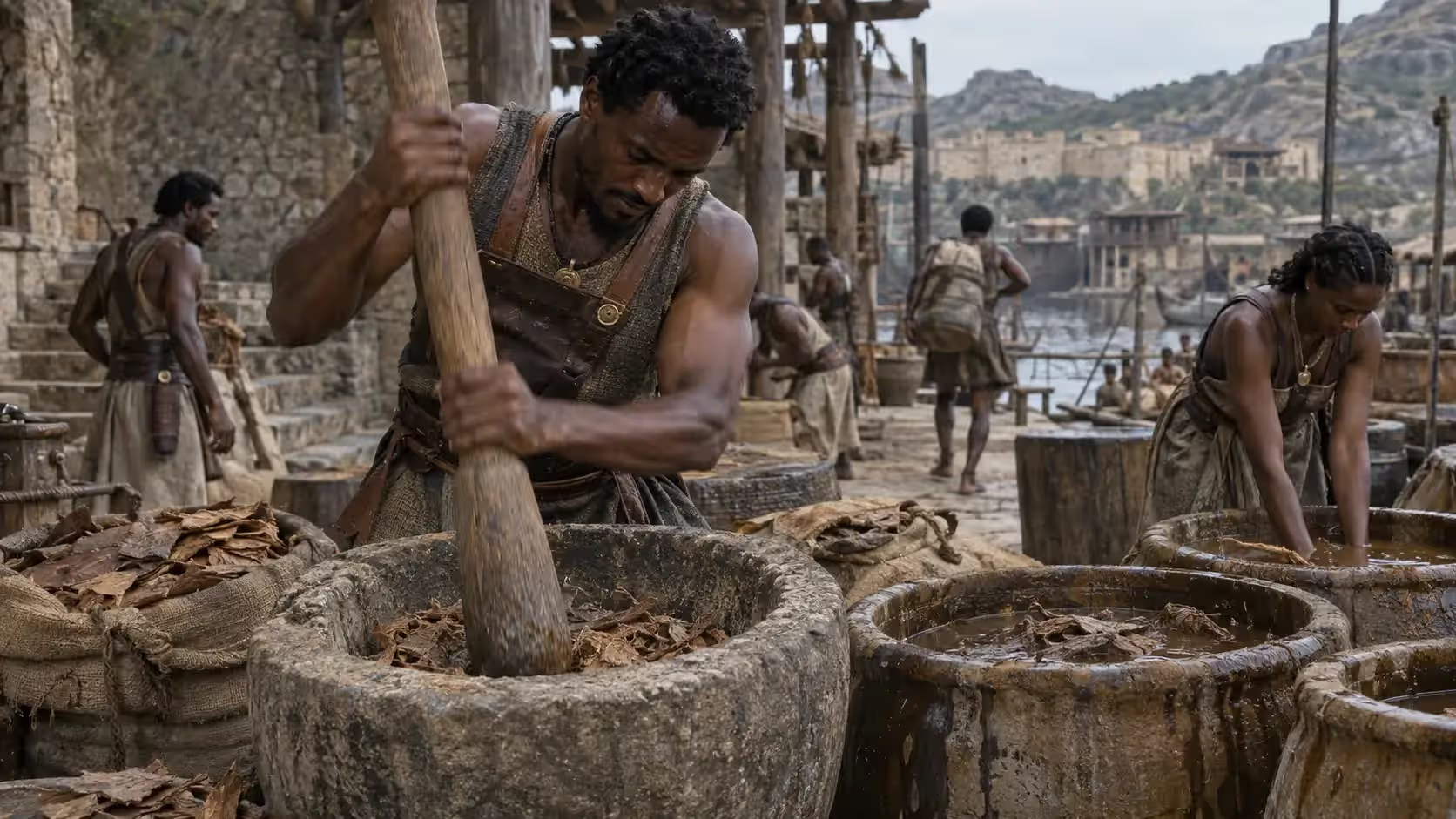
The Tanoris then grind it into a coarse powder under millstones drawn by draught hadrosaurs, and leave it to steep in water pits to draw off a brown liquor, stronger or weaker according to how long it soaks. They sell the tanneries either the ground bark or the liquor ready-made. A good Tanoris liquor is known by its colour and its harshness: the pit masters taste it with the tip of the tongue and grade it without hesitation.
What the tanneries expect
Dinosaur leather is tanned slowly. A sauropod’s thick hide needs long months in the pits, moved from a weak bath to stronger and stronger ones; a hadrosaur’s or an iguanodon’s needs less. The tanners of the capital’s lower levels, those of Velmor and those of the other duchies order their tannins seasons in advance, because a pit that runs short of liquor halfway through tanning spoils a whole hide.
The Tanoris do not tan themselves: they supply what makes tanning possible. But they know their customers’ demands. Velmor’s black harnesses want a dense, even leather; the saddles of Qor Zaï a leather that stands up to sweat and sand; tents and sacks a more supple one. Every order specifies the strength of the liquor, and every delivery records in the register the name of the Line that prepared it. The black of Velmor’s harnesses does not come from tannin alone: in Velmor, leather tanned with Tanoris liquor is steeped in an iron bath, made of forge scrap and soured wine, which gives it a black that does not run.
Brown hands
A Tanoris is recognised by his hands, browned to the wrists by bark liquor, and by the acrid smell that stays in his clothes. Their pits need a great deal of water; they lie near the floating basins, downstream of the log yards, where the bark arrives with the timber. The quarter smells of wet bark in summer and of the drying sheds’ smoke in winter. In a town of Orlantis, “having brown hands” names this trade, and there is nothing insulting in it.
Marriages follow the chain, as everywhere in the duchy. Tanoris children readily marry the children of tanners, saddlers or Lines that have bought their liquor for generations: a marriage seals a supply. The namesake Tanoris of Sarnor also produce their little stories, letters gone astray from one duchy to the other, tannin orders delivered to families of convoy men, and a register joke the scribes of both duchies tell each other.
A link of war
The Tanoris make no weapons, and yet a war can be read in their registers. When Velmor prepares a campaign, when the march of Qor Zaï renews its saddles or when the Empire replaces worn harnesses, tannin orders rise before any announcement. Tannin delivered late means a hide waiting in the pit; a hide waiting means a harness missing the following season.
The chain is too long for a single link to decide a war, but fragile enough for a single link to slow it. A fire in the bark sheds, a poor sap season or a Line closed for lack of an heir is paid for two years later in rationed harnesses. That is why military stewards know the name of the Tanoris of Orlantis, while most soldiers of Velmor do not even know they exist.