

Creatures
Sauropods
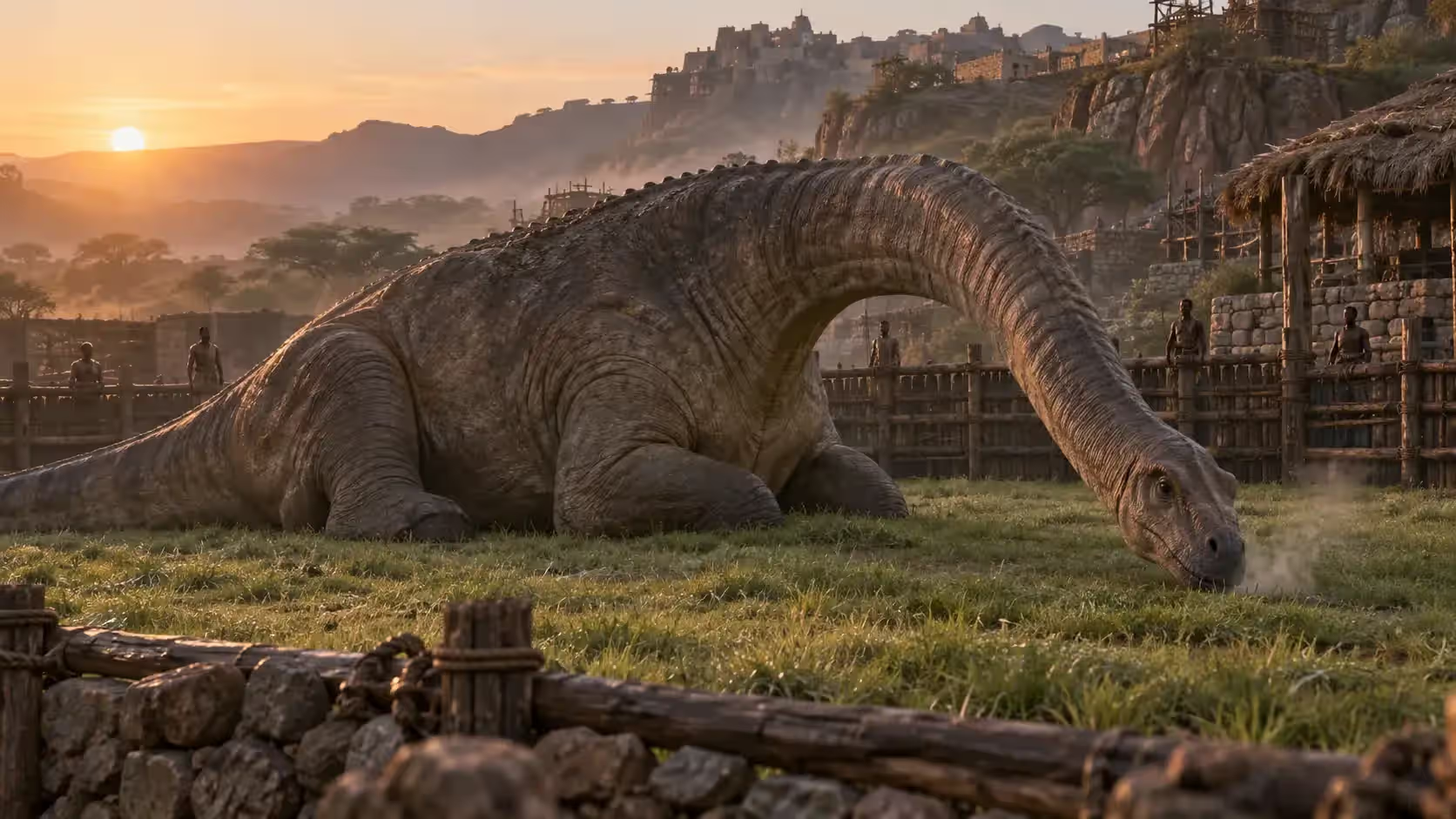
The great long-necked herbivores that carry the Empire of Urnok: heavy transport, lifting, great works, command and war.
One family, several lineages
Sauropods are the living heart of the Empire of Urnok. They carry the heaviest loads: transport, lifting, great works, command and war. They are not an interchangeable force: each lineage has its own uses, equipment, teams and availability.
Un mamenchisaure au cou immense se dresse dans une carrière de pierre blanche, au milieu des échafaudages et des ouvriers.
Each great duchy ties its reputation to a lineage. The imperial Ultrasaur stands for the Crown. The quarry brachiosaur works the blocks and great works of Bralnor. The Dreadnoughtus of the Silos belong to Sarnor’s landscape of storage. The black Supersaur stands for Velmor, whose siege sauropods serve the archduchy’s army. The march amargasaur belongs to the military domain of imperial Qor Zaï. The Diplodocus form a separate line, that of the Order of the Diplodocus.
Domestication through habit
Urnok’s tradition attributes the first great domestication of a sauropod to a female Diplodocus. It does not tell it as a conquest: the bond grew out of habit, food, repetition and several generations of humans who became predictable to a gigantic animal.
Handlers still work this way, with breath, posture, signals and each beast’s memory. An order can be refused; no two animals react alike. Breeding has since increased the size of the lineages by fifteen to thirty per cent, as it has for the great beasts of other nations.
Seven hundred titans, a single owner
The Crown holds seven hundred titans on its public roll, the largest number of very-large animals in the known world. Military titans legally belong to it, even when assigned to a duchy, a legion or an order. When they die, the carcass, bones, tendons, teeth, plates and scientific rights also return to it: recovery after a battle is both a military and a legal act.
This roll is not an army ready to march. Part of the animals serve on public works, guard territories, rest or receive care. Water, fodder, terrain and the number of trained teams limit what can actually be committed to one axis.
Feeding, housing, letting through
A sauropod needs fodder, tall grasses, grain, water and minerals. Imperial towns distribute these at several heights: the great animals eat at feeders set at neck height, served by service galleries. Feeders, carers, harness-makers, veterinarians and road crews surround each beast; its mass requires care platforms and a road able to bear it and let it turn.
Towns are organised around these bodies. Before a passage, crews close access points and divert pedestrians; refuges, escape corridors, absorbing squares and buffer pens are used if a beast refuses to move. On the lower levels, collectors, composters and canal cleaners remove dung and maintain the waterways.
At war
The Empire divides its war sauropods into specialised lines. The Order of the Diplodocus holds exclusion zones, breaks formations and forms the living wall. The Tours-Portantes lift command posts, archers, scorpions and ballistae onto brachiosaurs and other tall frames. The breaking corps use heavy lineages bred for pushing. The Porte-Ponts carry ramps and crossing sections, the Silos-Vivants water, grain, medicine and ammunition, the Engrenages Vivants the repair workshops. The Imperial Order of Orûs is a separate heavy guard.
A titan reaches its greatest power while crossing a line; once it has gone deep, it can lose its screen and be attacked from every side. Under-guards therefore protect its feet, its handlers and its straps. Committing many titans strategically requires the Mandat du Sceau Noir, with explicit responsibility for losses.
Veterans known by name
A titan can serve forty or fifty years in the same unit and become older than all its officers. Soldiers know its name, scars, campaigns, food preferences and the way it turns. The Ultrasaur Or-Valem only left combat after about eighty years of service. Exact lifespans by lineage remain unknown.
The loss of a titan is recorded with its name, its lineage, the commander who led it and the debt the loss creates. A lost animal can take decades of campaigns with it and reduce the breeding of a whole line.
Beyond Urnok
Great domestic sauropods are Urnokian. The League of the Stone Gates uses another sauropod, Magyarosaurus, a dwarf titanosaur suited to the size of its island and its ramps. The other nations build their power on other species: ceratopsians and pteranodons in Ishtir, raptors in Arkhan, marine reptiles in Volonia, spinosaurs in N’Goro.
Other working sauropods
Beside the great lineages, the Empire uses humbler working sauropods. The relay apatosaur, with a lower neck and a sturdy body, pulls convoys, handles towing and long transport and serves as a road barrier in Orlantis. The farm camarasaur, more compact, family-sized and numerous, ploughs and carries the harvests of Bralnor and Sarnor: a peasant wealth. The long-road mamenchisaur, with its outsized neck, serves as a watchtower and signal on Velmor’s eastward road. The bridge shunosaur, compact and club-tailed, works on the bridges and earthworks of Sarnor.
Sauropod dung is a wealth in itself: in Bralnor, farm brachiosaurs wear collecting harnesses, and people speak of “Titan’s brown gold”.
Laying small, growing immense
All sauropods share a paradox that astonishes visitors to the hatcheries: these giants lay small eggs, barely larger than a man’s head, in clutches of three to ten depending on the lineage. The hatchling weighs a few kilos; it will take nearly twenty years to become a titan of several dozen tonnes, and it will keep growing, more slowly, for much of its life. This immense growth explains the price of a sauropod: before carrying anything at all, it has been eating for two decades.
Sauropods do not chew. Their teeth strip leaves and branches, and it is the stones they swallow that grind the food in their stomachs; these gizzard stones, quarried in Bralnor, are sold like fodder, and those of a dead titan end up as millstones. Their teeth fall out and grow back all their lives, and those of military titans are gathered in the yards like the rest of their bodies, since the teeth too revert to the Crown. Their voice is a low rumble, felt in the chest more than heard.
Seventy-eight thousand sauropods
The seven hundred titans of the public muster are only the summit of a far larger population. The Empire counts some seventy-eight thousand sauropods of every size, from the Crown’s titans to farm camarasaurs and relay sauropods, and in heavy traction this herd is worth the labour of three to six million workers. It is Urnok’s living capital, and it has no equal anywhere.
This capital costs almost as much as it yields. Fodder, water, veterinarians and the upkeep of the load-bearing roads swallow a large part of the surplus it produces, and because of it the Empire carries a risk no other power knows: let a road be cut or a silo run short, and the whole body of the Empire slows down, unable to feed what makes it move. Imperial stewards call this danger metabolic paralysis, and a good share of Urnok’s institutions exist to prevent it.
Who may breed a titan
The birth of a very large animal is not free. It is reserved to great licensed houses, which hold a Crown licence for each lineage they breed, and it is entered in the register from the moment of laying. Titan eggs are handled as titles: they are counted in shares, pledged in dynastic inheritances, and a futures market in hatchings, legal and quoted, allows the share of a coming birth to be sold in advance. The highest lineages, the Crown’s, never pass through that market.
Everything outside this framework is a crime. A titan born without licence is seized and its breeder prosecuted; a titan egg eaten, the “brachiosaur omelette” of the proverbs, is a scandal of State; and an Urnokian lineage being born abroad is a matter the Empire treats as a threat. Neighbouring powers know it, and it is one of the reasons none has ever been able to rival Urnok in the number of its giants.
Gallery2 images
A harnessed brachiosaur hauls a cart of bones and timber. An old drover guides a young harnessed sauropod.