

Creatures
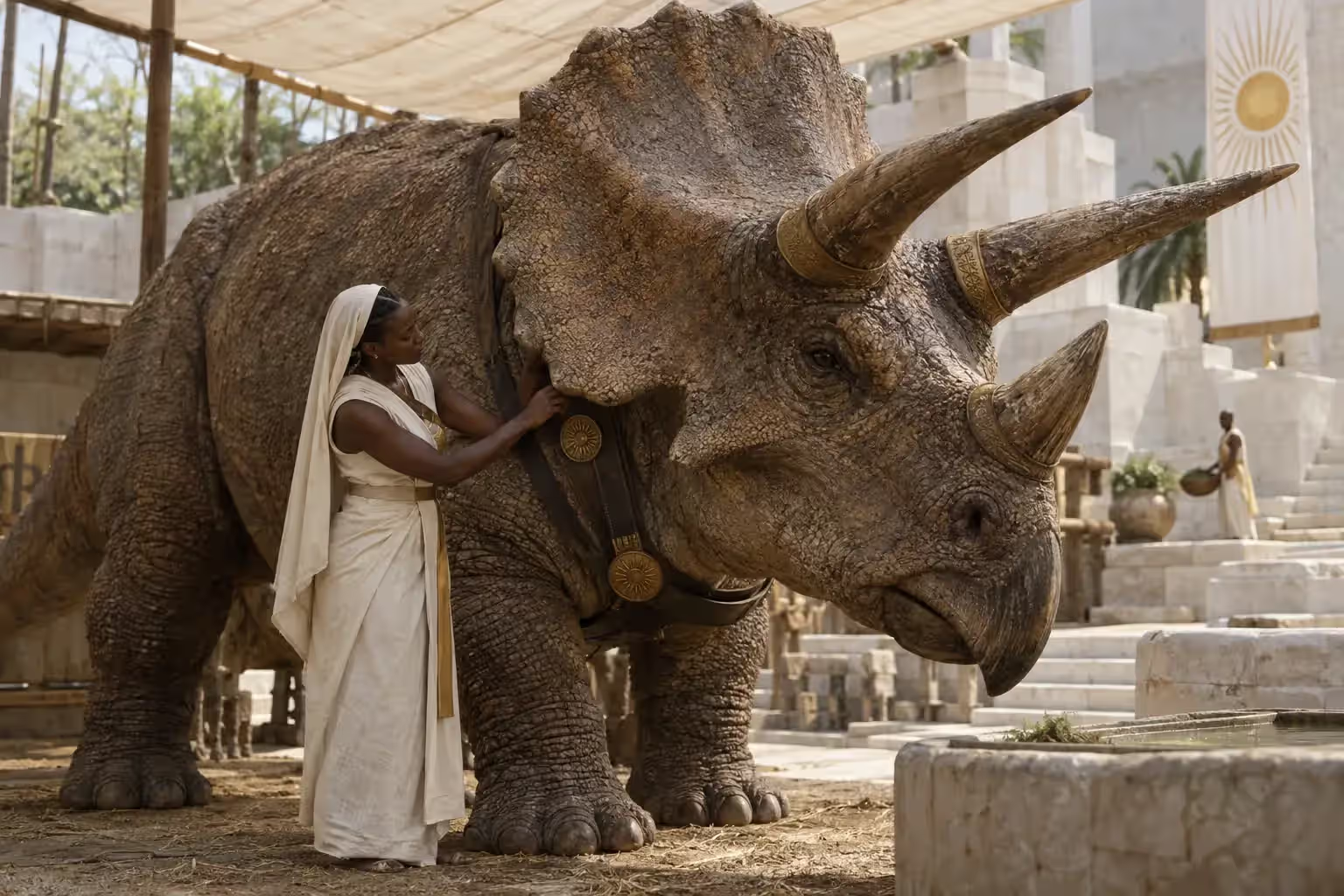
Ceratopsians of Ishtir
Horns, care and broad clearances shape their supply chain.
Bodies in the solar order
Ceratopsians are part of Ishtir’s public identity. Silver rank links command and certification with their use. The animals live in a society organised by the Weighing; their anatomy alone does not determine human rights or rank.
Gates wide enough
Side yards, horn clearance and broad turning radii organise schools, arsenals and ceremonial buildings. Removable barriers and cross exits absorb movement by crowds or animals without trapping bodies in an enclosure that is too narrow.
A chain of examination and care
Proof yards include markers, ropes, removable stands and care stations. Living animals require water, refuges and regular exits. An examination provides a specific piece of evidence; it does not replace records, appeals or rights.
Everyday animals
The ceratopsians an Ishtiri meets most often wear neither gold nor white cloth. The qerik, a stocky protoceratops without true horns, barely heavier than two men, is the ordinary animal of the Bronze farms: it pulls the light ard, carries baskets, guards the yard and provides the table eggs certified by the Greffiers du Nid. The udanoceratops, larger and hornless, pulls the plough, the harrow and the harvest carts.
For heavy work Ishtir harnesses the pachyrhinosaur to a breast harness: its bony nasal boss pushes stone blocks, building-site earth and bogged-down carts, and it is mostly this animal, culled and sterile, that is hired out abroad, never the lineage triceratops. The centrosaur of the Plains, gregarious and calm, ploughs in peacetime and in wartime forms the Bronze’s horned columns. These lines are not sacred in the least, but they are the ones that feed the country.
How many horns
Bronze farms count their qerik in tens of thousands, and every village has several per farm household. The great lines are far rarer. There are a little over a thousand column centrosaurs, a few hundred Aru-Qerim styracosaurs, a few hundred lineage triceratops, nearly two thirds of which live in the Plaines des Brontes, and barely more than a hundred chasmosaurs of the Silver Horns. The animals of the Enclos des Lignées d’Or are counted separately, and their exact number is not public.
These figures explain a great deal. A lineage triceratops takes seven or eight years to reach adulthood and years to train: it cannot be replaced in a season, and every animal lost in war is felt in the ranks of the Horns for a decade.
The two-year review
Every animal born in an Ishtiri herd comes before the review at two years old. In a staked pen on the Plains, a jury of herd chiefs, carers and instructors of the Horns walks the young ones one by one, turns them, stops them, brings them near a standard and a drum, then examines them closely: stance, breath, feet, beak, temper. A chalk mark on the flank records the decision.
The young are sorted into four ways. The best of their line go to breeding or to line training; others to work in the fields and on building sites; the gentlest to the schools and cohort houses; those that can serve none of these purposes are culled. The review resembles a Weighing, and the people of the Plains know it, but they take care never to call it that: only people are weighed.
Culled animals
Culling an animal does not mean getting rid of it. The Plains’ culls go to farms where less effort is asked of them, to temple gardens, to schools, or to households that claim them on their farm rights, like young Biscuit with Mila and Meren. The sturdiest, found sterile by the carers and the Greffiers du Nid, may be hired out abroad with their trainers: they are the only ceratopsians of Ishtir that cross a border.
A culled animal keeps its register all its life, and every change of place is noted in it. Culled qerik that can no longer pull end at the order’s butchery; the others die of old age where they served, and their bodies go to the tanneries.
What the horn people say
Ceratopsians have made their way into everyday speech. A man slow to change his mind is said to turn like a triceratops, a vain one to be showing his frill, and a settled matter to be back in the pen. Cohort wardens warn children in too much of a hurry that one does not pass in front of a horn, and herd chiefs repeat that a ceratops forgives hunger, but never the flank.
Children have their own games: leading a decorated qerik to the top of a ramp, imitating the solar wedge on all fours, chalking triceratops taller than the temples. On the Plains young animals are sometimes given cohort names and, in the towns, names of faults; everywhere, people end up talking to them as to neighbours.
Gallery1 image
The harvest: sickles, sheaves and draught Triceratops.