

Places and landscapes
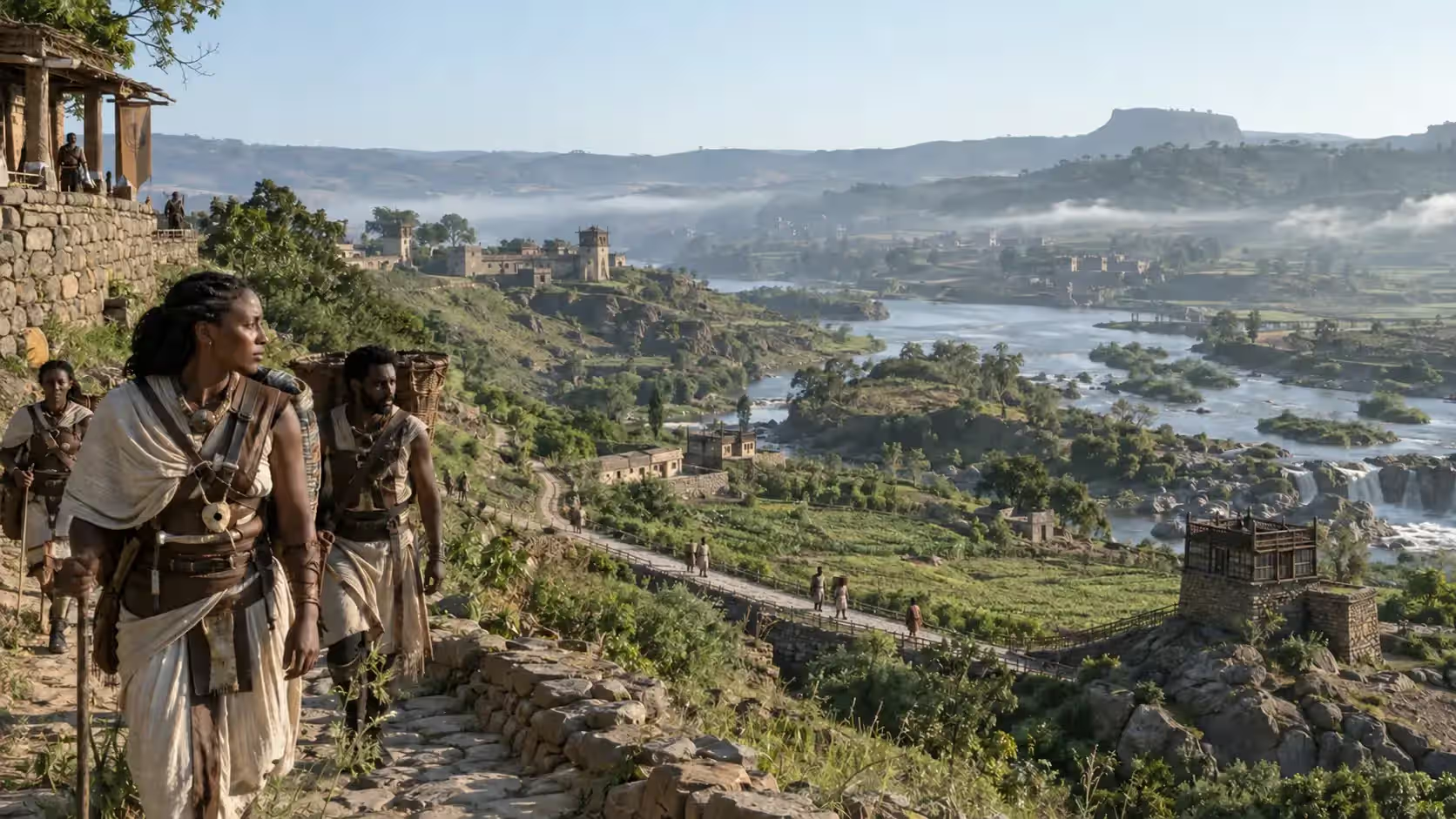
The load-bearing roads and routes of the Empire
Load-bearing roads, relays, rivers and canals link Urnok’s six duchies. Together with the granaries and breeding grounds they form a single system: the road feeds the Empire, and a broken road is its weakness.
A territory held by its roads
Urnok does not form a circle around its capital. Its territory, irregular and polycentric, is organised by basins, rivers, passes and load-bearing roads. The six duchies, born of former Crowns, hold distinct places within it: Calaron at the centre, Velmor to the east, Qor Zaï impérial to the south-east.
One formula sums up the Empire: the road feeds, the register assigns blame, the titan makes the Empire possible. Its weakness lies in the same things: a break in its roads, its fodder, its relays or its registers.
Roads, relays, granaries and breeding grounds
Imperial roads, relays, granaries, sauropod yards, corridors for the great beasts and farms belong to one system. A load-bearing road is worth what comes with it: its bearing capacity, its halts, its water points and the chance to repair a load on the way.
The great masses travel these roads in time slots. A sauropod’s passage sets off closures, ground crews and pedestrian diversions, followed by water, fodder, inspection and cleaning. Small human routes follow another pattern that skirts the road.
The main routes
Several main routes each carry one principal material. The quarry road takes Bralnor’s stone to Calaron and Sarnor: massive stone, marble and limestone travel with brachiosaurs over paving built against crushing, and Karûm-Brakh runs the works. The resin road leaves Orlantis for Qor Zaï impérial, Calaron and Volonia; its forest relays see timber, resins, ropes and fibres go by.
The fodder road links Sarnor to Calaron and the Longs-Pas: its supply posts, granaries and basins hand out compressed fodder, grain and water, with Sarnor Trois-Saisons and the Diète des Grands Silos. The Route noire joins Velmor, Korath and Calaron; a pass road with privileged trade, it carries black stone, rivets, chains and one-off parts in armoured convoys drawn by ankylosaurs, and the Armouries and pass forges work along it.
The march road links Qor Zaï impérial to Arkhan along fortified tracks: harnesses, weapons, passage tolls and fast beasts move there under a march command exposed to raids, sabotage and false relays. Lastly, rivers and man-made canals cross Calaron, Sarnor and Orlantis; barges and hadrosaurs carry grain, fodder, water and waste to the inland ports, at the risk of floods and contamination.
Road time
The Empire counts its distances in leagues, about four kilometres or one hour’s walk for a laden man, and more readily in days of road. A goods convoy drawn by hadrosaurs or iguanodons covers six to nine leagues a day: this is the Empire’s real pace. A relay courier, changing mounts, covers forty to sixty. An army advances five to six leagues; with its great beasts and siege train it drops to three or four.
Crossing Urnok from end to end takes one to two months by convoy and ten to fifteen days by courier. Fires, conches and horn relays carry a signal almost instantly along a line, but never a nuanced order. An empire of this size is not conquered: it is worn down.
Who keeps the road
The Haute Chancellerie des Voies Vivantes oversees compliance, upkeep and traffic. Karûm-Brakh, the only institution present in all six duchies, builds roads, bridges, aqueduct-troughs and feeding towers, lends to the major works and holds border posts. Calaron also has schools of the Road.
The Empire’s first level of mobilisation, the Garde de Route, answers local incidents: protecting relays, escorting and policing traffic.
Building a bearing road
A bearing road is built in depth. First a wide trench is dug down to firm ground; a bed of large blocks is laid in it, then layers of crushed stone and gravel, rammed by hand and with mauls, and, on wet ground, fascines of araucaria branches that spread the load. Next comes a layer of earth bound with lime, then the grooved slabs, laid with flexible joints. On either side deep drains carry off the water; without them the road sinks under the first heavy convoy after rain.
A league of bearing road costs more than a whole village, and it is never finished. Maintenance depots strung along the roads, with their gravel carts and hand rammers, redo the joints every season; a road that is not kept up becomes impassable for the great beasts within a few years.
The road’s markers
A bearing road is read from its markers. Every league is marked by a stone milestone carved with the distance from the capital, the class of the road, the permitted load and the distance to the next water point; the oldest are topped with a sauropod head facing Urnok. The carving is deep enough to be read by touch at night, when a convoy is finding its way by lantern.
Other markers are added as needed. The fodder posts of the house of Sarnor Trois-Saisons, small depots by the roadside, sell rations by the day’s march; the Living Markers set by the Chancellery flag slopes, water and turning areas; at the duchies’ boundaries, double markers carry the arms of both territories. Moving a marker is a crime judged like forgery.
Travelling on a bearing road
On a great road everyone has a place. The centre of the roadway belongs to heavy convoys; draught hadrosaurs and carts take the sides; walkers, porters and small mounts follow a side path, often separated by a planted bank. Nobody overtakes a sauropod convoy: you wait for it to stop at a halting area, or you leave the road for a byway. Imperial couriers are the exception, and the sound of their horn makes everyone pull aside.
The traveller lives to the rhythm of the relays, every seven or eight leagues, with their troughs, their dormitories and their tables where the state of the next stretch can be read. Dust in the dry season and mud in the wet are part of the journey, and people arriving from a great road can be recognised from afar by the colour of their legs.
Cutting a road, mending it
For an enemy of Urnok, a bearing road is the most profitable target. It can be cut by tearing up its slabs, digging under its drains, burning its relays or poisoning its water points, and each cut slows the Empire far beyond the place attacked. Raids from the steppe therefore strike relays and depots more often than forts.
The Empire answers with repair. Teams of pavers and navvies follow the armies, with their carts of ready slabs, their fascines and their beams; the Bridge-Bearers of the heavy engineers throw crossing sections wherever a bridge has been blown. A road cut in the evening is often reopened by noon the next day, at least for hadrosaurs, and Urnok’s officers judge an enemy by how fast he makes their crews work.
Part of this article covers events of season 1. Turn spoilers on in the menu to read it.