

Creatures
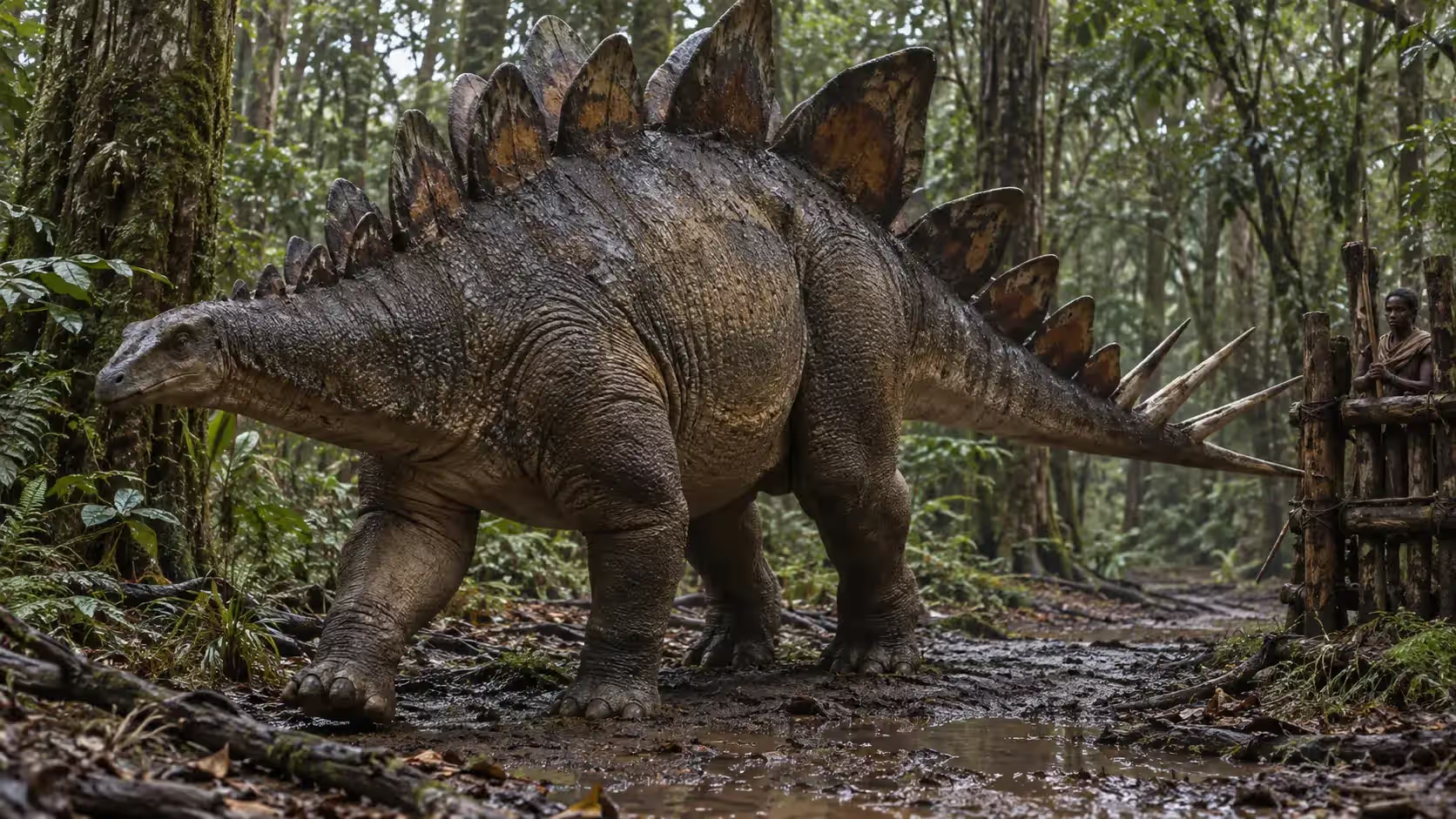
Stegosaurids of Orlantis
Breeding, harnessing and logging in the forest duchy.
An Orlantis supply chain
Within the Empire, stegosaurids belong to Orlantis. Velmor has another supply chain based on dark iguanodons and hadrosaurs and on sauropods. This regional distribution defines imperial uses; an emblematic animal does not automatically create a worldwide monopoly.
The Lomvar trade
The Lomvar Line handles breeding, training, harnessing and logging. The animal trade is distinct from the ducal House. Its enclosures stand in the outer belt, connected to the forest and heavy road: animals go around the centre.
Making room for the tail
Tail movement requires exclusion zones, pedestrian refuges and wide turning pockets. Basins, ramps, non-slip surfaces and plate inspection support care. The beauty of the plates never removes the need to organise space around the body.
From nesting pits to first steps
Orlantis’s stegosaurids are born in the studs of the Lomvaria. At the start of the hot season, each female ready to lay is given a pit dug into a bank of sand and loose earth, which the keepers line with fern litter. She lays six to ten eggs in it; they are covered with fresh fern, whose fermentation keeps the nest warm, and the litter is renewed as it cools. Hatching comes after about five months. Throughout that time nest watchers spend the night beside the pits, oil lamp in hand, against small predators and egg thieves.
Every egg is entered as seed stock in the registers of the Line and of the duchy, and none leaves Orlantis. The hatchling has almost no plates: they break through on its back in the first months, soft as new nails, and only harden during the second year. The young follow their mothers in the stud’s closed meadows, graze the low ferns and learn very early, the hard way, to keep out of reach of the adults’ tails. A stegosaur is adult at about seven; a kentrosaur somewhat earlier.
Five years of training
Training follows the years. At about two the young animal learns the lunge line and the voice of its future handler; at about three it wears an empty collar and walks the stud’s tracks; at four it pulls a light sledge loaded with brushwood. At five it is harnessed to a real log for the first time, side by side with an old, calm animal whose pace it copies. It only works alone once adult, and then it works for several decades.
The most delicate part of training concerns the tail. A stegosaurid is not taught not to strike: humans are taught never to be where it strikes, and the animal is taught to tolerate people approaching its flanks. Handlers read the hip signals, the slight stiffening of the thighs that comes before a blow, and make them a shared language with the soldiers who work around the animals. Kentrosaurs, whose shoulder and tail spikes are the longest, wear a thick leather sheath on the tail at work; it is only removed for war.
A harness for a back that carries nothing
A stegosaurid’s back carries nothing: the plates rule out saddle and pack. The whole Orlantine harness therefore rests on the shoulders and chest. A broad padded breast collar rests in front of the shoulders; two leather traces run along the flanks, below the row of plates, to the sledge’s swingletree or the log chain. Nothing is ever fastened to the tail. The leather comes from tanneries working with the Tanoris Line’s tannins, the ropes from the Nalen, the swingletrees and wooden rings from the Tolmen turners, and the whole is coated with a resin varnish that protects it from the rain.
War harness adds barding: panels of thick leather reinforced with bone plates, covering neck, chest and flanks without hampering the play of the back plates or of the tail. The new bards designed by the engineer Zaboka Tanis, for the workshop alliance that joins Orlantis, Velmor and Karûm-Brakh, proved at the Three Waves that they withstood more than expected. For ceremonies the animals wear a light caparison of varnished leather and matt gold pennants on the croup, and their plates are oiled until they take on the sheen of amber.
At the gates and on the resin roads
A little under two hundred stegosaurids serve outside the studs, on town ramparts and on the roads. At the gates of the outer belt, where convoys pass, two or three animals stand post with their handlers; placed side by side, tails crossed, they close a street more surely than a portcullis. Since they never cross a town, their guard pens back onto the rampart on the countryside side, and reliefs are made along the outer wall-walk.
On the resin roads, a large caravan takes a stegosaur at its head and a kentrosaur bringing up the rear. In the evening, at the bivouac, the handlers place their animals at the corners of the camp, heads inward and tails turned towards the night; predators prowling around the resin jars and pack hadrosaurs quickly learn to avoid those corners. Orlantis never sells the service except with its handlers: merchants from Volonia and the other duchies hire an escort, never an animal, and they pay by the day of road for the fodder it eats.