
Creatures
Ankylosaurs and nodosaurs
Armoured dinosaurs imported by Korath into its low marches: blocking, defending passes and carrying artillery.
Imported animals
Korath has no institutional great dinosaur. No dinosaur survives for long in the Black Mountains: the massif cannot sustain a viable population of large animals. Ankylosaurs, nodosaurs and pachycephalosaurs are therefore imported and kept in the valleys and low marches, at the cost of an expensive, localised acclimatisation. They shape neither the deep cities nor the country’s sovereignty.
Korath treats these animals harshly, as assets, test subjects and engineering problems. Its installations nonetheless show that performance requires concrete care: an animal depot must allow the pack to be unloaded, water and rations to be served and access to care to be kept.
Armour and artillery
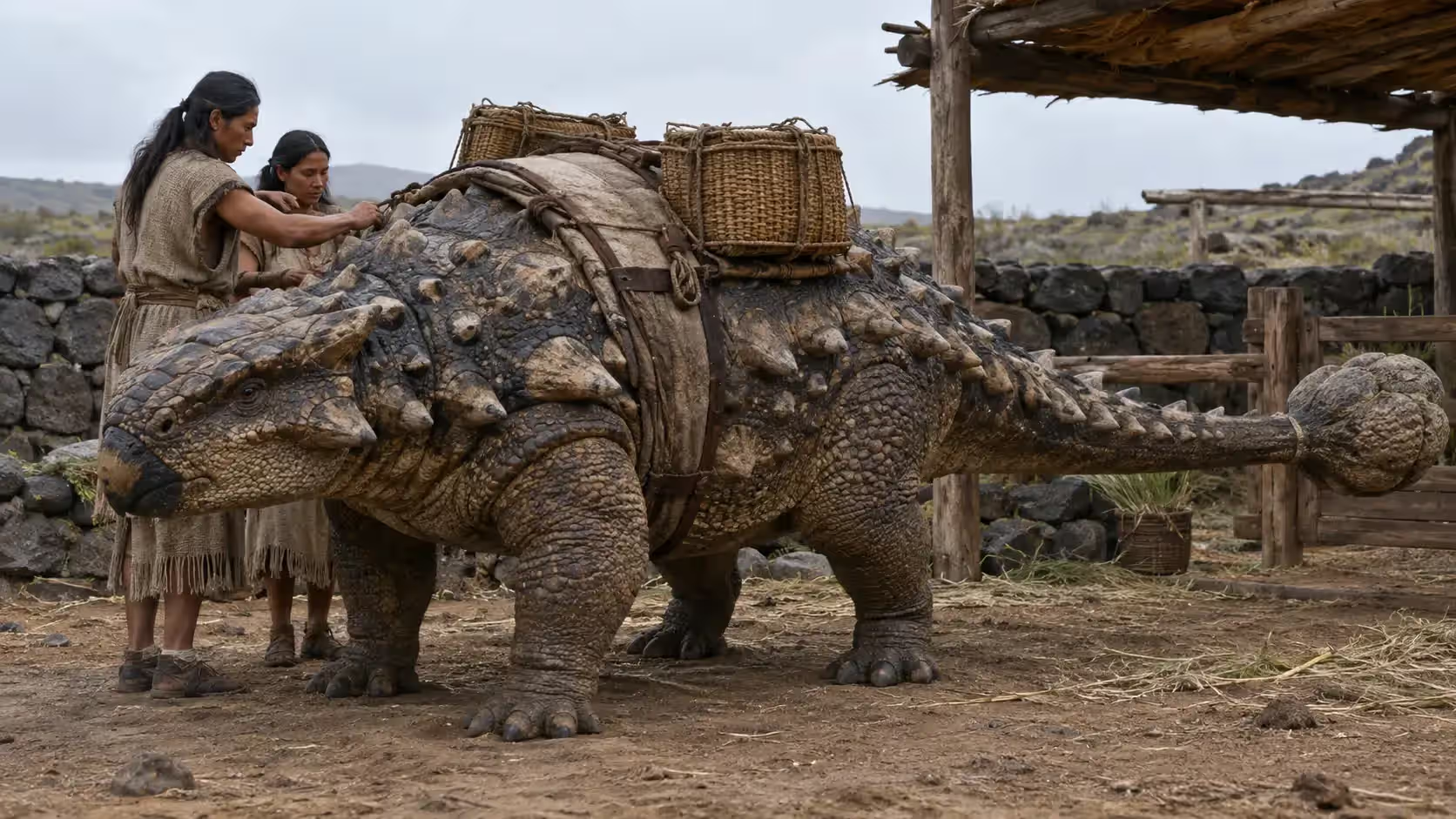
Their low build and body armour suit blocking and campaign equipment. An ankylosaur can carry an artillery platform, but the piece must still be crewed and maintained: crews, riggers and technicians account for stability, recoil and access. Animal yards keep room to turn and the tail’s free arc.
Nodosaurs and passes
Nodosaurs serve in the marches and suitable valleys, alongside ankylosaurs and pachycephalosaurs. Defending a pass takes account of its width, of turning, of supply and of nearby positions; a nodosaur can hold a protective place there without replacing a food reserve or a line of retreat. Their natural armour does not make them invulnerable.
Un garde brosse la poussière entre les ostéodermes du dos d’un nodosaure à la cuirasse rousse.
In the Empire
Urnok imports ankylosaurs and nodosaurs from Korath for controlled uses: armour, forge work, ballistae, mobile barriers. They arrive with pass crews, and Korathi parts remain indispensable to their equipment; licences, transport clauses and lineage rights go with the transfer. In Bralnor, draught ankylosaurs work alongside the construction brachiosaurs.
Forge, mine and convoy
In Korath each use has its animal. The forge ankylosaur, with a black shell and a tail club, breaks gates and forms a wall of plates, carries ore and protects the forges; it is slow and greedy. The gate-breaker, its armour reinforced with rivets, serves sieges and heavy mine haulage. The mine nodosaur, without a club but with an armoured back, hauls ore through the high galleries, and the riveter nodosaur carries tool platforms and plates. The convoy euoplocephalus, with a compact club, defends ore columns on the pass roads. On the worksites of Urnok as of Korath, the worksite ankylosaur, with a rounded shell, serves for earthworks and roads.
The armoured body
Ankylosaurians are four-legged herbivores, low-slung and as broad as carts, whose whole back is paved with osteoderms, bony plates formed in the skin. The largest ankylosaurids reach six to eight metres in length; those Korath uses commonly weigh six to seven tonnes. Their broad head is protected by plates fused to the skull, and some species, such as the euoplocephalus, even have armoured eyelids. They crop close to the ground with a horny beak and small teeth.
The ankylosaurid tail club is made of fused osteoderms at the end of a stiffened tail, and can break a bone with a single swing. Nodosaurids have no club, but often carry long spines on their shoulders and flanks, which make approaching them as dangerous as approaching a harrow. In both families, the skin between the plates remains the vulnerable part: it is what predators aim for, and what Korathi bardings protect first.
Temperament and training
An ankylosaur does not run away: faced with danger it lowers itself, braces on its legs and waits, tail ready to strike. This reflex makes it an ideal guardian for a passage, and a fearsome animal for those who do not know its habits. Most of the time the beasts are slow and placid, but a club blow comes without warning when something moves behind them, and carers learn from their very first days never to stand within the arc of the tail.
Korathi training uses this temperament instead of fighting it. The young are accustomed to the noise of the forges, the snap of the ballistae and the gongs; they are taught to stand still under a load, to walk at a steady pace in a column and to lie down on command to be unloaded. It takes several years for an ankylosaur to be judged safe; a beast that strikes with its tail for no reason is retired, however strong it may be.
What a retired beast leaves behind
Korath lets nothing of a dead or retired ankylosaur go to waste. The tail club becomes the head of a siege hammer or a ram; the osteoderms, sawn and trued into plaquettes, line bardings, corridor shields and the marquetry of salons; the hide, which keeps its small osteoderms set in it, becomes a thick lamellar leather used for armour linings, armoured harnesses and founders’ aprons. The tail tendons, braided and glued with anti-rot, give a short, very strong cable for quarry engines.
Nothing is left to the scavengers: crushed osteoderms provide an abrasive powder used to polish metals and mirrors, and the great shoulder spines of nodosaurs become shield spikes, harrow teeth or trophies hung at the entrances of forts. Korathi say a war beast serves twice, alive and dead, and see no particular cruelty in this.
Lineages, stud yards and exports
Korath’s ankylosaurs are imported animals, but their domesticated lineages are an asset the country guards carefully. The best are kept in a few stud yards in the low valleys at the edge of the massif, the only places where these beasts live long enough and in sufficient numbers to breed; the young are raised and trained there before going up to the depots of the marches. Births are rare, counted and registered, and the eggs are kept under watch until they hatch.
This scarcity explains the export policy. Korath sells or leases equipped beasts, with their barding, their harness and often their beast-master, but never breeding animals: the lineage stays in the mountain. The licences, transport clauses and lineage rights attached to each transfer to the Empire are drawn up with the care of a patent, and a foreign breeder who managed to hatch a fortress ankylosaur outside Korath would cause a scandal in every gazette in the country.
The other armoured beasts
Beside the ordinary ankylosaurs and nodosaurs, the marches use a few rarer species, each for a specific job. The borealopelta, a stocky nodosaurid with tight armour, copes better than the others with the damp of the low galleries and with salt: it is used in the salt mines and in pits where water seeps from the walls. The sauropelta, recognisable by the long spines on its neck, serves in the haulage galleries, where it pulls the mine carts in its harness.
These beasts are few and very expensive, leased or sold with their harness and without breeding rights, like the fortress ankylosaurs. Carers find them more nervous and harder to acclimatise, and the depots that house them have the reputation of training the best beast-masters in the country.
Part of this article covers events of season 1. Turn spoilers on in the menu to read it.