

Culture
Urnok : nourrir l’Empire vivant
Silos, eau, fourrage et statuts de reproduction font de l’alimentation une infrastructure politique.
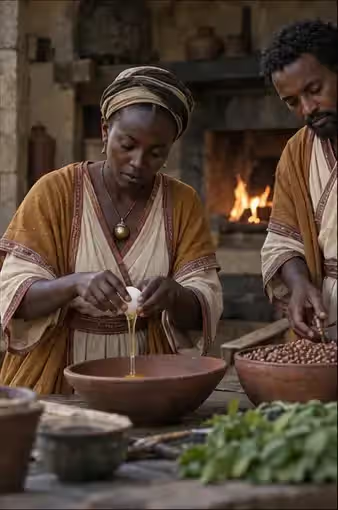
Le repas humain et la ration animale
Céréales, légumineuses, fruits et poissons de fleuve composent une grande part de l’alimentation humaine ; la viande circule dans un cadre contrôlé. Les herbivores reçoivent fourrage, grains, herbes, eau et apports minéraux adaptés. Les œufs de table sont licites et consommés au quotidien, tandis que les œufs-semences et les œufs consacrés relèvent d’autres destinations protégées.
Une ration doit rejoindre une halte
Silos, abreuvoirs, relais et distribution font partie de la nourriture. Un stock central ne nourrit personne tant qu’il ne franchit pas les derniers maillons ; traction, administration et chantier dépendent donc du même réseau.
Manger ne règle pas tous les usages
Le registre distingue les œufs destinés à la table, à la reproduction, à la récupération technique et au rituel. Les œufs de table peuvent être consommés ; ceux qui gardent une lignée ou une destination consacrée doivent être protégés. Une vente, un transport ou une transformation engage la personne qui répond de ce statut.
Meat under register
Meat circulates in Urnok within a controlled framework. The only kind that moves freely from one duchy to another is retirement salt meat: the flesh of draught hadrosaurs slaughtered on certificate, at the end of their service or after an accident, salted with green salt from the southern marshes. The small farm dinosaurs of urban farmyards provide fresh meat and table eggs, and the hunts in the forests of Orlantis a little game. A lineage animal is not slaughtered without its death being recorded and justified.
Most Urnokians get the bulk of their food elsewhere: grain, pulses, table eggs and fish. In the capital’s working-class quarters, fish from the great river, split and smoked on racks above the low canals, is the everyday dish.
The price of fodder
In Urnok the price of fodder is public news. The prices of grain and bales are set every morning at the Croisée-Silos hall, and the Petit Fourrage sheet, cried and posted in the relays, announces them along with the sentences handed down and the rumours from the silos. When fodder goes up, everything goes up: transport, bread, worksite stone, the price of places in a convoy. For their customers, the fodder sellers of the capital’s markets are the first to know that a season will be hard.
The Crown watches these prices like a border. Too sharp a rise triggers inquiries, the opening of reserves or a temporary ban on selling fodder outside the Empire; too steep a fall ruins the farms of Sarnor and worries the Bank, whose currency rests in part on the value of the reserves.
Feeding the capital
The capital produces only a small share of what its people and animals eat. Grain and fodder arrive from Sarnor along the fodder road and by canal, on barges drawn by hadrosaurs, and go to the city’s fodder stations and silos. Every morning the feeding towers serve the titans at the upper levels, medium-sized animals at the middle troughs and small ones on the ground, while the neighbourhood bakeries bake bread for the humans.
The two circuits do not mix: grain for people and fodder for animals have their own sacks, seals and warehouses. A well-run city can be recognised by this separation, and a scandal breaks out whenever a merchant sells people grain meant for animals.