

Families and social ties
The Tolmen Line
The High Line of fine joinery and turning: hubs, axles, pulleys and calibrated parts. It is the link that breaks.
The link that breaks
Tolmen holds fine joinery and turning: hubs, axles, pulleys and calibrated parts. They are modest parts next to a hall, but movement depends on them, and they are the ones that break.
The register turns them into addresses. If an axle breaks under eight tonnes of logs, no one looks for a culprit: the register is opened, the name of the Line that turned that hub is read, and everyone knows which door to knock on.
Shrill noise and fine sawdust
The Tolmen quarter is known by the shrill noise of its lathes and its fine sawdust. It comes after the drying sheds and steam rooms, before the tall spaces of the Mirvane carpenters. Timber, leather, fibre, rope, resin and small bronze parts are enough to make wheels, axles and carts; the roadway and the terrain then decide the means of transport.
The glue and the hub
The Tolmen lathes
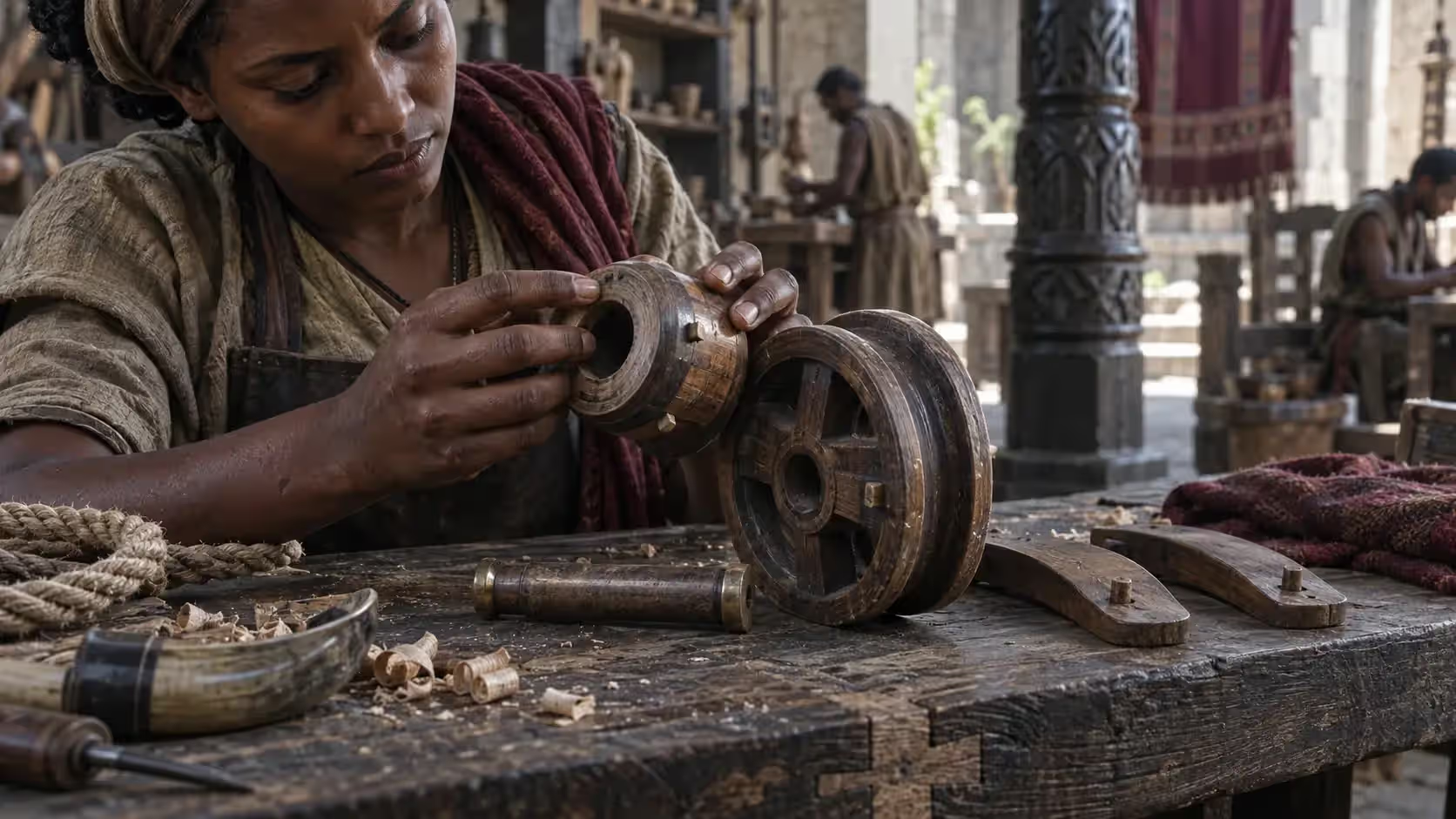
The Tolmen workshops work at the lathe. For small parts, pulleys, pegs, handles, they use pole lathes, in which a cord tied to a springy branch spins the piece one way then the other to the rhythm of the turner’s treadle. For hubs and axles, too heavy for one man, the Line uses great lathes driven by a long leather belt, turned by a hadrosaur walking in a circle in the workshop yard.
The turner holds the tool, a long hafted bronze chisel, and reads the wood by its sound: a steady hiss means a clean cut, a crack means a fibre tearing out. The Tolmen quarter can be recognised from afar by this shrill noise, mixed with that of mallets, and by the fine sawdust covering the doorsteps; the Tolmen sweep their workshops three times a day, because sawdust burns as well as resin.
The Empire’s gauges
Tolmen work rests on gauges. For every axle, hub and pulley in common use, the Line keeps templates of bronze or hard bone, registered and stamped, that fix diameters and lengths. A Tolmen hub must be able to take an axle turned in another workshop, and a pulley replaced on a Bralnor site must fit the original tackle. That interchangeability is worth as much to the Empire’s roads as a well-laid roadway.
The reference templates are kept in the quarter, and the workshops come to check their own against them at regular intervals. A turner who delivers out of gauge does not merely have his part refused: he calls the whole Line into question. The Tolmen say a false gauge is more dangerous than a broken axle, because nobody sees it break.
The right wood for the right part
The Tolmen do not turn just any wood. Hubs need very dense, close-grained woods able to resist crushing and wear; axles, woods both hard and a little supple, which bend before they break; pulleys, woods that stand the friction of a loaded rope. The pieces come out of the upstream drying sheds and steam rooms after several years of seasoning for the largest, and wood turned too green splits in service.
The Line therefore depends entirely on what the upstream quarters send it. A wet winter that slows the drying sheds, a riot at the steam rooms or a plot badly chosen by the Berlan turn up, a few years later, in hubs that split. When an axle breaks under a load of logs, the register is opened at the Tolmen name; but the Tolmen, for their part, then open that of the drying sheds.
Wheels for war
War rolls on Tolmen parts. Supply wagons, the wheeled carriages of the imperial ballistae, the tackles that hoist shooters onto the platforms and the pulleys of temporary bridges all depend on turned, gauged hubs, axles and pulleys. On campaign, a column carries spare parts by the crate, and army wheelwrights know that a spare axle is worth, on some days, a company of soldiers.
When the Empire prepares a war, orders flood into the Tolmen quarter well before any declaration. The lathes then run late into the night, by lamps kept well away from the sawdust, and the allied families of the chain, Corvel first among them, speed up with them. In the duchy they say one hears a campaign being prepared before one sees it, by the noise of lathes that no longer stop.