

Institutions
Urnok’s imperial command
The Crown decides; institutions, duchies and logistical chains make a decision executable.
Decision is not enough
The Emperor holds sovereignty, supreme justice, war and arbitration between dukes. This authority gives the Empire direction, but it does not by itself move food, animals or materials. Roads, reserves, credit and local holders of responsibility determine what can actually follow an order. Imperial command is therefore a decision-making centre connected to a network of capabilities, not a word that abolishes distance.
An heir of continuity
Sahina is the designated heir and acts in high stewardship, logistical crises and the Long-Pas. Her role makes an essential part of Urnokian power visible: a decision about war, relief or movement matters only if bodies and animals can be sustained for its entire duration. An established succession does not remove tensions of government; it simply prevents reducing them to a rivalry between claimants.
Duchies, orders and services
The Grand College brings together the dukes, the Archduchess of Velmor, great orders and major institutions. There the Crown meets the territorial and technical powers on which it depends. Duchies are not interchangeable provinces: Calaron concentrates the administrative centre, while other territories carry specific materials, skills and roads. The College gives political form to this interdependence without making maintenance, reserve or priority conflicts disappear.
Offices better known than their holders
Several services are defined by their duties: issuing, guaranteeing, maintaining, examining and certifying. Some offices have no identified holder; they are understood through the work they demand and the institutions they answer to.
The Council and the High Intendancy
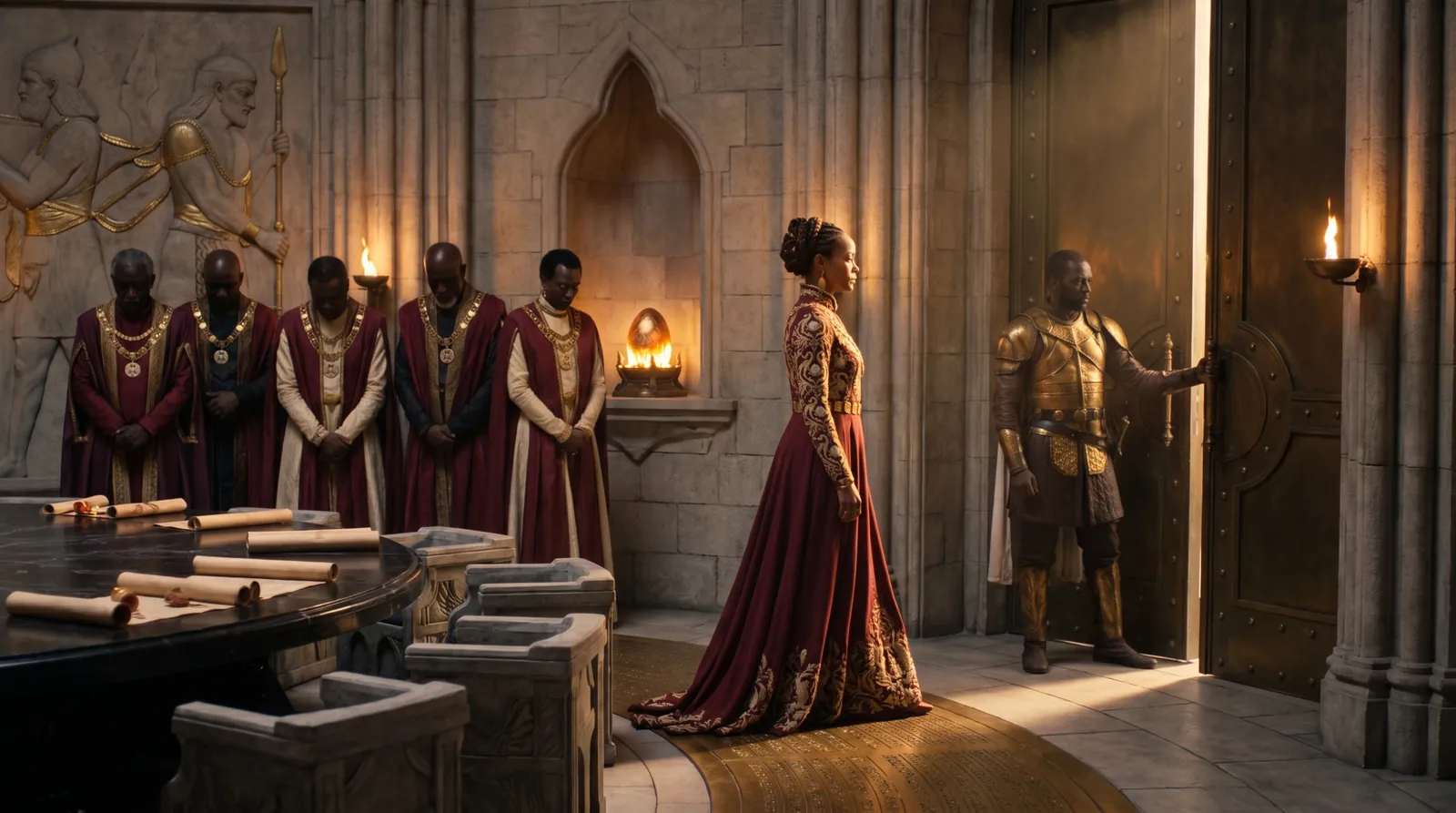
The Council prepares the Crown’s decisions by gathering information, objections and responsibilities. The state of the roads, a debt or an insufficient reserve can change what an imperial order actually allows. Edras Tewolde, the prime minister, carries administrative continuity and the concrete cost of decisions; Selam Qoré, secretary of state, works on letters, borders and the different readings of a file. Sahina holds the High Intendancy: she coordinates the Living Ways, logistical crises and sensitive projects involving roads, supply and great animals.
Le doyen du Conseil, en armure de cérémonie.
Le doyen du Conseil, en armure de cérémonie.
Deciding war, conducting it
The Crown decides on war; the Generalissimo commands the operation and sets objectives, reserves and the commitment of the great orders. Imperial and ducal forces can be brought together in the Grand Host, and three Seats ensure continuity of command. The imperial decision matrix involves the Emperor and the Grand College in declaring a war; the Bank, Sahina’s logistics and the dukes concerned can prevent it from being carried out.
Pions d’ivoire sur une carte incrustée de nacre.
Pions d’ivoire sur une carte incrustée de nacre.
Five levels of mobilisation
The Empire distinguishes five levels of mobilisation, from the most local to the most extreme. The Road Guard answers an incident: protecting a relay, escorting a convoy, policing traffic. The Ducal Campaign deals with a limited crisis recognised by a duchy or a march. The Grand Imperial Host is war coordinated by the centre, bringing imperial and ducal forces under a single command.
The last two levels engage the very existence of the Empire. The Mandate of the Black Seal opens the strategic use of many great animals and makes responsibility for their losses explicit: whoever commits them answers for every beast. The Opening of the Rings is the ultimate defence of the imperial heart, almost never used. Decisions at these last levels go beyond the authority of a relay chief or a local officer: they commit the Crown’s institutions.
Three Seats and a chain
Beneath the Crown, which authorises general war, peace, mobilisation and the arbitration of the duchies without directing each battle, operational command rests on three Seats. Seat I is that of the Generalissimo, who commands the Grand Host and the main theatre; his orders are not overturned by a vote of the generals. Seat II belongs to the first deputy, informed of the whole plan and immediate successor. Seat III is that of the second deputy, third operational authority and successor in depth.
Below the Seats, the chain descends by numbered echelons. A Grand General of the Front coordinates several armies on one theatre, from eighty thousand to more than two hundred and fifty thousand fighters; a General of the Army commands from thirty-five thousand to ninety thousand men; a General of the Legion, a combined-arms legion of four to eight thousand. Further down, the captain commands an autonomous unit of five hundred to twelve hundred fighters, plus the animals attached to it: in Urnok a unit is always counted in men and in beasts.
The technical chains
Alongside the vertical chain runs a series of transverse technical chains, each with its functional authority. The High Living answer for the commitment, withdrawal and recovery of the great animals; the Longs-Pas, for the great sauropod branches; the Fires, for ballistae and firing priorities; the Platforms, for weapons and crews carried on the animals. Heavy Riding and Mobile Riding hold the hadrosaurs and iguanodons used for shock or liaison. Then come Signals, Engineering, the Ways, which judge the bearing capacity of roads and bridges, the Living, which cares for the beasts, the Wounded, Intelligence and Discipline.
The rule linking them is strict. The Crown decides on war, the Generalissimo decides on the operation, and the specialists say what matter and the living really allow. They have no political veto during action: a master of the Ways may write that a bridge will not carry a column of colossi, but he cannot forbid the Generalissimo to attempt the crossing. His opinion is nonetheless recorded, and responsibility for a failure will be read in the register.
The Crown’s titans
Military great animals legally belong to the Crown. Assigning them to a duchy, a legion or an order does not transfer ownership, and at their death the carcass, bones, tendons, teeth, plates, harness and scientific rights also return to the Crown. Recovery after a battle is therefore both a military and a legal act.
These animals serve in specialised branches: the Ivory Whips of the Order of the Diplodocus, which deny an area and break formations; the Bearing Towers, brachiosaurs and other tall frames that carry command and marksmen; the breaking corps; the Bridge-Bearers of heavy engineering; the Living Silos, which carry water, grain, grease and remedies; the Living Gears, mobile repair workshops. The Imperial Order of Orûs forms a heavy guard distinct from the Order of the Diplodocus.
The same animal may remain forty or fifty years in the same unit. The soldiers know its name, its scars, its campaigns, its food preferences and its way of turning; it is often older than every serving officer. The legions call it a flag that breathes.
Gallery2 images
Sahina listens to an elderly councillor in Council. An elder speaks at the council before Sahina Vael-Orûn.