

People
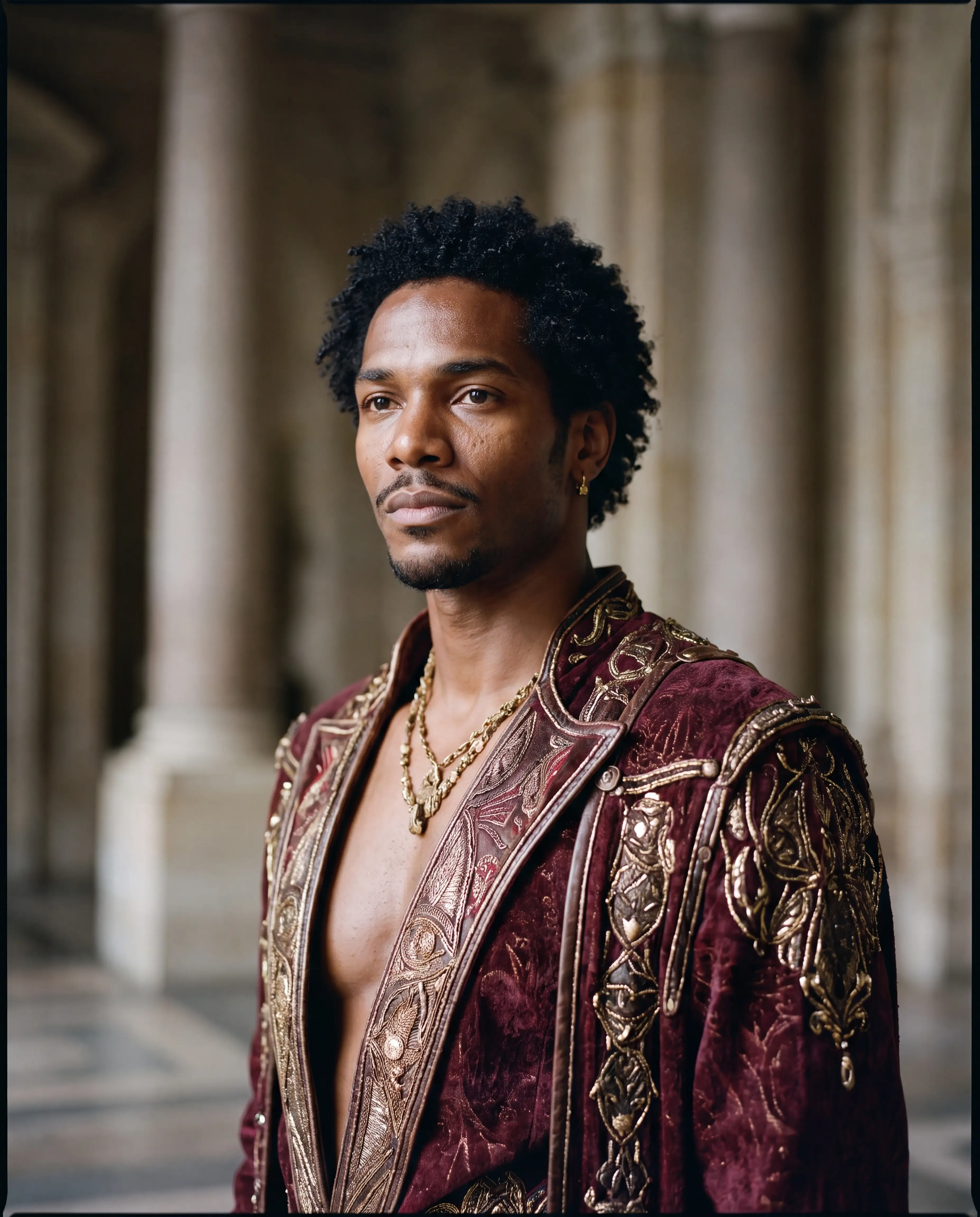
Maivar Vael-Orûn
Urnok’s younger prince: charm, games and difficulty facing his own potential.
A prince within the Crown
Maivar belongs to Urnok’s imperial family. Sahina’s brother, he moves through a world where rank opens doors before competence is tested. His social ease contrasts with his sister’s logistical discipline: where she looks for a responsibility, he often finds a joke.
Charm as a passage
His charm eases encounters and defuses solemnity. He starts more readily than he finishes and wants others to come looking for him. Humour can help him postpone effort as much as create intimacy.
The gaming table
Maivar enjoys games. He has opportunities, yet fears what genuine concentration would demand of him. Having talent and agreeing to use it are two different difficulties for him: an easy start does not guarantee that he will sustain his effort.
The salons of Volonia
Maivar’s rank opens Urnok’s court and foreign houses to him. He frequents in particular the parties and salons of Volonia, where imperial prestige meets a society of gaming, trade and reputation. There he wins with an ease that looks like an accidental victory, gets himself welcomed and hears questions that the solemnity of an official meeting would keep at a distance.
His closeness to Andrea Vornëa links the Crown to a Volonian house of luxury and spectacle. With Sahina, the bond is hard to reduce to a function: she knows how to count for the Empire, but her brother’s needs do not always take the shape of a problem a file can solve.
Being the younger brother of an heir
In the great Houses of Urnok, sex sets no ceiling: the principal office and the continuity of the House come first, and women inherit, command and hold the highest posts. Maivar, younger son of Orûs III and Marjory, therefore has no advantage of succession over his elder sister. The Grand College recognised Sahina as heir unanimously, and she holds the High Stewardship. He has no defined office.
That lack of function is both a freedom and an embarrassment. Maivar represents the Crown at festivities, accompanies embassies, presides over ceremonies nobody blames him for preparing badly and frequents salons where a prince without a file gets in more easily than a steward. Almost nothing is asked of him, which suits him, and little is expected of him, which hurts him more than he says.
Winning drunk, losing sober
Maivar loves games, and games repay him strangely: he wins when he has drunk too much and loses when sober. Those close to him see a joke in it; those who know him better see a fear, of what he would do if he really concentrated. He says himself that he loses like a rich student, elegantly and without consequence.
He is seen at the tables of the capital as at those of Volonia: relay games in which wooden pieces are moved across a road map, hadrosaur knucklebones, bets on races of young iguanodons, painted cards the Volonians have made fashionable. He knows the rules of all of them, sometimes invents new ones mid-game and readily leaves a table just as he starts winning in earnest. Professional players find him dangerous for that reason: one never knows whether he is playing.
A charm that opens doors
Maivar’s charm is a tool he never chose to use as one. He remembers first names, laughs at the right moment, gets people talking about what they love and defuses a solemn moment with a joke dropped half a second too late. The palace servants love him, so do the junior officers; ambassadors let slip before him confidences they would never make to the steward.
He starts a great deal and finishes little. The court tells over the list of his abandoned projects: a treatise on the games of Volonia, training to ride to war, a collection of old maps, a reform of the capital’s festivities. He wants to be sought out and takes offence when nobody comes. Those who love him say he has every talent except that of taking them seriously.
The steward’s brother
With Sahina, the bond is deep and hard to describe. She knows how to count for the Empire, and he knows how to talk to people; she looks for a responsibility where he finds a joke. Facing her brother, the heir tends to hold out a file where he was waiting for a word, and that clumsiness costs her more than she admits. He teases her about her severity and defends her the moment a third party tries it.
In House Vael-Orûn, the two children form a pair of contrasts the court loves to comment on: the heir who carries the roads and the prince who carries the festivities. It would be wrong to see rivalry in it. Maivar has never disputed his sister’s place; he only disputes her right to laughter, and the court notes he is often the only one who manages to make her laugh.
Part of this article covers events of season 1. Turn spoilers on in the menu to read it.
Gallery2 images
Maivar and his sister Sahina, of House Vael-Orûn.