

Places and landscapes
Vertebra relays, nodes and relay forts
Along the imperial roads, small regular forts carry Urnok’s style to the horizon. At road nodes, fortified crossroads, tolls, courts and relay towns synchronise the convoys; on the borders, relay forts turn dwellings into defences.
Forts along the roads
Along the load-bearing roads, small regular forts, the vertebra relays, extend the imperial style to the horizon. Their beacon towers can be seen from afar. The roads themselves are tended like crops: slabs regularly reset, joints refilled, edges planted against erosion. Relays fit into them like the organs of a body.
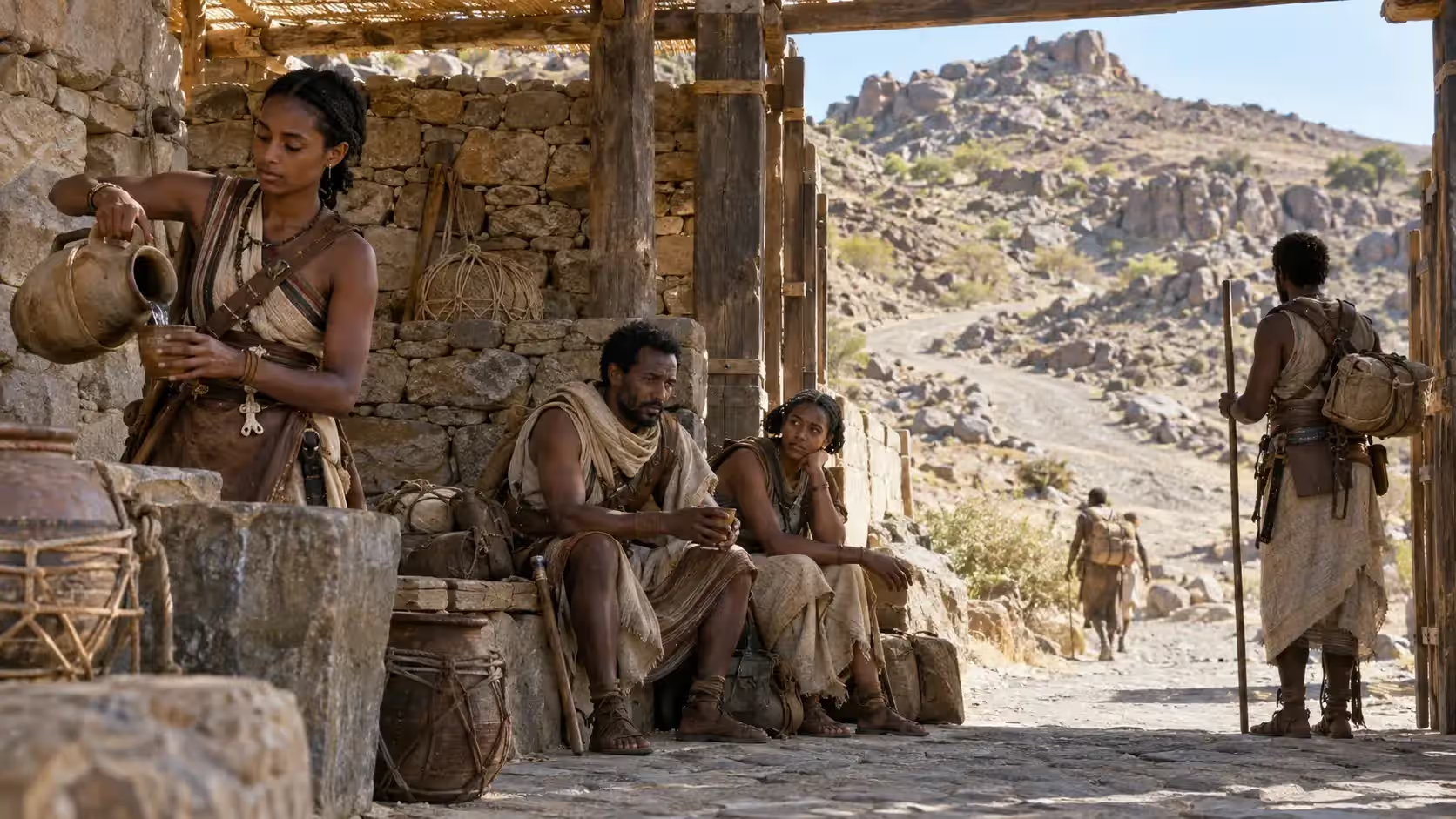
A relay offers convoys water, fodder, rest, inspection and repairs. Its architecture separates bodies: a single relay must let pedestrians, working animals, carts and heavy loads turn, drink and wait without mixing them.
Convoy nodes
The whole network is thought out in nodes. Crossroads become fortified squares; markets and courts set up directly on the nodes; some towns, the relay towns, exist only to synchronise convoys. At the same nodes, road courts combine tolls and contracts: there the road becomes law.
On the borders, dwellings become forts
On militarised borders, dwellings become forts. A relay fort rises every 15 to 25 kilometres, about four to six leagues; villages can fold back behind palisades; ditches and predator traps are built into the landscape. The march duchy of imperial Qor Zaï indeed counts march relays among its trades, alongside its bone customs and counter-tracking.
A relay for each day of convoy
On the imperial roads, a relay stands every seven to eight leagues, roughly one day’s convoy travel. It offers a trough, fresh mounts, a fodder depot, a repair workshop, and the upkeep of the markers along its section. It is thanks to this mesh that the imperial post can cover forty to sixty leagues a day by changing mounts at each relay, and cross the Empire in ten to fifteen days.
The relay is also an observation post. It records the convoys that pass, their load and their direction, and sends these records to the duchy’s road office. Read as a series, this register gives an almost exact picture of what moves through the Empire, and an unusual column on a march road is noticed first in the relays.
The relay master
A relay is run by a relay master, holder of the Road patent issued by the capital’s schools. He answers for the water, fodder, mounts and markers of his section; he keeps the register of passages and the book of incidents. If a courier goes missing between two relays, those two registers are opened first to find out where and when he was last seen.
The master lives at the relay with his family, his hadrosaur handlers, his fodder-men and a small guard. Some relays are farmed out to houses that run several at once, hire out the mounts and carry the post; the Chancellery then supervises the farmer as it would a master. In the marches the relay master is often a former soldier, and his guard a small garrison.
Fires and horns
The relays’ beacon towers carry signals faster than any courier. A fire lit at the top, smoke by day, a horn call passed from tower to tower run along a whole line in little time. But a signal carries only a simple piece of information, alarm, danger, convoy expected, never a nuanced order: it announces that a letter will follow, it does not replace it.
Each road has its code of signals, which relay masters learn by heart and which is changed after a betrayal. On the forest roads of Orlantis, the calls of crested hadrosaurs, whose voices carry far under the trees, once served as relay horns, and some relays keep the custom.
When the relay becomes a fort
In troubled times the relay is the front line. The Road Guard, the lowest of the levels of imperial mobilisation, consists first of protecting relays, escorting convoys and keeping traffic moving. On the march road of Qor Zaï, facing Arkhan, the relays are true forts, and raids target them first: burning a relay cuts a road more surely than destroying a bridge.
When a raid threatens, the relay closes its gates on the convoys inside, shelters the animals in its yard and lights its fires to call the next fort. Its garrison is not meant to hold out for long: it must hold until help arrives, a day’s march at most, and it is this delay that sets the spacing of the forts along the frontiers.