

Power and institutions
The Empire of Urnok
An imperial centre, six duchies and interconnected supply chains. Power also takes shape in grain, timber, stone and records.
Urnok, within Calaron
Families and responsibilities
A House holds a duchy; it does not own all its trades or resources. The Trade Register distinguishes Houses, High Lines, Lines and Short Lines. A family name identifies an address of responsibility, without automatically establishing kinship between namesakes. Changes of position involve slow notarised mobility, rather than through a new guild.
A continental empire
Urnok is the most populous of the six powers: about thirty million inhabitants out of the known world’s hundred million, spread over some six million square kilometres. That is barely five people per square kilometre on average, with dense farming plains, multi-storey towns and immense stretches of forest, uplands and almost empty borderlands. The Empire cannot be crossed in a few days: a convoy needs one to two months to go from one end to the other, and a courier changing mounts at the relays ten to fifteen days.
Six duchies share this territory, each with its own material. Calaron, around the capital, holds the register, ink and egg paper; Sarnor grain, seed and water; Bralnor stone; Orlantis wood and resin; Velmor, the only archduchy, leather and the bow; Qor Zaï imperial, the south-eastern march, bone and intelligence. The Empire holds together through its load-bearing roads, its reserves and its registers more than through its borders.
Born of a famine
The Empire was born of a famine, about ten thousand years ago. Starving Arkhans stopped in the fertile plains of the centre and settled there; these first Urnokians swore “never again”, and the whole civilisation that followed descends from that oath. The silo-cathedrals, the fodder posts, the currency backed by reserves, the Counters and the Synod that trains stewards all answer the same fear.
Two peoples thus came out of the same hunger by two opposite paths. Arkhan answered with predation and the track; Urnok with storage, registers and roads. The loathing that sets the two powers against each other today, down to the way they eat an egg, is a geopolitics of scar tissue. Urnokian tradition also places in those early times the first great domestication of a sauropod, a female Diplodocus that generations of people learned to feed and understand.
Crowns turned into duchies
Before the Empire there were kingdoms: Sarnor, Bralnor, Orlantis, Velmor, the crowns of the centre, the marches of Qor Zaï and others long since vanished. One of the central crowns prevailed, and Calaron became the common heart. The victor did not erase the vanquished: it absorbed ancient states while keeping their administrations under an imperial layer, and the defeated kings became dukes. The duchies of Urnok are, in an often quoted phrase, defeated states that have had several millennia to officially forget they were states.
Velmor was the last great kingdom to submit, by negotiation rather than defeat, and it kept the rank of archduchy, a military court and its claims. Several dynasties then held the throne; House Vael-Orûn has held it for three generations. Every border of the Empire keeps the memory of these successive layers, and every dead claim may one day serve as a pretext for war.
Governing thirty million people
At the top, Emperor Orûs III holds sovereignty, supreme justice, the decision of war and arbitration between the dukes; his daughter Sahina, heir designated unanimously by the Grand College, exercises the High Intendancy. The Grand College brings together the dukes, the great orders and the major institutions; it confirms the heir and steps in during constitutional crises. At the centre, three Houses of Empire hold specific functions: Calaris protocol, arenas and seals, Tewolde-Baran civil status, Qoré-Mirhan the chancellery.
Four institutions carry the working of the State. The Imperial Bank of Scales and Roads issues the currency and guarantees credit; the High Chancellery of the Living Roads keeps the roads, bridges, relays and watering places; the Synod of Living Measures trains scribes and stewards by examination; the Diet of the Great Silos publicly certifies the reserves. Below the Houses, the craft Lines entered in each duchy’s Register of Trades give every link of production a known person responsible.
A living capital
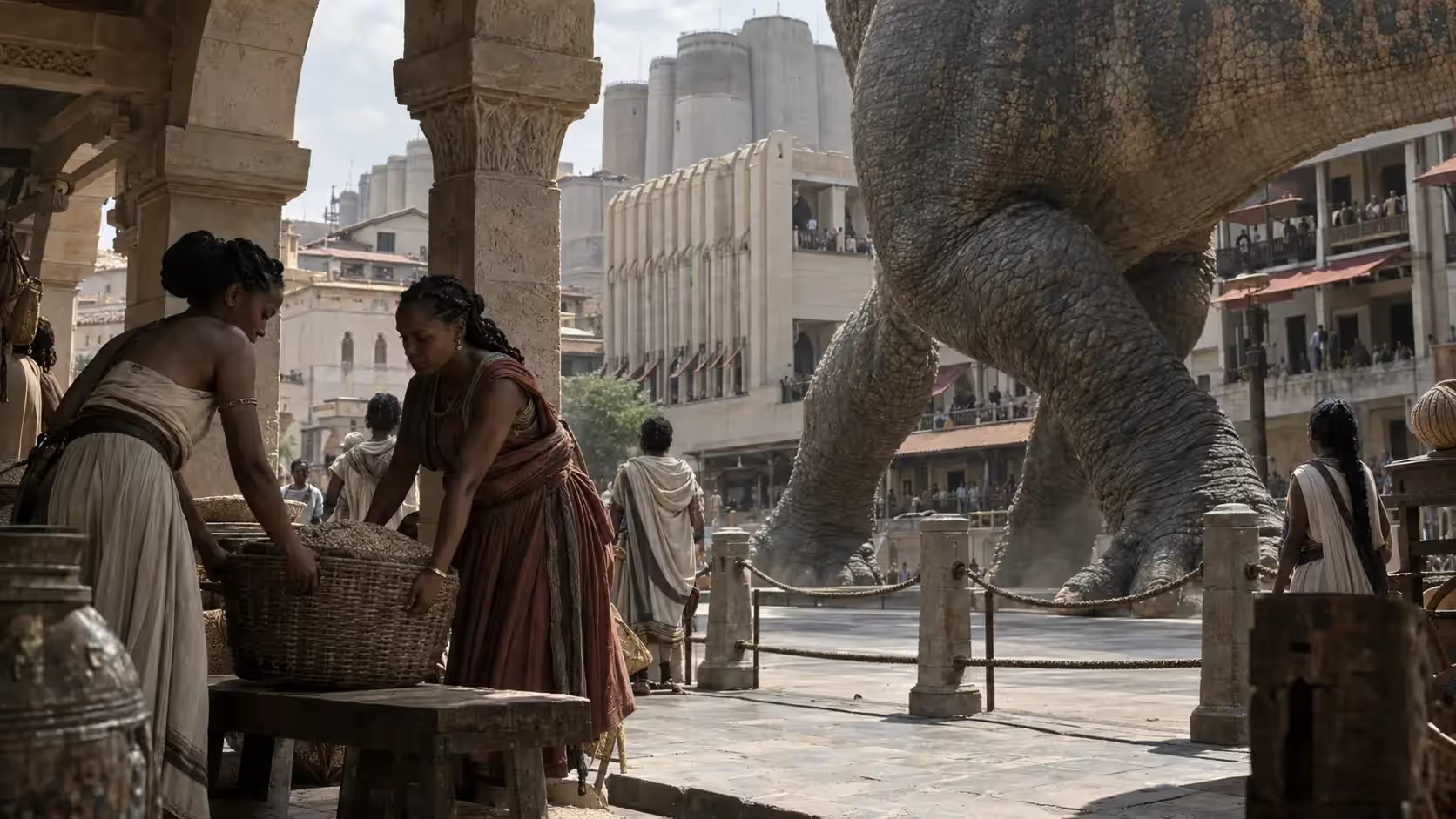
Urnok’s wealth walks. Sauropods carry heavy loads, lift blocks, guard roads and form the core of the army; hadrosaurs plough, pull wagons and barges; iguanodons serve as everyday mounts and harness animals. These animals are honoured as living infrastructure: statues of brachiosaurs and ultrasaurs stand at crossroads, and town avenues are wide enough for a very large animal to pass without slowing.
This capital is expensive. It eats, drinks, falls ill and wears out the roads; a broken silo or road can paralyse the Empire like an organism deprived of food. The law frames it closely: the breeding of very large animals is reserved for licensed great Houses, and military titans legally belong to the Crown, even when assigned to a duchy or an order, down to their remains. In imperial ideology, feeding the animals is an act of sovereignty.
The mass that does not bend
Urnok does not win its wars by striking first; it wins them by never collapsing. Where Arkhan bets on the first charge, the imperial army bets on endurance. It is the most complete army in the known world: heavy infantry of the Crown Legion, Silo Pikemen against great beasts, crossbowmen, torsion ballistas, shock cavalry on hadrosaurs, scouts on iguanodons and fortress sauropods carrying archers on their backs. As long as the line holds and the rations arrive, it wears the enemy down.
Its weaknesses are well known: it is slow, it does not pursue, it is costly and it has no flying force. This is why logistics, roads and fodder take up so much room in Urnokian military thought: they are the language in which this empire wages war. A saying of the High Chancellery sums it up: “A war without rations is a defeat written earlier.”
Five neighbours
Arkhan is the border rival, the visceral danger: the march of Qor Zaï imperial exists to hold back the Horde and its raptors, and contempt between the two peoples crystallises around the egg, ordinary food for one, a legal asset for the other. Korath is a partner the Empire depends on: Urnok sells it tendons, Korath sells it ballista parts and armour, and Velmor serves as the hinge of this exchange.
Volonia trades with the Empire, buys its fodder and materials, receives the wood and resins of Orlantis in exchange for pearls and luxury goods, but seeks to stop it adding command of the sea to its continental depth. Ishtir supplies, under control, ceratopsians and their handlers, and the question of Aryel weighs on the eastern border. Finally N’Goro, a small people with worldwide leverage, sells the anti-rot glues without which the Empire’s tendons, leathers and bows would spoil; yet the two powers have already clashed on a southern front.
The Draco and the Scale
The Empire’s unit of account is the Draco. Its gold coin, the Golden Scale, is issued by the Imperial Bank of Scales and Roads under the Issuing Seal, and its value is guaranteed by the Empire’s taxes, roads, silos and fodder, as well as by the right of seizure. A currency backed by grain reserves says enough about what this empire fears.
Taxation takes several forms. The imperial sales duty takes a tenth of certified transactions; company profits are taxed; the great tolerated industrial houses, such as Karûm-Brakh or Sarnor Trois-Saisons, pay a thirty per cent surtax for the privilege of having become indispensable; in wartime an emergency contribution can rise steeply. The average output of an inhabitant is estimated at about sixty-eight Dracos a year, with wide gaps between duchies and between trades.