
Weapons and materials of war
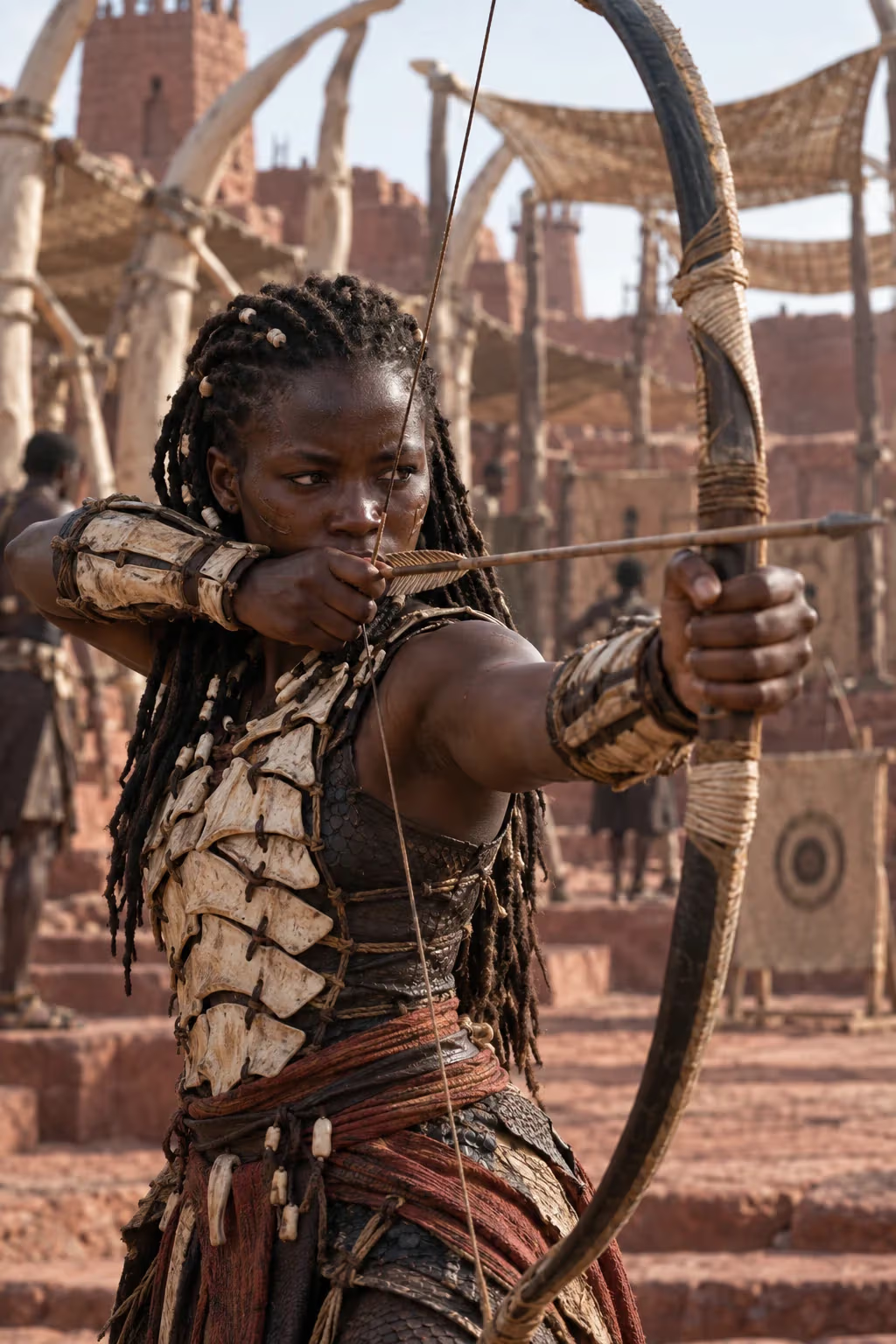
Wood, tendon, bone, horn, hide, metal, resins and N’Goro preparations: the weapons of the known world combine living materials with metal, and are designed to fight enormous bodies.
Hybrid materials
Living matter supplies tension, compression and traction; metal is kept for edges, rivets and mechanisms. Each material has its use. Selected wood gives long shafts, frames and controlled flex. Tendon serves for bows, torsion, cables, load-bearing seams and recoil. Bone, horn and tooth make points, reinforcements, hooks, plates, tools and ammunition.
Hide gives harnesses, barding, interfaces and articulated protection. Metal provides edges, rivets, sockets, mechanisms and strategic alloys. Resins glue, seal, protect, preserve and serve for fire. N’Goro’s preparations bring irritants, haemorrhagic agents, antidotes and filters, whose effect depends on the dose and the body.
Human weapons adapted to giants
The great anti-giant pike channels a charge, creates a forest of danger and forces the enemy to choose a passage; on its own, it does not stop a colossus. The depth pike, shorter, can be turned against raptors, hadrosaurs and animals already mixed into the line. A dedicated lance protects the feet and the handlers inside a sauropod’s envelope.
Un guerrier au plastron treillissé de lattes d'os tient une lame d'os dentelée et un bouclier rond de peau tendue devant les tentes d'un camp.
The lost-head lance belongs to the Arkhan cavalry: its sacrificial head stays in a joint or a wound. The hamstring hook worsens a wound and catches a bard, a strap or an exposed tendon. The tendon bow draws its rate of fire and power from the animal lineage of its tendon. The running scorpion is light wheeled artillery, quickly towed, that fires and then moves. The great ballista, finally, is judged by its range, its height, the mass of its ammunition and counter-battery fire.
No size fights alone
These weapons only make sense within a system. A colossus without a human screen becomes open to attack from every side once it has broken through; a pike phalanx can be overrun by noasaurids under its shafts; a ballista without observation fires on a position already empty. Any legendary unit is legendary only within a combined-arms system.
Seams and hides
Hide protection follows precise sewing techniques. The reversed stitch runs the thread back over several points, so that a tear has to climb against its own tension. The living seam overlaps on the bias to allow stretching without tearing. The tide stitch leaves sections that open for drying, desalting or replacement without taking the whole garment apart. The sacrificial thread lets a piece go before the rider’s body breaks.
Memory hide is moulded hot and damp on its wearer. The soft core keeps hardened faces and a flexible centre that absorbs shock. Grooved hide receives its folds before hardening, to guide the joint. Cold skin, treated with oils, waxes and salt, resists spray and mould, at the price of a strong smell in the heat.
Korathised ballistae
So-called Korathised ballistae can be recognised by their agility, their recoil control, the firmness of the bolt and the penetration rate. Some Arkhan batteries combine local tendon, Korathi recoil mechanisms and Volonian financing or transit. Korath’s reputation in artillery goes back to the Shared Recoil, one of its legendary patents.
An absolute limit
Arkhan’s weapons use a great deal of animal bone, teeth and tendon, but never human bone: not from an enemy, a slave, a condemned person or an abandoned corpse. A human piece spotted in a delivery stops the work and goes to the mortuary teams. Animal bone is wealth and industry; human bone lies outside all material.
Weapons with a name
A few weapons and pieces of equipment bear a proper name: the Ashkhandi, Arkhan’s great champion’s weapon; the Vent-Coupant bow, the saddle bow of the Wind Walkers; the Cliff Claw of the Riders of the Skull; Volonia’s heavy harpoon; the solar plate of Ishtir’s ceratopsians; Korath’s pass ballista.
The weapons of the sea
Naval war has its own weapons, and it is Volonia that has taken them furthest. The heavy harpoon, thrown by hand or by a ballista, serves to pin a hull, hook a marine reptile or drag a lone man out of a line. Velasar’s harpoon galleys carry whole batteries of them, which fix the enemy ship hull to hull before boarding. Against the sky, the anti-pterosaur teams fire nets weighted with marine teeth and lead, and cable crossbows: a pteranodon caught in the mesh falls like a torn sail.
Sea materials turn up everywhere. Marine teeth provide harpoon heads, boarding blades and quay weapons that do not rust; treated marine hides make waterproof leathers; the bolts of the sea crossbowmen are often tipped with Korathian points. The crossbowmen, used to aiming from a rolling deck, keep their rate of fire when the line wavers.