
Places and landscapes
Koraa-Vrii: femur, clay and thatch
A humble village of the marches, built at neighbourhood scale.
Around thirty round houses
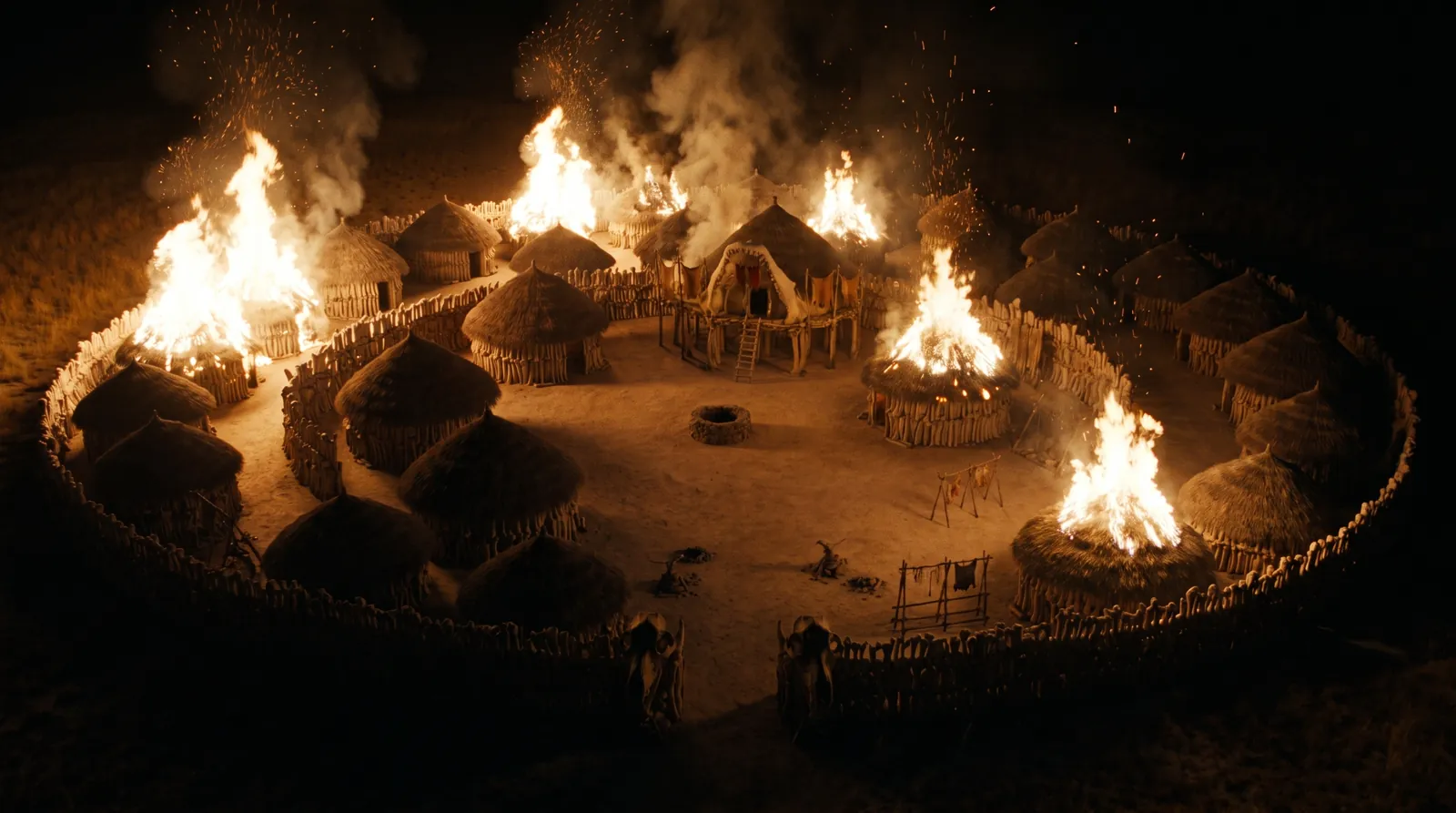
Koraa-Vrii is a humble village of around thirty round houses. Bone plates are joined with clay and covered with thatch. Pale earth and golden grass form its surroundings. Buildings remain at a scale where house, lane and square are close together; each form first serves the life of a small neighbourhood.
Observe gestures and materials · 2 images
Dans une hutte aux murs de côtes d'os, une mère et ses enfants se cachent dans l'ombre tandis que des lanciers courent dehors devant le feu.
Koraa-Vrii, la ruelle ombragée
La vie de Koraa-Vrii se glisse entre murs d’argile et couvertures de chaume.
Protection built from femurs
A wall of stacked animal femurs surrounds the village, with a gate marked by two animal skulls. The chief’s house remains modest, raised on bone piles. Raptor statuettes carved from teeth form the local totems. Bone, clay and thatch therefore bring protection, housing and signs of prestige together at an everyday scale.
Une case sur pilotis d'os, précédée d'un portail en mâchoire et d'un squelette de raptor monté.
The village within track memory
Koraa-Vrii belongs to Arkhan’s marches. In this country of tracks, travel rests on memories of water, shelter, smells and animal passages. A stage derives its value from what it allows travellers to drink, recover and cross. This geography gives the village a concrete relationship with the routes beyond its walls.
A neighbourly life
Koraa-Vrii lives from its pens and its well. Families keep a few young hadrosaurs there, some small livestock and a handful of guard raptors; the well, in the centre, has a wooden shutter whose mismatched hinges creak so loudly that the children know which one to lift so as not to wake everyone. Stores are kept in large clay-sealed jars, and a cart lane crosses the village to the square, where a long house stands for meetings and evening gatherings.
Nothing here is monumental. The round houses huddle along narrow lanes, the thatched roofs almost touch, and every object has its story: a badly rimmed wheel that an old man refuses to have redone, a sandal mended with white tendon, a shutter that has served three generations. It is a village where people know each other by their habits.
The saar and the clan
The village chief holds the title of saar, like the close-range chiefs of the bands. His house, on bone stilts, is hardly bigger than the others; his bone blade, long and serrated along its upper third, is old-house work, handed down more often than land. The saar arbitrates water quarrels, keeps the count of the beasts and speaks for the village when a caravan or a band halts before the gate with the two skulls.
Koraa-Vrii belongs to no great khanate. It is a weak clan of the marches, without Apex or Vur-vaa, which makes up for it with its totems: the raptor figurines carved from teeth express a loyalty to the raptor that the village cannot afford to feed on any scale. Trail people know it, and rank it among the places where one stops to drink, not among those one fears.
An ancient name
The village’s name keeps a very old word. According to the tradition most widespread throughout the known world, the first dinosaur ever domesticated was an archaic raptor called Vrii; many families and places whose names carry a V preserve its memory without knowing it, and trail people still call the small guard raptors Vrii.
The elders of Koraa-Vrii tell the simplest version of the story: a child is said to have found an egg, hidden it from his family and kept it warm until it hatched. They do not claim that the child came from their village. They only say that the village carries his word so that he will be remembered.
Building with what is at hand
The village is built with what the marches provide. The bone plates come from livestock and hunted game, never from very-great beasts, whose bones cost too much outside the cities; they are fitted into curved panels, the joints are stopped with clay and the thatch is redone after every rainy season. The saar’s house is raised on stilts to stay dry and to keep its smell away from that of the pens.
The wall of femurs is the work of several generations: long bones stacked crosswise, bound with tendon, wedged with packed clay. It stops wild beasts, thieves and small bands. It was never made to stop a troop mounted on raptors, and nobody in the village ever believed it was.
Part of this article covers events of season 1. Turn spoilers on in the menu to read it.
Gallery16 images
Koraa-Vrii's two-skull gate on a raid night. Koraa-Vrii's wall of femurs on a night of fire. Koraa-Vrii: femur, clay and thatch. The chief of Koraa-Vrii. Koraa-Vrii at night: a claw slits the hide of a tent. A young raptor tethered to a bone stake. The raid: a raptor bursts into a tent.