
Preparing meals that travel
Flatbreads, broths and containers connect kitchens with life on the move.
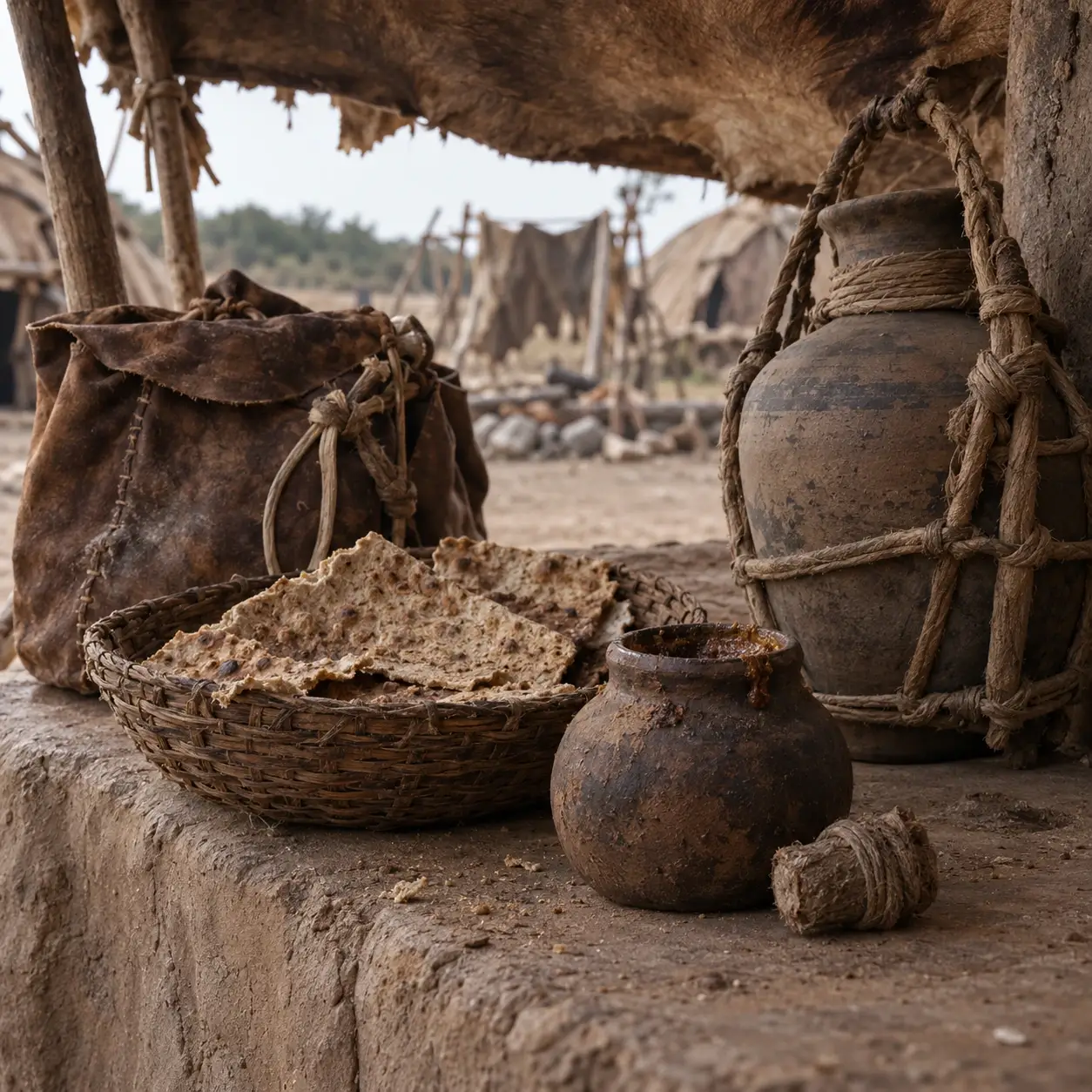
Human food for a convoy
Several ways of keeping food
Brining, salting, smoking, drying and fermentation form different paths to preservation. Timber, peat, smoke chambers, hooks, vinegars and preserving pastes appear among the supplies. Provisions thus carry work done before departure: they were prepared somewhere, with tools and a process, before becoming something carried on the road.
Carrying what has been prepared
Jars, amphorae and watertight bags connect this cooking to container workshops. In food halls, pits, evaporation, fermentation, smoking and salt also serve to preserve provisions. Provisions can change form with place and journey: the same food does not impose the same vessel or meal organisation everywhere.
What each people carries
Every nation has its road ration, and you can tell a traveller by what he takes out of his bag. The Arkhan rider eats in the saddle strips of meat from small dinosaurs, salted with marsh salt and dried in the wind. The Korath soldier of the passes receives a ration of hard bread made from imported grain, smoked meat and dried cave mushrooms, which keep for a whole winter. The N’Goro carries cakes of tubers and black flour sealed under a resin that protects them from rot: it is the only ration that keeps in the marsh.
Urnok’s convoys live on road flatbreads, concentrated broth and fish from the Ur smoked on racks above the canals, the protein of the poorer districts. The only meat the register lets circulate freely is cull salt meat, taken from hadrosaurs slaughtered under certificate. At sea, the Volonians keep fish in black salt and mask the taste of six-week salt meat with a blend of spices and bark.
The margins have their own: pemmican of pounded meat, fat and berries in the northern marches, fish dried in the cold wind without salt in the islands, which keeps two years in a hold.
What a road meal costs
Feeding a man on a journey costs little compared with what his animals cost. At the average rate of the known world, a lot of twenty road flatbreads is worth 0.38 Draco, a concentrated soup of ten rations 0.33, a kilo of salt meat 0.75 and a kilo of dried fish 0.58. A week of siege rations comes to 1.70 Dracos per man, while the same week of fodder costs 180 Dracos for a construction sauropod.
Water is the heaviest provision, and often the most expensive to carry. A fifty-litre amphora of drinking water is worth 0.22 Draco at departure; the same volume of filtered caravan water, in a sealed barrel, 0.31. On the dry tracks, the cisterns sell water to travellers far more dearly than at the well, and a convoy master plans his stages first by watering places.
These prices rise with distance and danger. A convoy crossing a region infested with predators pays more for its provisions at the last relay, because whoever brought them that far took a risk.
The convoy kitchen
A large convoy has its cook, and often several. The hot meal is taken in the evening, at the halt; at midday, food is eaten cold, flatbread and dried meat, without stopping the column. The cook lights his fire away from the fodder stores, under the eye of the fire-keeper, because a spark in a bale of dry fern can lose the animals their food for a week.
In regions of great predators, the kitchen changes its hours. Food is cooked before dusk, leftovers are buried far from the camp and strong meats whose smell carries far are avoided. Some convoy masters forbid all grilling on the hunting tracks, and their men hold it against them until the next relay.
The meal of the men and that of the animals are never mixed. The cook does not touch the animals’ rations, prepared by the handlers, and the handlers do not eat the animals’ food, even in a shortage. The rule seems obvious; the convoys that forgot it in times of hunger paid for it with starving animals at the moment they had to flee.
Rations at war
An army starves before it loses a battle. General staffs count their reserves in days, and a general who does not know how many days of food he has left has no place at the head of a column. In Urnok, the ration sergeant keeps food discipline: he issues, records and punishes, and the theft of a comrade’s ration is judged more severely than disobedience.
Every nation has its own way of feeding war. The Empire carries its food with it, by convoys and supply markers, and it can hold out for a long time; Arkhan lives partly off the land it crosses and strikes fast so as not to have to hold; Korath, which lacks grain, prepares its pass rations months in advance and fears above all that its imports will be cut.
Sieges invent their own cooking. In a besieged town, the siege ration shrinks week after week, and the cooks learn to draw a broth from whatever the town still keeps. Veterans say that you can tell a siege is ending by the smell of its pots.