

Religion and rites
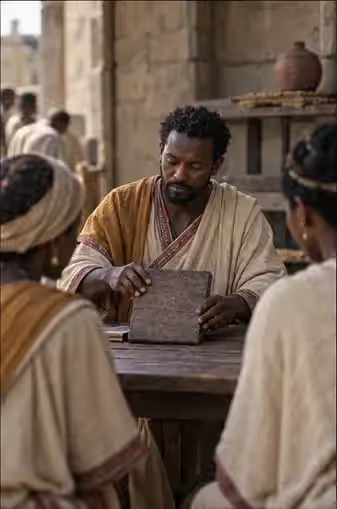
Urnok: returning to the register
Name, offices and debts close a life; roads remain open to the living.
Closing the name, keeping obligations
A supplementary rite gives a Counter the task of closing the name in the register of the dead. Offices held are read, debts transferred and the register sealed. The funeral gesture thus reveals a life through its responsibilities. A person dies; the roads, work and obligations on which others depend must continue.
The dead and roadside grass
Cremation can connect the ashes with grass plots along roads. Memory joins what feeds the Empire’s journeys. This practice gives mourning a material continuation, without supernatural action by the deceased. Funeral gestures may vary with people and circumstances.
Remembering a function
The Urnok model favours service rendered and uses left to the living. Register, road and reserve are supports of memory as well as administrative instruments. What remains of a person can therefore be told through an office held or a structure maintained. The ceremony belongs to the living; it proves no magical survival and does not end the Empire’s material needs.
Born into the register
An Urnokian’s life begins with an entry. Within forty days of a birth, the family declares the child at the civil registry, before two witnesses: its name, its parents, its Line if it has one, its quarter or village. In many families the newborn is also weighed that day, and its first weight is noted in the margin of the record; it is read again, with laughter, once the child has grown. A declared child exists for the Empire: it will be entitled to a ration in times of dearth, to a neighbourhood school, to a place in its Line’s registers.
The celebration that follows is a family one. A meal is shared, the child is given a small object from its future trade — a saddler’s awl, a wooden gauge, a blank seal — and a measure of grain is left at the neighbourhood house of rites, which hands it out.
Joining a Line
The second great passage is entry into a Line. An apprentice is entered at the end of the apprenticeship, by a notarial act read by the Line’s elders; the apprentice then receives a mark — punch, stitch or stamp — which binds them for every piece they make. The entry is celebrated in the district, because one more link in the chain is good news for everyone working downstream.
One does not always join one’s parents’ Line. A labourer’s child may be admitted to a short Line, a son of a Line may change Lines through marriage or adoption, and the Synod opens another road, that of examinations. Every change goes through the register: the register, not birth, says what one answers for.
Marriage, a chain contract
Marriages follow the chain of trades more than geography. A family of glue makers readily marries its children into a family of turners, because glue and wheel hub have worked together for generations; a silo Line allies itself with a convoy Line. The marriage is concluded before an Oath-Weaver, who reads aloud what each family brings and what it promises: shares, a workshop, supplies, sometimes a debt.
The celebration that follows brings the two districts together. Craft objects are exchanged, drinks are taken from cups bearing the marks of both Lines, and the witnesses sign the contract before sitting down to eat. An Urnok marriage is no less tender than any other; it is simply better written.
The animals’ rites of passage
Animals have their passages too. A working animal receives a name and a register number when it is declared, often engraved on a leather collar or on a bronze token fixed to the harness. A young hadrosaur’s first time in harness, a sauropod’s first load, an old iguanodon’s retirement are marked by small ceremonies in the harness yards: the animal is named, its years are read out, it is given a chosen ration.
The death of a very-large animal in service is a public event. Its carcass goes to the Crown, but its memory stays with those who drove it: a load stele, carved with the loads it carried, is raised beside the road it used to travel, and handlers passing by lay a hand on the stone.