

Culture
Volonia : la table commence au quai
Pêche, viviers, salaison et circulation portuaire font de l’alimentation une affaire de mer et d’organisation.
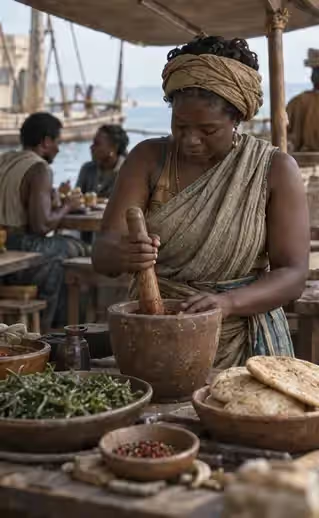
Au-delà de la table de prestige
Poissons, crustacés, coquillages et algues sont des ressources quotidiennes. La mer fournit aussi huiles et nourriture pour certains animaux entretenus près des quais ; ce résultat dépend de capture, tri, sel, conservation et manutention.
Garder sans confondre les eaux
Les viviers donnent au port une réserve vivante et un lieu de soin. Eau, déchets et animaux doivent rester organisés par usages. Cette logistique organise la réserve vivante, le soin, l’eau et les activités du quai.
Le port nourrit aussi des routes
La pêche devient cargaison préparée, assurée et redistribuée. Elle relie mer, marchés et routes extérieures.
Salting, smoking, drying
Fish spoils quickly in the sun of the quays, and a large part of Volonia’s food work consists of keeping it. The simplest method is brine, in large sealed jars. For long voyages, black salt is used, a salt smoked over charcoal and seaweed that preserves fish for six weeks in the hold: it is what allows the fleets to stay out on the Great Ocean. Sardinellas are dried in strings on poles above the terraces; the roe of silver-bank fish is pressed, salted and dried into amber ingots, boutargue, eaten on board and offered to business partners.
These tasks fill whole districts: salting sheds, smokehouses, drying racks and cooperages line up behind the fish auctions, downwind of the dwellings. The salt comes from the salt marshes of Vaesh, the barrels and jars from neighbouring workshops, and the company that prepares black salt guards its knowledge jealously. Without these workshops, fishing would feed only the ports themselves, and only on days of a good catch.
What the sea does not provide
Volonia does not live on the sea alone. Its large islands carry fields, orchards and vineyards, especially around Malvia-la-Blanche and the bays of Marévant, and every district raises small quayside fowl. But these lands are not enough to feed ten million people. The republic buys a large share of its grain, its long rations and the fodder for its hadrosaurs from the duchies of Urnok, above all from the duchy of silos, Sarnor; the grain arrives by whole cogs and sleeps in the free warehouses of Port Volon until it is sold.
The plantations of the Souths, on the warm grasslands of Séloris, provide the molasses, ember-pepper and sweet bark that flavour the kitchens. The dependence on foreign grain, however, is known to all. The old remember seasons when the cogs stopped coming and the price of bread doubled within a few tides; in the wreck districts people then ate refuse fish and seaweed, like the animals. Houses that store grain against such seasons make handsome profits from it, and the Great Board regularly sees measures go up to build common reserves.
Feeding the animals
A considerable share of what the sea provides does not go to people. A traction plesiosaur eats nearly ninety kilos of fish a day, and the basins of Velasar, Marévant and Port Volon keep hundreds of them. They are fed mostly refuse fish, heads, guts and unsellable catch, squid caught at night and traction rations made of refuse, fat and salt. Racing flèches-mer and messenger mounts receive a sifted, oiled fish meal, the mast pterosaurs strings of small dried fish, and the quay hadrosaurs seaweed and fern.
This competition between mouths is organised. The auctions sell table fish and basin fish separately, and houses that own teams sign seasonal contracts with the fisheries. When fish runs short, an old rule of the ports says the team eats before the crew, because a crew without a team gets nowhere; the sailors respect it, grumbling.
Feeding war
In war, food becomes a matter for the Admiralty. The soldiers and sailors of the gathered fleets receive a ration of salted fish rather than meat, which Volonia produces little of; supply ships take on food, fresh water and refuse fish for the long-range squadrons. Every committed house must declare its stores, and the price of salted goods rises at the first rumours of blockade.
Blockade is the threat Volonia fears most and the weapon it wields best. It knows how to close a roadstead to an enemy port until its markets empty; it also knows that a hostile fleet cutting the route of the grain cogs would starve its terraces within a season. That is why grain convoys always travel insured and escorted, and why the Quarantine of Vaesh, which controls everything living that comes in, also keeps an eye on food arrivals.