

Trades
Care starts with the harness
Fitting, cleaning, inspecting and stopping an activity are part of caring for working animals.
Weight must be distributed
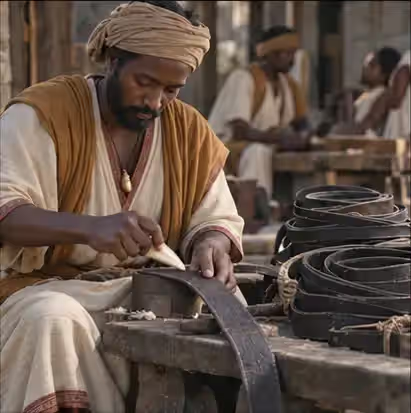
A harness joins a load, vehicle, person and living body. Straps, padding and tension parts distribute effort and keep fastenings inspectable. Care starts before departure, in how a load is placed and in the ability to remove it.
Practices that prevent wear
Harness inspectors, saddle repairers, carers and convoy leads do not hold the same post, but their work follows in sequence. They observe fit, the condition of a component and resumption of movement. Their cooperation explains why a working animal is not a machine that can simply be replaced when a strap wears out or a crossing puts it in difficulty.
The parts of a harness
A draught harness is made of parts that each have their role. The collar or yoke takes the effort at the base of the neck and the shoulders; the traces pass it on to the load; the girth holds the whole in place; the breeching, passed behind the thighs, holds the load back on descents. Between the leather and the body come padding in several layers, tension pieces adjusted hole by hole, and guards against rubbing where the skin works hardest.
The hadrosaur draught harness, a collar with a shoulder piece and traces of ribbed leather, is the best-selling harness in the Empire. A traction sauropod’s is of another order: its shoulder yoke alone weighs around a hundred and sixty kilos and is set to the inch by a Harness-Master, the person responsible for the gear of the very large. A saying of the trade sums up the importance of this work: a strap is worth a battle.
Fitting a body that changes
A harness that fitted well in spring can wound in autumn. Working animals put on muscle at the start of heavy works, lose weight during a dry season, swell after a long march; the young grow from one season to the next and must be measured again every time they return to the stable. Harness makers take measurements with a knotted cord passed around the neck, chest and belly, and enter them in the animal’s register.
The signs of a bad fit are quickly learned: skin that whitens or heats under a strap, scales torn away at the edge of the collar, a stride that shortens, a head that shakes at every start, an animal that refuses to move when it is time to take up the load again. A careful driver slips two fingers under each strap before tightening, and does it again at the first halt. Harness makers, for their part, keep for every valuable animal a spare harness fitted to its measurements, so that a piece that wounds can be removed without stopping the work.
The skin under the strap
Caring for the harness and caring for the skin are done together. After work the animal is unharnessed, the rubbed areas are washed with clean water, the dust caught between the scales is brushed out and an Orlantis resin balm is applied where the skin has become irritated. The leather is wiped, dried in the shade, greased with tallow and inspected seam by seam, for a strap hardened by sweat wounds more than a worn one.
A harness sore is treated without a harness. Every relay knows the rule: until a wound has closed, the animal works unladen or rests, and the piece that caused it is altered before it is put back on. Carers know that a small neglected sore under a collar can lay a hadrosaur up for weeks, and a sauropod for a season.
Knowing when to stop an animal
Stopping the use of an animal is a decision that is written down. The carer, the harness inspector or the Harness-Master can ask for it; the keeper pronounces it, and the retirement is entered in the animal’s register with its cause and duration. An old animal first moves to light work, pulling a farm cart or carrying loads around a relay, before being withdrawn altogether.
For the very large, retirement is one of the passages that Urnokians mark as a rite, like the first harnessing or the first load: the harness is removed in front of the team, the animal’s register is read and a hand is laid on its flank. Retired hadrosaurs end more prosaically at the slaughterhouse, on certificate, and their salted meat is the only meat whose free circulation the register allows. The register keeps the name of the person who asked for the retirement, and it is often the one who knew the animal best.