

Creatures
Stegosaurids
Orlantis’s plated, tail-armed dinosaurs, emblem of the forest duchy and of no other.
The emblem of Orlantis
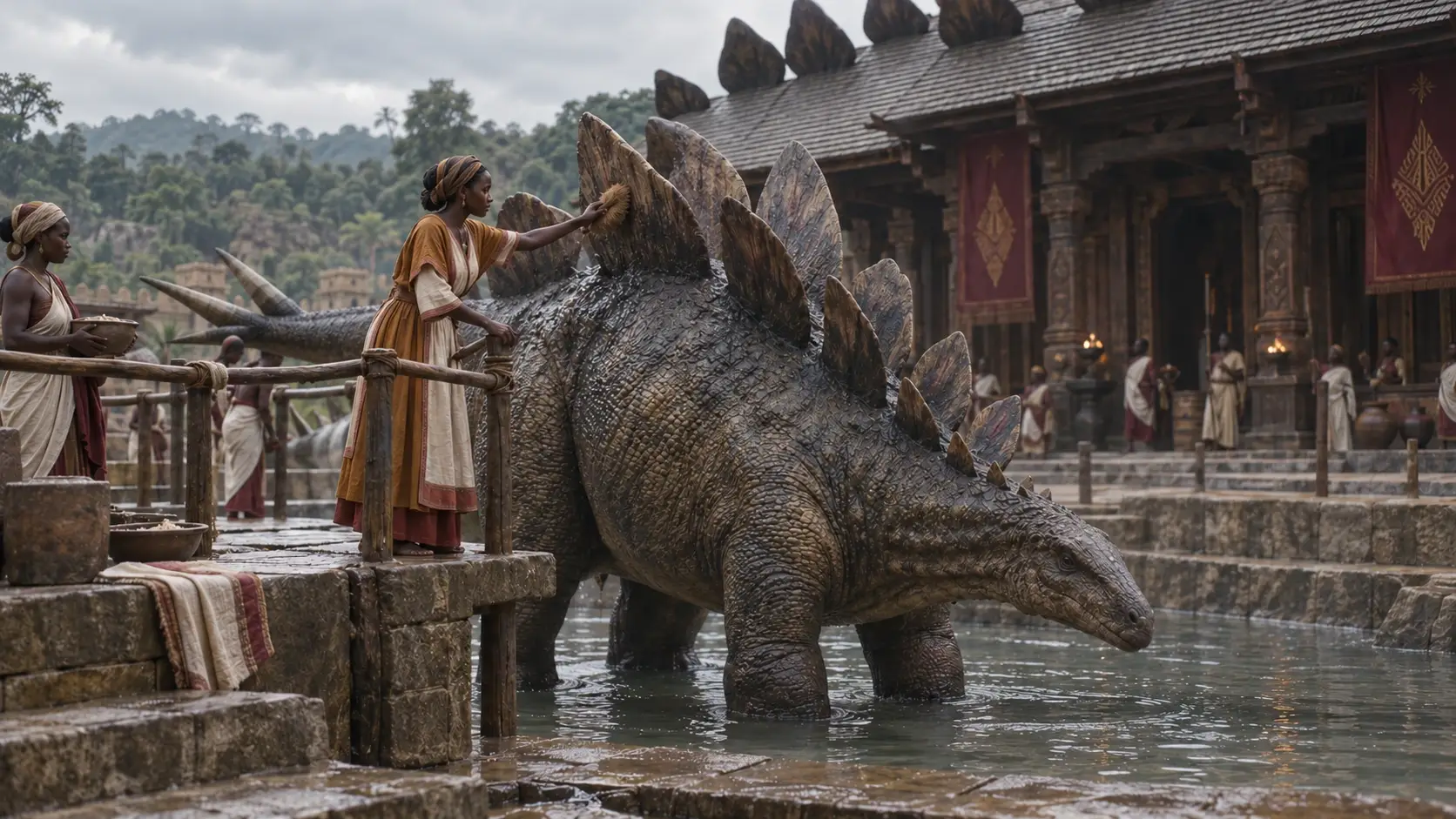
The stegosaur is the emblem of Orlantis, the duchy of forests, resins and ports. Within the Empire, stegosaurids belong to Orlantis alone: Stegosaurus, Dacentrurus and Kentrosaurus are found only there. Velmor has none; its war lineages are other species.
Un dacentrurus aux longues épines caudales avance dans une futaie résineuse, sous une galerie de bois sculpté.
The duchy harnesses them to caravan sleds and to logging. A stegosaur is about ten metres long; a person stands knee-high to it.
The Lomvar trade
The Lomvar Line handles breeding, training, harnessing and logging: hauling logs out of the high forest to the transport roads. Its pens line the edges of the forest towns, with direct access to the trees and to the bearing road; the animals bypass the workshop centres. Their tail movements require clear zones and refuges for pedestrians; carers have veterinary basins, plate brushes and suitable spaces. Orlantis’s architecture bears the mark: plate roofs, fin walls, tall drying sheds and thermal gardens.
Three species, three functions
At war, Orlantis’s stegosaurids are not a mere line of monsters. At the Three Waves, on Urnok’s left, Stegosaurus, Dacentrurus and Kentrosaurus filled different roles: wide sweeps, receiving heavy masses, clearing out raptors. The infantry knows the tail arcs, the windows for passing and the hip signals; it moves into the cleared space and works in the gaps left by the tails.
Un kentrosaure se glisse entre des soldats qui reculent et intercepte de la queue une cible suspendue.
Stegosaurus, Dacentrurus, Kentrosaurus
The three genera bred in Orlantis are only partly alike. The stegosaur, the largest and most famous, measures about ten metres and weighs some five tonnes; it carries two alternating rows of large flat plates on its back, polished amber and orange and visible from afar beneath the trees, and its tail ends in four long spikes of bone. The dacentrure has the same weight on a squatter body: its plates are smaller, its spines more numerous, and long points grow from its shoulders.
The kentrosaur is the small one of the family: about five metres, a little over a tonne and a half, a back set with narrow plates that turn into spikes towards the rear of the body, and shoulder spines even longer than the dacentrure’s. It is also the most highly strung. The three genera are not mixed in the studs, and each has its own handlers: in Orlantis they say that a man who learned on a kentrosaur can drive anything, and that a man who learned on a stegosaur believes he can.
Growth, laying and lifespan
A stegosaurid grows quickly compared with sauropods: it reaches adult size at about seven and can live some forty years, sometimes fifty, about thirty of them working. A female lays six to ten eggs per laying season, and the young hatch after roughly five months. The animal browses low, head close to the ground: ferns, horsetails, cycads and young shoots make up its ration, nearly two hundred kilos a day for a large stegosaur, with more than two hundred and fifty litres of water.
Its head is small for so heavy a body, and the people of Orlantis readily joke about their emblem’s “walnut brain”. Handlers do not find the joke funny. They know their animals remember: a passage where one was hurt, a track where it slipped, a man who struck it stay in its habits for years, and so each has its own history. That is why the Lomvar Line keeps a register of every animal from its birth, and why a handler taking over an animal begins by reading it.
The tail and its spikes
The tail is the stegosaurid’s weapon and its danger. A stegosaur’s four spikes reach the length of a forearm; they are held at the height of a man’s hip and sweep a wide arc when the animal pivots on its forelegs. The blow comes without warning for anyone who cannot read the stiffening of the hips, and it is enough to break a leg, split a shield or pierce a raptor’s flank. Handlers know the exact reach of each animal; they measure it in paces and paint it on the posts of the pens.
The spikes of a dead animal return to the Line. Polished, drilled and hafted, they become handler’s staffs passed down in Lomvar families, and an apprentice receives his on the day he is entrusted with his first animal. In war the tail decides everyone’s place: the infantry that works with stegosaurids knows the tail arcs and the passage windows, and only enters the cleared space on the handler’s signal. A stegosaurid without specialised infantry slaughters its own allies, and no imperial general forgets it.
Wild herds and fresh blood
Stegosaurids are not a creation of the studs. Wild herds still live in the deep forests of Larn and on the wooded margins of the known world, where hunters of the Culorn Line come across them during their drives. They are not hunted: House Voranis forbids it, and a wounded wild stegosaur is too dangerous to approach. The Lomvar Line sometimes takes an egg from them, under ducal licence, to bring fresh blood to a stud lineage that has grown too narrow.
Such takings are rare and supervised. A wild egg brought back to the stud is registered like the others, but the young animal that hatches from it is watched with particular care all its life, because neither its parents nor its inherited habits are known. Outside the Empire, wild stegosaurids are found in other forests of the continent; no other nation harnesses them as Orlantis does, and foreign travellers visiting the thermal gardens often discover there, for the first time, an animal of this family that accepts a harness.
The plates of House Voranis
The stegosaur appears on the banners of House Voranis, plates raised, and its silhouette recurs throughout the duchy: on the seals of the forest Lines, on the pediments of the elegant relays that made Orlantis’s reputation, in the plate roofs and fin walls of its architecture. The matt gold pennants of its ceremonial caparisons have become an embroidery pattern that the women of Orlantis wear on feast days.
The other duchies readily take stegosaurids for an Orlantine affectation, an emblem more handsome than useful. Those who have seen the Comb of Orlantis rake a battle wing, or a gate of the outer belt closed by three crossed tails, speak of it differently. In Orlantis itself the animal feeds pride and proverbs: an affair best not followed too closely “has a stego’s tail”, and strangers are advised never to stand behind a Lomvar, nor behind his animal.