

Economy
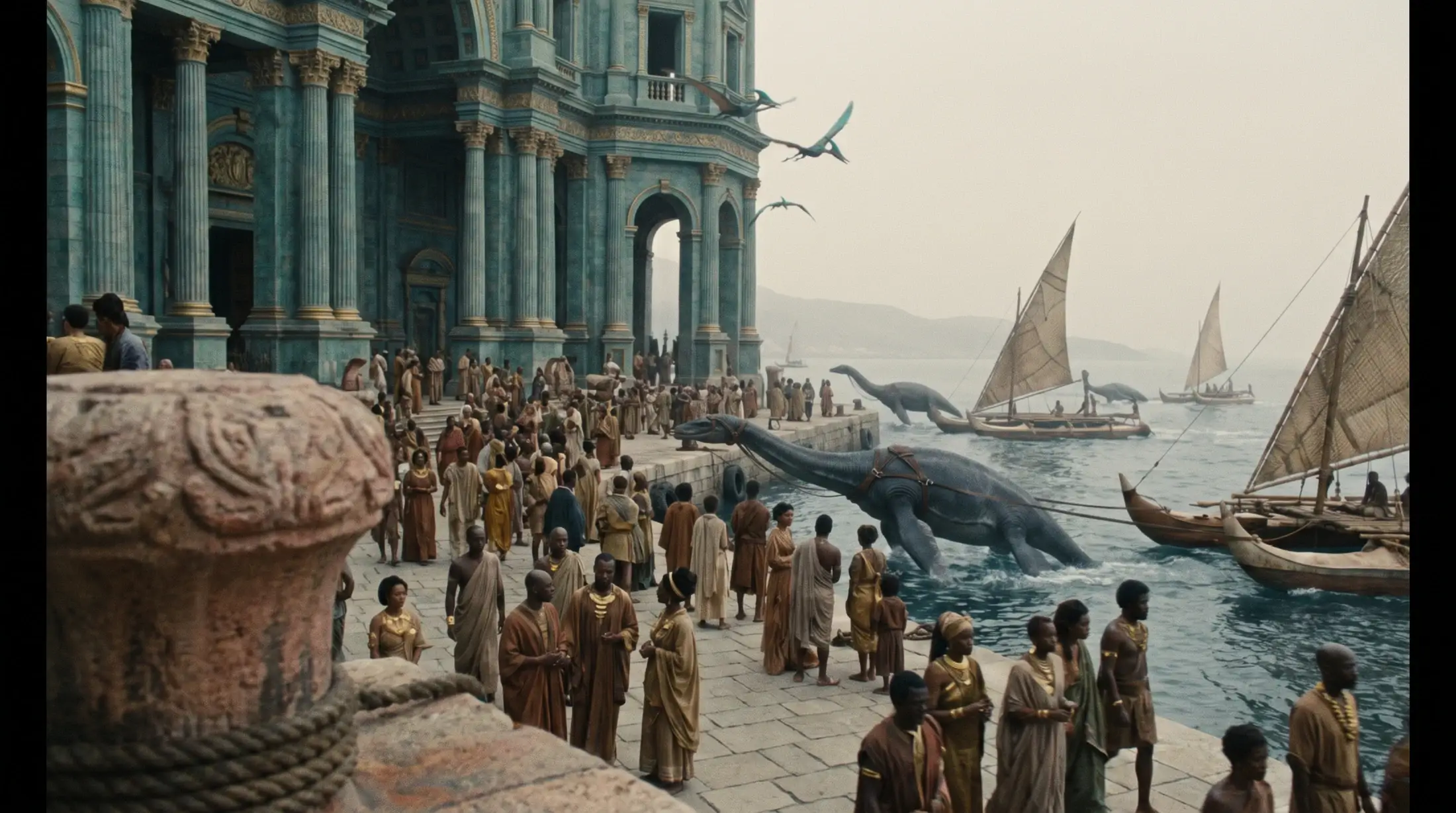
The Voile-Rachat
The league of caravan insurers decides what can be insured, and therefore what pays; its name gave Volonia its word for insurance.
Deciding what is insurable
The Voile-Rachat brings together caravan insurers. It holds caravan insurance, interest rates and road finance. Its real power is to decide what is “insurable”, and therefore what is profitable.
Its aim is to privatise security, following a simple sequence: the escort, then the contract, then dependence.
Ransom-cover and its trades
The word has passed into Volonia’s language: the rachat, or Voile de Rachat, means insurance. Volonian logic comes down to five terms — premium, seizure, reputation, proof and risk — and one consequence: Volonia turns monsters into prices.
The league’s trades are those of risk: the caravan insurer, who covers theft, fire and beasts; the risk-gauger, an old-fashioned statistician working with tables, omens and weather; the road insurer, who turns a crisis into a premium.
Insuring the land routes
The Voile-Rachat is the only great Volonian institution whose trade is carried on far from the sea. It insures caravans: convoys of goods on the roads of Urnok, columns of animals going down to Sand Port, metal convoys crossing the passes of Korath. Its seat is at Marévant, but its brokers work in the inland towns, where local agents place risks with it for a commission. A merchant of Urnok who has never seen the sea can thus pay a premium to Marévant every season.
A caravan costs less to insure than a ship: for a thousand Dracos of cargo, the league usually asks some fifteen Dracos on land, against nearly double for a voyage by sea. Its tables keep count of the routes and their dangers, season by season: brigands, wild beasts, floods, bridges swept away, unexpected customs and wars. The premium on the same route can change from one season to the next, and a rumour of war is enough to make it leap.
The name of the buy-back
It is said that the first caravan insurers wrote their contracts on a strip of sailcloth sewn to the load it covered. In case of loss, the merchant brought back the strip, and the insurer “bought back” the cargo, that is, paid what it was worth. The strip of cloth became the league’s seal, which its agents wear sewn on the shoulder, and the word spread through the whole language: in Vòlon, to take out insurance is to take a buy-back, and the contracts blessed at the Reckoning of the Tides are called Voiles de Rachat.
The league remembers this with pride. It claims to be older than most of the houses of Marévant, and its members, insurers from father to son for many of them, see themselves as the keepers of a knowledge that owes nothing to the sea. Maritime insurers regard them as somewhat rustic cousins who know ruts better than currents; they reply that a land road never calms down by itself.
Escort, contract, dependence
The league’s ambition follows a sequence that can be observed on many routes. It begins by offering an escort: guards hired from the contract companies accompany a caravan through a dangerous passage. Then come route contracts: an escorted caravan pays a lower premium, and soon merchants no longer dare set out without one. In the end, the route depends on the league: nobody travels it without its buy-back, and it can decide the conditions on which people pass.
This power becomes a weapon in wartime. The league need only declare a route “uninsurable” for caravans to stop, without a single Volonian soldier having fought. Urnok knows it and is wary: the Empire can strike Volonian contracts with a war surtax, and its administrators take a dim view of foreign escorts on their roads. The khans of Arkhan, who levy their own tax on whatever crosses the steppe, negotiate with the league as equals.
When a caravan is lost
A loss on land is harder to prove than a shipwreck. There is no wreck to raise, and the remains of a plundered caravan vanish quickly. To pay, the league therefore requires either the visit of one of its road investigators or the declaration of a witness in the Hand mode, made before an agent in the nearest town. Its investigators ride hadrosaurs along the insured roads and know the false attacks: loads sold on the way, accomplice brigands, animals declared dead and resold at the next market.
Payment is made at Marévant or, for inland merchants, by a letter of credit drawn on a Volonian counter in their own country. A merchant who has cheated once never again finds an insurer in any town where the league has agents.