
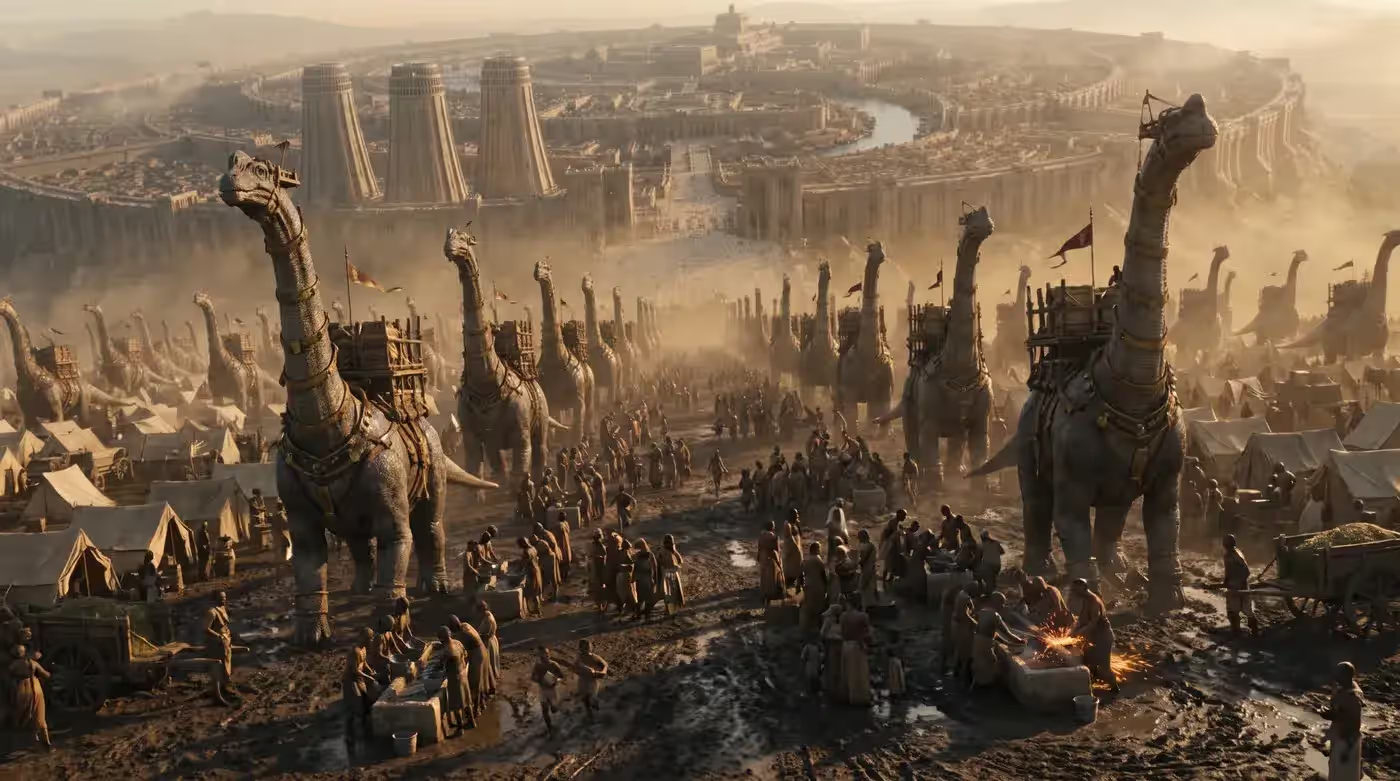
War platforms and harnesses
At war, the harness becomes an engine: swivelling firing platforms, archers’ towers, bone armour, campaign silos and forges, mirror signals, engineering rakes. Each engine depends on a specific body, its load, its turning radius and its stamina.
The harness as an engine
A mounted war engine is never placed on an animal at random. It depends on the load the body can bear, its turning radius, its field of vision and its stamina. The weapons stay of their time: tendon ballistae and scorpions, bows, nets, hooks, counterweights and winches.
Some powers have made whole branches of them. The Empire of Urnok divides its war sauropods between Tours-Portantes, Porte-Ponts, Silos-Vivants and Engrenages Vivants; in Volonia, heavy plesiosaurs carry two platforms close to the trunk, manned by archers or light ballistae. The engines described here extend these uses.
Firing platforms
The Flow Rings equip a medium ceratopsian, a styracosaur: two rings linked by cables form a circular harness that lets gunners aim their ballistae all the way round the animal. The Silent One mounts a double scorpion, a heavy ballista, on an ankylosaur; a tendon winch aims it, and at each shot a counterweight of osteoderm plates absorbs the recoil.
The Spiral Tower is a small tower of bone and timber wound around the flank of an ankylosaurid, a euoplocephalus: an archers’ platform crowns it, a spiral stair climbs it, and it serves for assaults on ramparts.
Seeing and being heard
The Thousand-Eye is a circular structure carried on a brachiosaur’s back, fitted with mirrors and lenses: it sends light signals over long distances and serves to watch the battlefield. The Sounding Frame exploits the parasaurolophus’s hollow crest: a timber frame fitted with clappers surrounds it, and during the charge the crest’s vibration produces sounds that disorient the enemy lines.
Armour, silos, tents and campaign forges
The Engraved Cuirass dresses an iguanodon in lamellar armour of recycled ankylosaur bone engraved with signs; it protects convoys against wild raptors. The Bone Silo is a harness with an adjustable frame that unfolds into a mobile storage pit: an apatosaur, taken off the front line, becomes a living silo loaded with tonnes of fodder.
On the backs of maiasaurs, great tents with hinged sides unfold into bridges to cross a river, or into a wall for a fortified camp. On an alamosaur, iron gears fitted to the neck and tail pass the body’s movement on to the bellows of a forge carried on its back: weapons and parts are made there in the middle of a campaign. Urnok’s Engrenages Vivants, which repair on the march, follow this logic.
Engineering and terror
The Canal Dredger arms a baryonyx, a spinosaurid, with a jointed rake that clears and cleans marsh canals; a side net-launcher defends it against water reptiles. The Hammer Horror is a half-wild apex, a carcharodontosaur trained to carry sectional armour, its jaws fitted with hooks; behind it, a crew works chains tied to its tail, which drive a swinging crusher.
Sauropods add a whole field engineering: mobile bridges and deck-laying, siege trains, archers’ platforms, towing harrows, stakes and barriers, digging ditches and raising palisades, evacuating the wounded on a platform like a mobile hospital.
Who builds and maintains them
A mounted war engine is the work of several trades. Urnok’s harness-master is responsible for the interface between person, load and beast; the saying “a strap is worth a battle” comes from him. In Qor Zaï, the guild-house of the Harnais Triplés, led by Odrik Vauln, called Leather-Hand, makes heavy harnesses, military saddles, anti-raptor straps and the collars of the very-great, and sets the imperial standard; in the march they say that a noble commands a beast, but a Vauln knows whether it will accept. The Armureries Vivantes, lastly, armour the beasts that will carry the engine.
Each engine then has its maintenance team, which dismantles it, greases its cables, changes its tendons and checks every evening the points where the harness touches the skin. An engine that is badly maintained does not last a campaign.
When an engine fails
Mounted engines fail in a few well-known ways. The most frequent is the beast’s fatigue: an animal that carries a tower or a ballista through a whole day’s march arrives at the fight exhausted, and a ceratopsian that has turned too often refuses to turn again. Next come breakages: a tendon cable that has taken the damp, a worn strap, a split wooden peg. In wet countries, without N’Goro’s anti-rot glues, tendons rot within a season.
The worst failure is still panic. A beast that takes fright under its engine may tear it off, crush it against a wall or carry it into its own lines, with the crew clinging to the platform. That is why teams drill relentlessly at cutting the fastenings in a few moments: an engine that cannot be cast off is a danger to its own side.