

Creatures
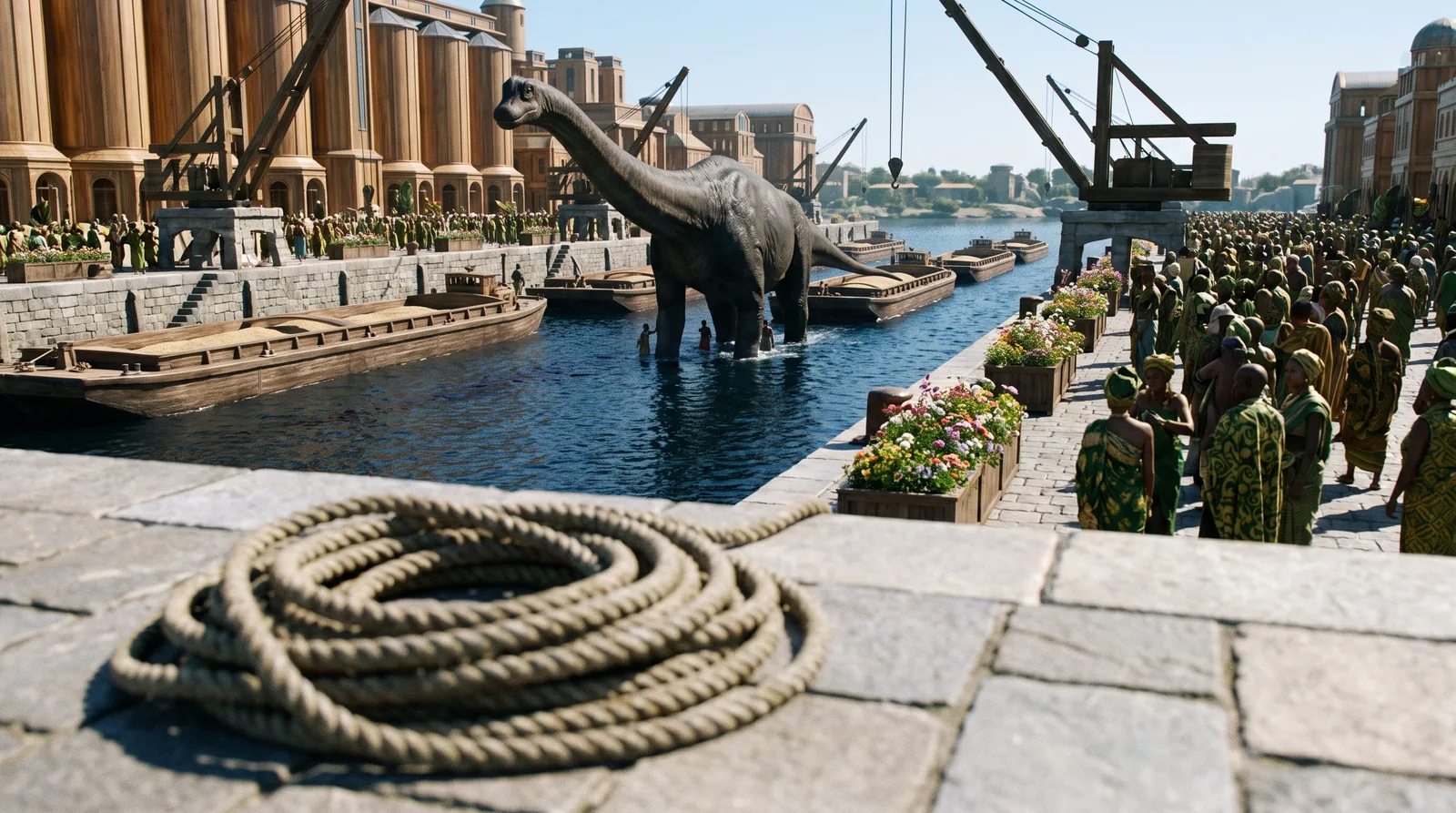
The sauropod of the silos
Sarnor grows grain, keeps seed and supplies the fodder that sustains the Empire’s convoys and great animals. The Dreadnoughtus of the Silos belong to this landscape of storage and supply. With the convoy hadrosaurs and farm animals, they tie the duchy’s reputation to food and to the movement of reserves.
The silo Dreadnoughtus is the emblem of House Orlenox, which holds the duchy without owning all the grain it stores: dozens of silo families share the reserve capacity.
The heaviest of the titans
The Dreadnoughtus of the Silos is the heaviest sauropod in the Empire. An adult measures some thirty metres from snout to tail and weighs close to sixty tonnes, the weight of about twenty draught hadrosaurs. Its neck, shorter and thicker than a brachiosaur’s, is carried almost horizontally; its body is a broad barrel set on four pillar-like limbs, and its tail, short for a sauropod, does not sweep like a diplodocus’s. Its ochre-brown hide, thick and wrinkled, forms folds at the shoulders and thighs into which a man can slide his hand up to the wrist.
Nothing about it is quick. It walks at a stroller’s pace, stops often and never trots; Sarnor’s handlers say they have never seen one run and have no wish to. It grows slowly: a ten-year-old has not reached half its adult weight, and the animal only attains its full size after twenty. The yard registers record Dreadnoughtus kept at work for more than seventy years. Handlers do not credit it with a single temperament: each animal has its habits, its refusals and its hours. They agree on one rule of the trade only: an animal that has decided not to move is not argued with; it is waited for.
Born in a Sarnor yard
Breeding a Dreadnoughtus is a reserved privilege: as for all the very large, it takes a great licensed house and a Crown licence. Sarnor’s yards, set outside the walls along the load-bearing roads, house most of the Empire’s breeding stock, and the Empire counts a little under a hundred of these animals in all. A female lays three to six eggs, seldom more, and not every year. The egg of such a giant always surprises visitors: it is barely larger than a man’s head. It is brooded for nearly a year in the warm sand nests of the hatcheries, watched by keepers who record its warmth every day.
Each egg is entered as seed stock from the moment it is laid, with its lineage, its mother and its hatchery; it is handled as a title rather than a thing, and in Sarnor they say a Dreadnoughtus egg is worth a village. The hatchling weighs less than a four-year-old child. It spends its first years in growing pens, with the young of its season and a few old females who keep the group together, fed on tender ferns and then on branches. The duchy’s araucaria groves are pruned at neck height for the adults, and the pruners work there on ten-metre ladders.
Carrying grain and water
In peacetime the Dreadnoughtus moves the reserves. It carries on its back a pack frame with a double row of chests and leather cisterns, some ten tonnes of grain or water, along the titan corridors that link the cathedral-silos to the towns and fodder stations. For exceptional loads it is harnessed: on rollers or a greased slipway it hauls sixty to a hundred and twenty tonnes at the slowest of paces over a few hundred metres, enough to bring a silo block to the foot of its winch, a bridge section or a hull onto its slip. Three hours of such effort make up its day; its handlers know it, and the yard regulations put it in writing.
In war the same animals form the core of the Living Silos, the branch that makes water, grain, grease, medicines, ammunition and spare parts follow the armies. A column that brings two or three Dreadnoughtus carries several days of autonomy with it, and its general knows that better than anyone. Each animal itself eats more than a tonne of fodder a day: handlers say a Dreadnoughtus carries its own hunger before it carries anyone else’s.
A living gate
The Dreadnoughtus does not charge: it occupies. Planted across a road, a ford or a breach, it becomes a gate no charge can pass, and that is how the imperial army uses it when a passage must hold. It is set at an angle so that its armoured flank takes the shock, ringed with pikemen and under-guards who protect its feet and straps, and screens and archers are raised behind it. Its war caparison, made of quilted plates dyed a dull gold over thick leather, covers the exposed flank more heavily than the other.
The role has limits that officers learn early. A motionless animal pursues nothing and tires quickly under missiles; it must be relieved, watered and tended while others hold in its place. The Silo Pikemen, born like it in Sarnor’s granaries, are its natural companions: they plant their shafts at its feet as they would in front of a silo. In the legions, a well-defended position is said to “hold like a walking silo”.
Blessing before the campaign
Before every campaign, the silo chiefs bless the Dreadnoughtus that will carry the armies’ grain and water. The ceremony is held at the foot of the silo at dawn. The silo chief pours a measure of grain from the last harvest into the animal’s first ration with his own hand, then reads aloud the inventory of what it will carry: so many measures of grain, so many cisterns, so many jars of remedies. A scribe records the reading, the handler sets his mark, and the animal leaves with that register sewn into a pocket of its pack. On its return the empty pack is weighed before the same silo, and what has been given is read out.
House Orlenox has taken the Dreadnoughtus as its emblem, and the animal appears on its banners laden with its pack, never in battle. In Sarnor children grow up within sight of these slow silhouettes; they learn to count by counting the chests on a pack frame, and a Dreadnoughtus passing on the fodder road halts conversation in the villages. The people of the duchy draw a proverb from it that they gladly repeat to strangers: “Behind the Dreadnoughtus, there is always bread.”