
Places and landscapes
Port Volon: a capital beside the currents
The capital brings together terraces, docks, theatres and different degrees of protection.
The capital of a maritime network
Port Volon is the capital of an archipelago organised around ports, channels, currents, shipyards and quarantine. Life at the centre depends on those connections: a route changes with season, cargo and draught animal. Pilots, divers and shipwrights make circulation possible before exchanges become contracts.
Escalier de quai entre des bâtiments de pierre
Vue de détail.
Daily life on lagoon terraces
Lagoon terraces form Port Volon’s ordinary face: housing, workshops, theatres, markets and basins. Service channels, ramps, bridges and drained floors accompany streets. Fresh water, brackish water, salt water, waste and animal basins require distinct circuits. The habitable neighbourhood results from this work of separation and maintenance.
An address exposes or protects
Volonia’s social geography distributes risk. Wrecks, small islets and walkways expose the poorest to storms; lagoon terraces, villas and harbour rings provide other protections. In dry spaces underwater, privilege depends on air, pumps, exits and maintenance. A place’s safety has a material cost.
The seat of the republic
Port Volon is Volonia’s network capital: places of government, finance, justice and spectacle stand beside the quays, lagoons and floating districts. The Council of the Five Families, the collegial executive of a republic without an individual sovereign, sits at the Palais des Gouvernants. The Grand Comptoir, the Chambres des Mises and the Cour des Marchands are there too, with palaces, theatres and a large tourist trade.
The Pact of the Houses of Port-Volon belongs to the republic’s constitutional history: it set the port houses within a common organisation, beyond the interests of a single family.
Places and place names
The Quai de la Ligue is among the capital’s named places.
Arriving at Port Volon
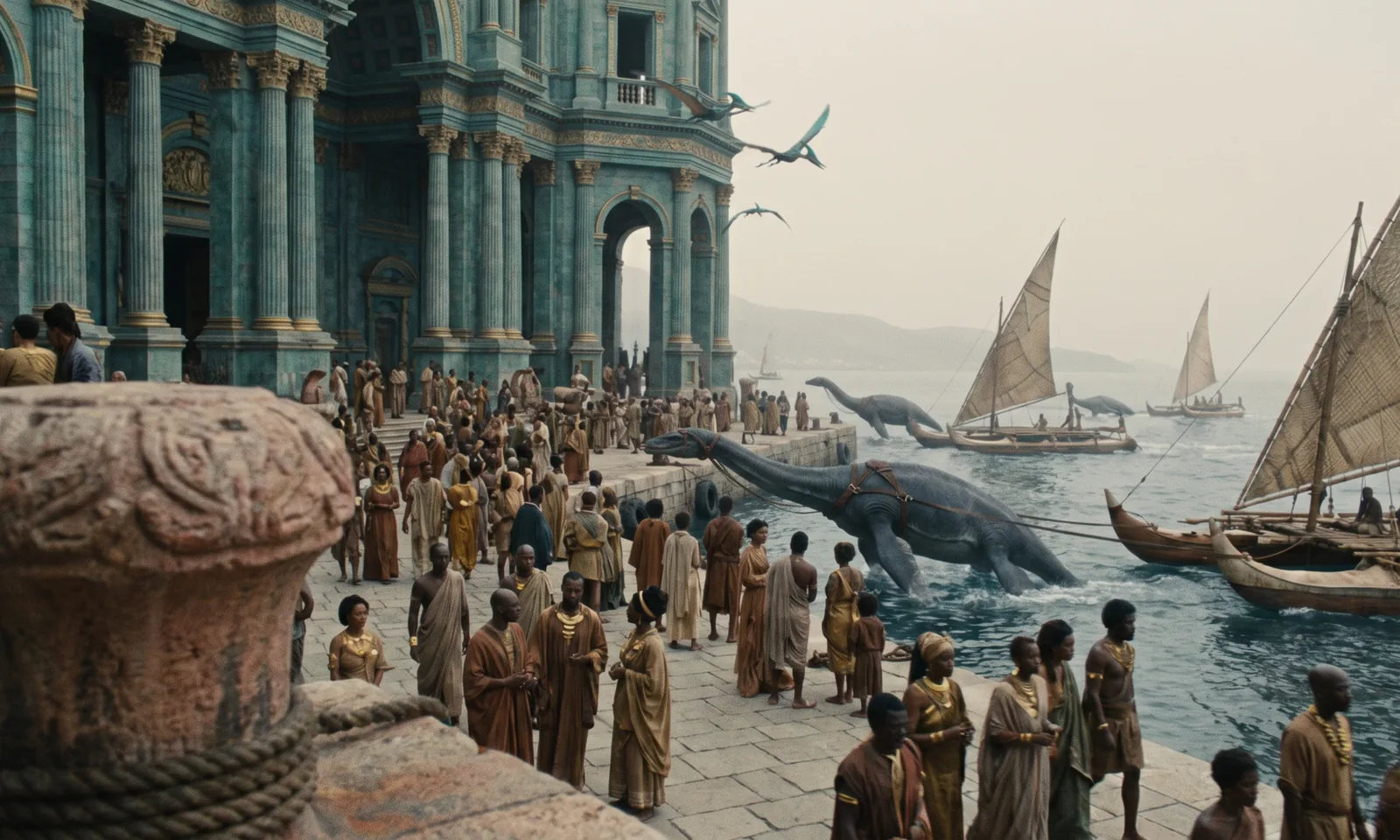
For a traveller coming in from the open sea, Port Volon announces itself long before it can be seen. The Signal Tower on Semaphore Island has already passed his sail on to the capital when the pass pilot boat comes out for him; in the channel, the port’s draught plesiosaurs take his ship in tow, and the first watchtowers appear on the islets that close the roadstead. If the ship carries animals or a living cargo, it has already been diverted to Vaesh: no one enters the capital with uninspected living things.
The rest is revealed in layers. First the harbour rings and their deep basins, where the Great Hulls lie at anchor; then the merchant quays, crowded with boats, small quay hadrosaurs and porters; then the lagoon terraces climbing in tiers, with their coloured awnings, service canals and bells. Above the roofs rise the Palace of the Governors, the towers of the Great Counting House and the stands of the maritime theatres. The first sound foreigners remember is that of the bells: those of the Counting House, which ring the close of every tide, answer one another from district to district.
A capital made of islands
Port Volon does not stand on a single island. The main city occupies the largest one, around the roadstead, with the Palace of the Governors, the Great Counting House, the Chambers of Stakes and the Merchants’ Court. Each of its districts has its trade: the Bankers’ quarter around the Counting House; the quarter of the Artisans of the Sea, where ropemakers, sailmakers and smiths work; the Navigators’ quarter, where cartographers sell their charts; and a sector of customs-free warehouses where Orlantis timber and Urnok grain lie in store.
A short distance away, the island of Lomarel carries the League Quay: there are the Admiralty of the United Fleets, the Register of Hulls and Routes, the Captains’ quarter, refit docks and barracks of contract companies. Further off, Malvia-la-Blanche, the white city, lines up its terraces, vineyards, salt pans and rentiers’ villas, and draws visitors fleeing the noise of the quays. A wooded island supplies the port with extra timber, tar and lookouts. With their towns and islets, these islands hold nearly a quarter of the republic’s inhabitants.
What the capital makes
The capital is Volonia’s richest region per inhabitant, and its wealth comes first from services. Nearly one worker in four works in markets, floating markets, taverns and theatres; nearly one in five in banking, credit, exchange and insurance. The port, the warehouses and pilotage employ one in ten, the shipyards, ropewalks and sail lofts a little fewer. The islands’ fields and vineyards feed part of the city, and the rest arrives by sea.
Yet Port Volon produces a great deal. Its yards make planking, sails, ropes and boats; its distilleries, rum; its workshops, goldsmiths’ work and quay weapons. It hires out contract companies to the whole republic and sells its exchange, credit and insurance abroad. A large part of what it earns comes from clients who will never set foot there.
The capital’s animals
The capital is full of animals, and each has its lane. Draught plesiosaurs tow hulls through the passes; construction plesiosaurs serve as floating cranes in the refit docks. The Voilecous, long-necked lagoon elasmosaurs, guide barges and lead the League’s processions with lanterns hung from their harness. Flèches-mer carry the mail between the islands and race on feast days; the foam riders, mounted on swift ichthyosaurs, handle dispatches and rescue.
On the quays, small hadrosaurs pull ferries, floating-market barges and carts; saddle turtles weighing several hundredweight slowly carry visitors between the islets. The port police patrol on trained basin reptiles, and a guard of Double-Fins watches over the Admiralty’s basins. Overhead, thousands of small mast pterosaurs and relay pteranodons come and go between perches, signal towers and ships.
Friday at the maritime theatre
On Fridays, the capital goes to the theatre. Port Volon’s maritime theatres stage water dramas, re-enactments of crossings, plesiosaur ballets and races; the largest of them, the Stage Basin, is reputed to be the vastest theatre basin in the known world, deep enough for ships to manoeuvre in during staged naval battles. Families find their usual seats there, children see the great animals up close, and the houses pay for shows that carry their colours.
These theatres also serve the republic. Great votes are announced there, fleet homecomings are celebrated there, and it is in one of them that the public execution of the very great fraudsters takes place when the Court orders it. Volonians see no contradiction in this: the theatre is the place where the city looks at itself.