

Places and landscapes
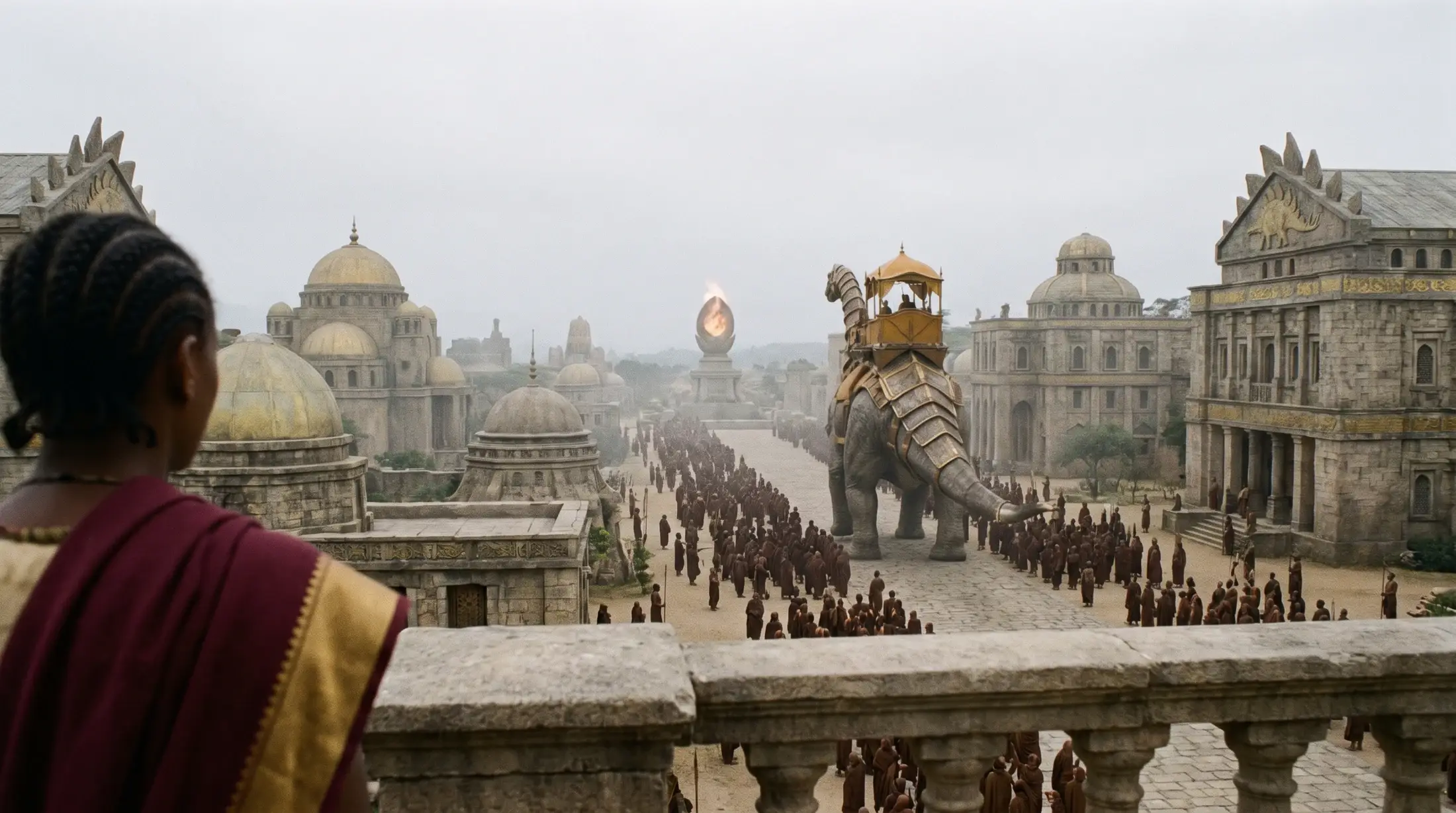
The Gué-Long
House Orlenox’s cathedral granary in Sarnor, the Gué-Long stands on a spur above the basins and holds the grain of four valleys. It is the most visible share of the duchy’s reserves, not the whole of them.
A cliff with doors
The Gué-Long is one of Sarnor’s great cathedral granaries, a third-generation work set on its spur above the basins like a cliff with doors. It holds the grain of four valleys and the seed reserves of two draught lineages. Its vats are checked from above, its ventilation chimneys carry the smell of grain up through the floors, and warm niches on its southern flank keep clutches in reserve. A lower hall can host an audience.
The granary belongs to House Orlenox, which holds the duchy. Yet Sarnor’s grain is not all theirs: the Orlenox hold perhaps a fifth of the duchy’s capacity, the most visible and monumental share. The neighbouring cathedral granaries of the Upper Ford belong to the Karnil Line, and several dozen granary Lines share the rest.
Three generations of silos
Sarnor’s silos are classed by generation of construction. The oldest are low granaries and sealed pits dug into the terraces when the duchy was still an independent Crown. The second generation raised round stone towers, ventilated from the top. The third, to which the Gué-Long belongs, is that of the cathedral granaries: hollow buttresses that draw the air upwards, stacked vats checked from above, extraction chimneys and lanterns.
This third generation was born of the stone of Bralnor. Blocks of noble limestone, rolled down from the northern quarries, made walls thick enough to keep the cool and tall enough to house the grain of several valleys. The Gué-Long is held to be one of the most accomplished of its generation: its vats have been reworked several times, but its silhouette has not changed in centuries.
The grain of four valleys
At harvest time, the convoys of the four valleys converge on the spur. The wagons climb a ramp cut into the rock, wide enough for two teams of hadrosaurs abreast, and unload on a weighing floor at the foot of the doors. There the grain is weighed, probed and recorded before going up to the vats; the seed lots go separately to the warm niches on the south side.
The silo does not live alone. Below, the basins of the Corsen Line regulate the water of the fields, and the flood mills of the Marlen Line turn on the stream; some distance away stand the cathedral granaries of the Upper Ford, held by the Karnil Line. Two neighbouring towers, two owners: the landscape itself is a reminder that Sarnor’s grain is shared.
Those who serve the silo
A cathedral granary of this size employs a small town. The silo chief answers for the whole before House Orlenox and before the Diet. Under him, a probe master directs the probers who lower their poles into the vats at several heights; lineage scribes keep the registers of the grain and of the seed clutches; ventilators open and close the chimneys according to wind and humidity; porters, sifters and sack weavers work at the foot of the doors.
Guard duty falls to the Pikemen of the Silos, the troop trained to stop a maddened animal before it tramples the harvest. Their reflex, plant the shaft and hold, has become the imperial answer to great predators; at the Gué-Long it serves mostly to hold back the crowds on distribution days.
The silo’s year
The Gué-Long’s year follows the grain. After the harvest come the filling and sealing of the vats, then the autumn certification, when the Diet of the Great Silos reads out the state of the reserves. Winter is the season of the probes: the heat and moisture of the grain are checked at regular intervals, vat by vat. In spring the warm niches release the seed, and the silo opens its first vats for the convoys of the lean season.
In summer, when the vats are at their lowest, cleaning and repairs are done. It is the only time one can go down to the bottom of the vats, and the old hands say one breathes there the smell of every past harvest. The silo’s bells mark the rhythm of this work and can be heard in all four valleys.
The part that gets painted
The Gué-Long is the most visible part of Sarnor’s reserves, and it is the part that gets painted. Its silhouette appears on the banners of House Orlenox, on the seals of its acts and on the bronze gauges given to deserving silo chiefs. For a traveller arriving in the duchy, the gated cliff of the Gué-Long is the first sign that he has entered the granary of the Empire.
This visibility has its other side. What happens at the Gué-Long becomes known faster and further than what happens in the silos of the Lines, and the ducal house answers before the whole duchy for the state of a structure everyone is watching. The Gué-Long’s silo chiefs are therefore chosen with particular care, and their office is held to be one of the most exposed in Sarnor.
Part of this article covers events of season 1. Turn spoilers on in the menu to read it.