

Families and social ties
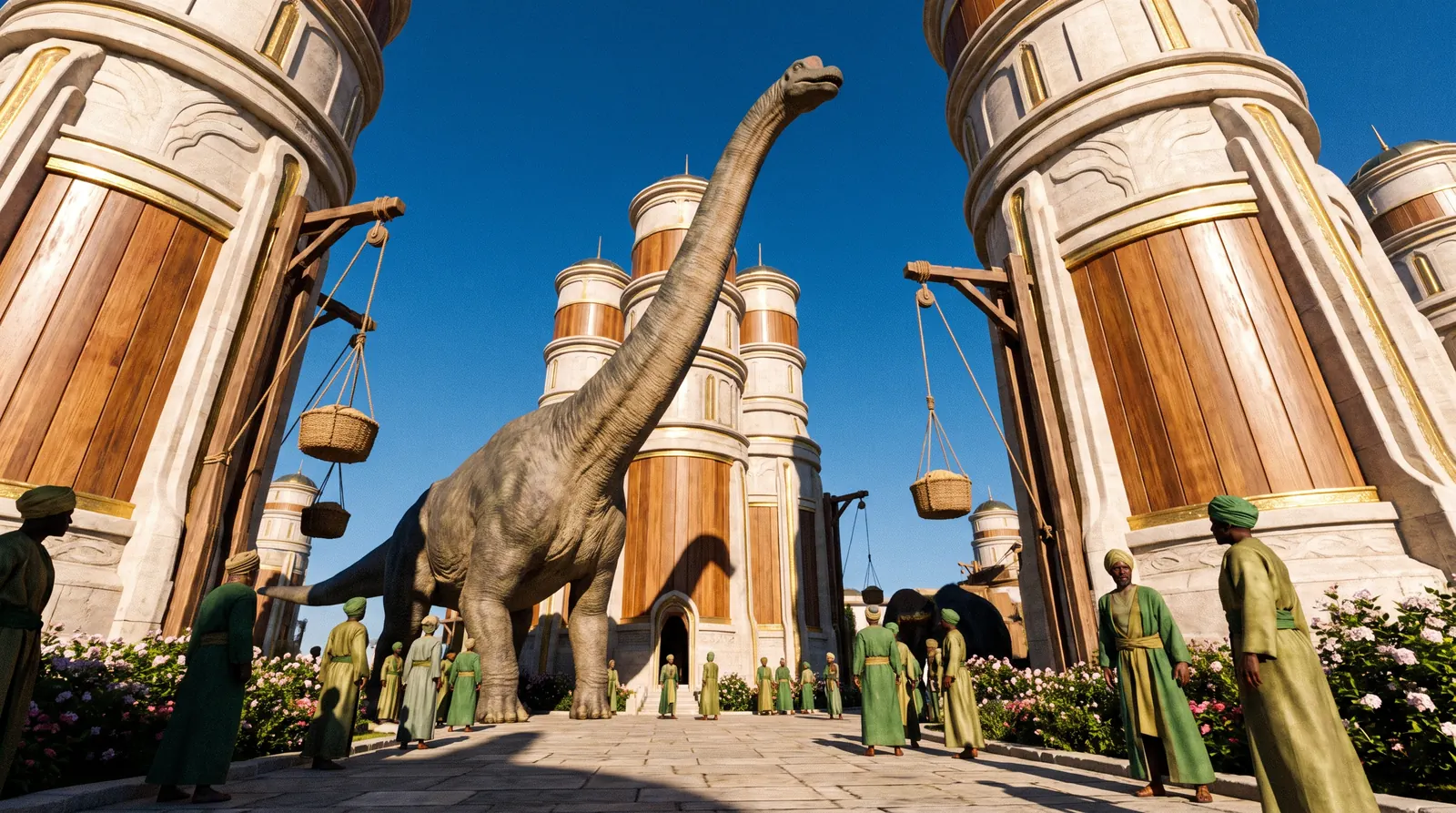
House Orlenox
The ducal House of Sarnor, the Empire’s granary. It governs the duchy of granaries without owning all of its grain.
The House of reserves
House Orlenox holds Sarnor, the duchy of granaries, reserves, grain and farming basins. The duke, Teren Orlenox, is a child duke; the territory is governed through a regency.
It is one of the oldest Houses of the Empire: its history goes back at least eight thousand years. An ancient House of reserves and granaries, it gave rise, several millennia later, to a distant branch that now carries the Crown: the Vael-Orûn.
The name Orlenox belongs to the agrarian layer of Sarnor, recognisable by endings in -ox, -en and -il. Sarnor is a former agricultural Crown, absorbed early by unification. The duchy’s emblem is the Dreadnoughtus of the Silos, the heaviest war sauropod of the Empire; convoy hadrosaurs and hauling sauropods complete the animals of the granary.
The duchy belongs to the Orlenox, the grain does not
Governing Sarnor does not mean owning its reserves. The Orlenox hold, among others, the Gué-Long, a cathedral granary of the ducal House. They hold perhaps a fifth of the duchy’s capacity: the most visible and monumental share, the one that gets painted.
The rest is divided among several dozen granary Lines: about ten High Lines and forty to sixty Lines below them. Five High Lines are named. Karnil keeps the cathedral granaries of the Upper Ford, with the oldest registration in the duchy, older than Unification. Ulmen holds the seed and the draught lineages, the grain that is not eaten. Corsen holds the basins, sluices and irrigation canals. The Tanoris of Sarnor hold rationing and convoys: they own no grain, they own the right to move it. The Marlen of Sarnor hold milling and the flood mills.
This division takes nothing away from the House’s rank. It states who answers for each link of the granary.
Why the House endures
House Orlenox has outlived the imperial dynasties, partly because the granaries belong as much to their keepers as to the duke. The Empire’s granary is a set of distributed responsibilities: a crisis in the House does not stop the other Lines, which go on delivering.
This position gives Sarnor a political weight of its own. The granary bodies can refuse a requisition that threatens the next season, which forces an arbitration above the local command. The House can thus halt a campaign by refusing to let the food of the future be burned.
Trust in the reserves also runs through the Diet of the Great Silos, which publicly certifies their moral quality; the granary chiefs elect its Grand Guardian every twenty years. Sarnor Three Seasons, a private house of fodder and rations, works in the same duchy without owning the food chain.
Miraya and the Grand Keeper
Miraya Orlenox, sister of the young duke, is among the House’s heirs. Amon Sarn-Tarek, Grand Keeper of the Diet of the Great Silos, is one of Sarnor’s faces, but his office remains distinct from the ducal house and allows him to contradict it.
A regency since the old duke’s death
Since the old duke’s death, the ducal office has passed to Teren Orlenox, still a child, and the duchy is governed through a regency. Salmée, a kinswoman of the House, a woman of age and bearing, exercises it in his name. An Urnokian regency is not a sovereignty: the regent administers, signs and answers for the accounts, but may neither alienate the House’s lands nor commit the duchy to a lasting alliance without the Crown’s consent.
The young duke learns his trade in the silos as much as in the study rooms. It is said he counts aloud everything he sees, the steps of a staircase, the sacks of a load or the guards at a gate, a silo heir’s habit that amuses and worries those around him. He rides a lambeosaur named Moisson.
The Great Farm of Sarnor
Beyond the Gué-Long, the House’s own wealth lies in its estates, which have always been called the Great Farm of Sarnor. It is not a farm but a whole of lands, villages, mowing meadows and granaries that belong directly to the Orlenox and are run by the House’s stewards. The farmers pay their share there in grain and fodder, and part of that grain fills the ducal silo.
The Great Farm is also a showcase. Visitors are shown the duchy’s best fields, its finest teams and its most generous harvest festivals. The silo Lines smile at it: they point out that the House holds the most visible share of the granary, and that the other four fifths are in their hands.
The measure of seed
House Orlenox is the distant mother house of the Vael-Orûn, and a custom recalls the link. At every imperial coronation, a representative of the Orlenox brings the new emperor a measure of Sarnor seed, drawn from the House’s reserves and sealed before witnesses. The emperor receives it, then immediately gives it back to the duchy.
The gesture has been explained the same way for centuries: the Crown receives the grain, it does not keep it. The measure returns to Sarnor and is sown the following year in a field of the Great Farm, whose harvest is in turn poured into the seed reserves. The Calaris enter this moment in the coronation protocol.
Part of this article covers events of season 1. Turn spoilers on in the menu to read it.