

Places and landscapes
Ramp palaces and throat gates
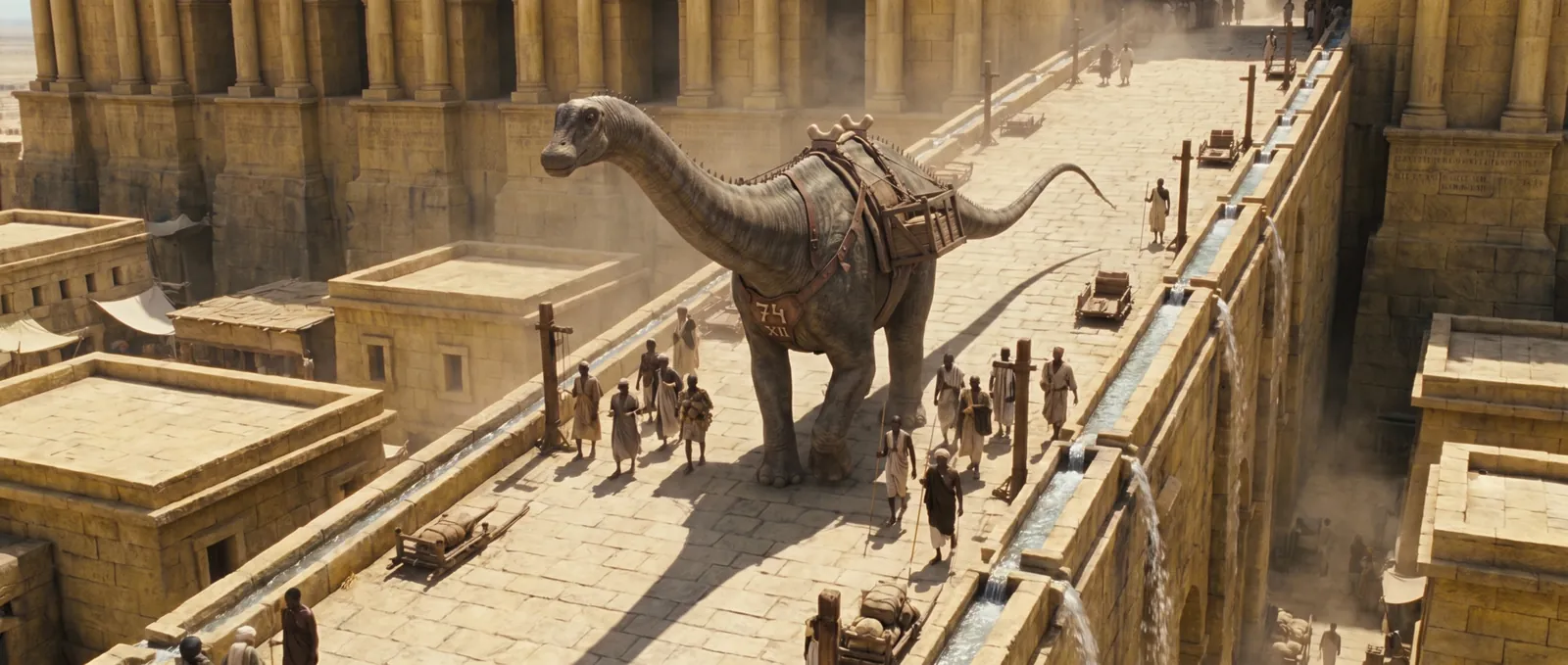
An Urnok style in which temple-palaces are gently sloping pyramids that heavy traffic can climb, and gates are curved throats that swallow columns of animals. The façade serves as an engraved traffic map, and one passes under the guardians’ throats.
The ramp rather than the stair
In Urnok, the ramp wins over the stair. Gentle ramps serve heavy loads, animals and carts, and towns rise in terraces by a spiral rather than by vertical levels. This style carries the rule up to the palace: every temple-palace is a layered stack that heavy traffic can climb, a gently sloping pyramid carved like a relief of polished basalt. Its façade is not decoration: it is an engraved traffic map.
In administrative districts, each level becomes a service road wide enough for a sauropod and its carts. At the centre, polygonal sorting cores carry out health and tax sorting: the architecture is literally a sorting machine. Roofs become waiting yards, with shade, water and care, and parapets carry route maps in relief, legible from a walkway.
Gates that are throats
Gates are not arches but throats: S-shaped entrances, curved corridors between two stone cheeks, sized for columns of animals. These mouth-gates swallow the columns and send them on to polygonal airlocks; their curve limits panic and crushing. In front of them stand long-necked guardians whose nape forms a portico: one passes “under the guardian’s throat”. Other colossi, seated, hold their arms as giant yokes through which ropes and banners pass: the statue is infrastructure.
Friezes that work
The low reliefs tell stories in friezes, but they also work: their texture prevents slipping, their pictograms regulate traffic, and weights, taxes and routes are engraved on them as in a register. Repeated, closely set buttresses give the wall the rhythm of a ribcage. The stone is a dark basalt, with pale limestone for the reliefs; inserts of oxidised copper in the grooves serve as signage, and layers of pale and dark stone mark the clean and dirty zones.
Inhabited ramparts
A fortified variant packs the city into its ramparts. Inside, they house dwellings, workshops, granaries and reservoirs; outside, they show buttresses, ramps and aqueducts. Breaches are curved, fortified corridors that separate clean and dirty zones and pass through washing. The walls carry topographic reliefs — maps, routes, treaties — legible from the ramps, and the great temple there is not a tower but a void: a cavity opened by an oculus, for there the sacred is a hollow.
The slope of a ramp
A palace ramp is not laid out at random. The builders’ rule requires a slope so gentle that a laden hadrosaur climbs it without stopping: one rises hardly more than a pace for every twelve walked. Every few dozen paces a flat landing lets the beasts catch their breath, with a trough, a tethering ring and sometimes a shaded niche. On the largest palace-temples it takes nearly an hour to reach the top at a convoy’s pace.
Each level has its function: stores and airlocks below, offices and audience halls in the middle, archives and sanctuaries above. Climbing therefore means changing business, and a litigant whose case is advancing is said to be “taking the ramp”.
Reading a carved façade
The façade of a ramp-palace reads like a plan. Pictograms carved in relief mark the reserved ways: a round, massive foot for sauropods, a three-toed print for hadrosaurs and iguanodons, a human outline for pedestrians. Bands of ochre, lime white and resin green tell the function of the levels, and carved figures give the loads allowed on each landing.
Children of the administrative quarters learn these signs along with their letters. Foreigners often get lost among them, and the guides who offer their services at the foot of the great palace-temples make a living explaining the façades to delegations from Volonia or Korath.
A gorge that defends
Gorge-gates do not only calm the beasts: they defend. An enemy column caught in an S-shaped entrance can neither charge nor see what awaits it beyond the bend, and it advances beneath galleries from which defenders shoot and hurl. The forts of the march of Qor Zaï, facing Arkhan, have made it their ordinary entrance: a pack of raptors launched at full speed loses all its momentum in the first bend.
That is why arsenals, courts of weights and measures and the walls of the supply rings adopt the same design. In the capital, visitors are told that the most beautiful gates are also the hardest to take.