

Places and landscapes
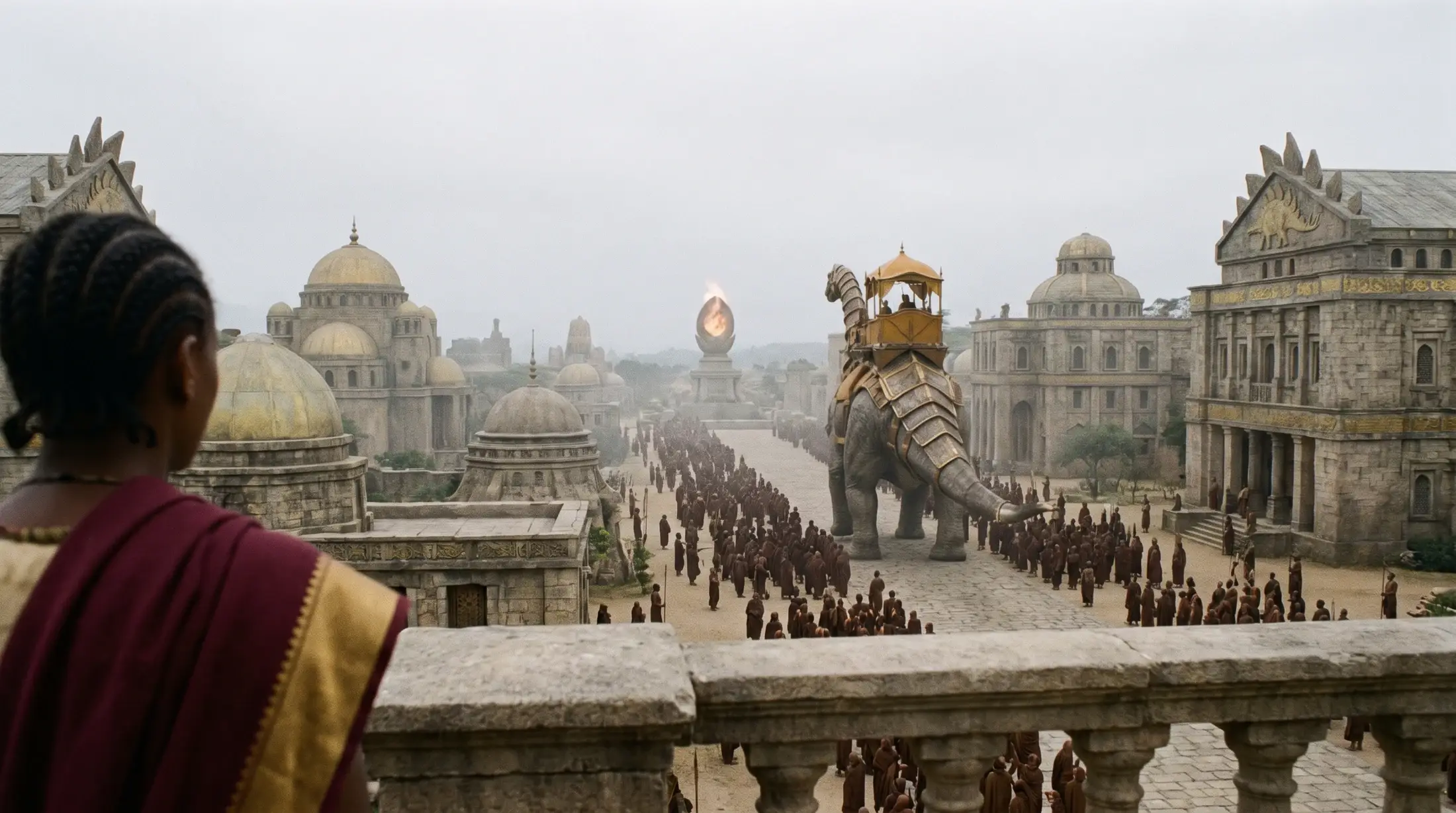
Turning circles, convoy yards and harness yards
To turn, a sauropod needs a circle. Urnok’s turning circles are round squares with a rough floor marked by grooves and mooring rings, around which convoy yards, harness yards and colonnades are arranged.
Circles for turning
A city of colossi must first bear and turn living masses. Its floors are ribbed slabs laid with flexible joints; its corridors are wide and follow turning curves. At every great crossing, a turning circle, a round square floored with rough marble, lets a sauropod pivot. Mooring rings line the track; traction grooves and coloured mineral marks of ochre, iron or verdigris guide the convoys.
These squares owe their beauty to their geometry. During the Procession of the Colossi, the animals pivot there to cheers, and their handlers salute from the harnesses.
Convoy yards
Around the circles open the convoy yards, immense courts lined with tiers, which serve both for spectacle and for control. In the capital and the duchy of Calaron, these circles follow one another in convoy rings: roads there become orbits, the ground bears grooves, and troughs and tax bollards mark the route. Circular frescoes on the ground record roads, weights, taxes and calendars; orientation needles mark winds, seasons and flows.
Harness yards
Harness yards are low cathedrals of timber and bone, holding winch frames, monumental yokes and leather and studding workshops. Straps are fitted there, frames repaired, animals prepared before departure; in everyday life they extend the religion of the harness team celebrated by the harness cathedrals.
Colonnades and orders of constraint
Around the turning squares, Urnok stretches and thickens the colonnade. Columns are ribbed and cut with grooves through which straps pass; they come in pairs, linked by low arches, to carry galleries and walkways, and their spacing lets necks and flanks through rather than people. Steps give way to gently ramped porticoes, with waiting landings for convoys. Pediments show sky charts and animal silhouettes; the paving of the squares is engraved with deep gutters.
Statuary there is abstract: balances, weights, knots and pulleys, tool-ideas saying that Urnok’s thought is a logistics. These colonnades serve seal houses, markets, schools and places of parade and public announcement.
The size of a turning circle
A turning circle is sized for the largest beast it must take. To pivot without its tail sweeping the edge, a sauropod needs a circle a little wider than its own length; the capital’s circles, built for the Crown’s ultrasaurs and dreadnoughtus, are therefore about a hundred paces across. Hadrosaur circles, in market quarters and relay yards, are four times smaller.
Each circle has its class carved on the entrance marker, with the list of beasts admitted. A driver who takes too long an animal into too narrow a circle commits an offence entered in the register, even if nothing happens; if there is an accident, he answers for it, not the city.
Turning a colossus
At the centre of each circle stands a pivot stone, low and round, on which the manoeuvre guide takes his place. From there he sees the animal’s head, flank and tail, and directs the movement by voice and with a raised staff. The driver, on the neck or at the shoulder, follows his signals: a few steps, a halt, another quarter turn. A coloured ring painted on the ground marks the line the tail must not cross, and people stay behind a second, more distant line as long as the beast is turning.
A full manoeuvre takes time, and convoys follow one another. At busy hours the manoeuvre guides take turns every two hours, because a moment’s inattention is enough to put a tail weighing several tonnes where a stall should never have been.
Life at the edge of the circle
Between manoeuvres, the circles are squares like any other. Traders set up on the edge terraces and fold their stalls at the sound of the bell announcing a convoy; tax scribes keep counters there, since every convoy passes through; children count tails and bet on which beast will turn fastest. On festival days the terraces fill up like those of an arena.
The circle has also given the language an expression. In the capital, “turning round” does not mean that all is well in general, but that a matter is following exactly the planned order, step by step, without anyone needing to shout.