

Armies
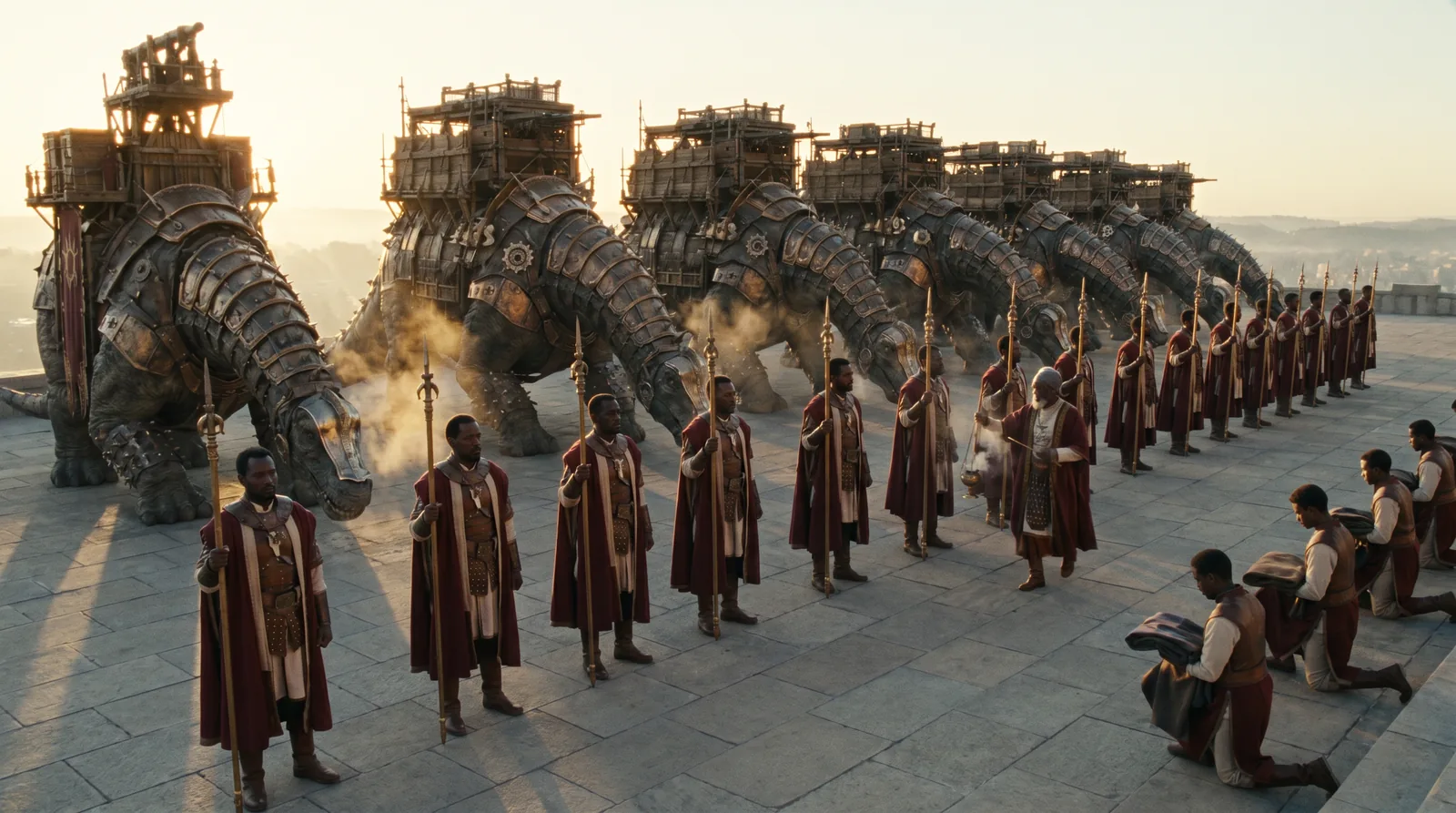
The forces of Urnok
Roads, fodder, siege and responsibility: imperial power moves through its networks.
Logistical depth
Urnok combines siege warfare, administration and sauropods. A campaign road also requires relay stations, grain reserves and harness trades. Its seven hundred public titans represent a national capacity; they are not seven hundred mounts available in one place.
Arcades de pierre et enceinte de rassemblement
Vue de détail.
Regional forces
The duchies contribute through distinct supply chains. Velmor uses dark iguanodons and hadrosaurs, archers, ballistae and sauropods; imperial stegosaurids belong to Orlantis. The geography of fodder, stone and timber matters as much as a unit’s prestige.
The road must hold
Slabs, drainage, rotation and rest keep a heavy road usable. A great animal also needs water, care, human shelters and clearance. A broken road or a relay without fodder reduces mobility before fighting begins.
Winning through continuity and depth
Urnok’s doctrine seeks to win through continuity and depth. Its sword brings together breakthrough great animals, the Diplodocus and heavy hadrosaurs; its shield, pikes, deep formations, roads and reserves. Its advantage is to build the battlefield and to be able to start again after a failure: replacements, siegecraft, strategic mobility and finance sustain a composite army and redundant convoys. For Urnok, the road is a military unit.
Its weaknesses are the reverse of this strength: dependence on systems and load-bearing axes, political slowness, overloaded roads, vulnerability once predators close in. The general rule of war applies here more than anywhere: no size fights alone, and a titan without a human screen can be attacked from every side once it breaks through.
Seven hundred great living animals
The public inventory counts seven hundred great living animals, the largest force in the known world. They belong to the Crown, the imperial orders and ducal requisitions; the share held directly by the centre varies from twenty to fifty per cent depending on the period, and only an existential war justifies mobilising them all. Legally, every military titan belongs to the Crown, and its carcass — bones, tendons, plates, teeth, harness and the secrets of its lineage — returns to the Crown after its death.
Au milieu de la mêlée, la queue d’un sauropode balaie la ligne ennemie derrière des fantassins urnokiens.
A great living animal can serve forty or fifty years in the same unit. The soldiers know its name, its scars, its campaigns and the way it turns; its loss takes with it a crew, workshops, a lineage and decades of training.
Orders and ducal forces
The great animals serve in specialised orders and branches. The Order of the Diplodocus, founded by Marjory and nicknamed the Ivory Whips by the people, holds exclusion zones, breaks formations and can form a living wall; Tigist is its captain of the mass handlers. The Imperial Order of Orûs is a separate heavy guard. The Tours-Portantes carry command, archers and ballistae; the breakthrough corps push; the Porte-Ponts make crossings; the Silos-Vivants carry water, grain, medicine and ammunition; the Engrenages Vivants repair on the march.
The duchies bring their own branches. Velmor, the only archduchy, fields black iguanodons and hadrosaurs, archers, ballistae and sauropods, and holds a right of private war through the Oath of Velmor. Orlantis supplies the Empire’s only stegosaurids: Stegosaurus, Dacentrurus and Kentrosaurus. Imperial Qor Zaï holds the march facing Arkhan with its ducal contingents and a few legal raptors.
The Three Seats
The Generalissimo commands the Grande Ost. The two deputies, fully briefed, hold the second and third Seats: if the first falls, the second takes the place at once, without a vote. During action, the great generals cannot formally overturn an order of the Generalissimo, and the master of a great living animal may report a risk but may not refuse an order that is maintained. In imperial military culture, the supreme fault remains defeat: correct procedure does not excuse a commander who loses. Marjory became Generalissimo at twenty-one through this succession, for the Three Waves.
The combined-arms legion
The basic unit of the imperial army is the legion. It is not a type of soldier but an administrative and tactical structure, which can bring together heavy and light infantry, archers, cavalry, artillery, engineers, signals and animals; two legions of the same size may share almost nothing in their composition. A combined-arms legion numbers four to eight thousand fighters under a legion general; several legions form an army, and several armies a front.
Here are the corps that make the Empire’s reputation. The Crown Legion, heavy infantry with tall shields emblazoned with the Ultrasaur, recruited among average graduates of the Synod and veterans of the roads, advances at the slow pace of a convoy; its virtue is not to move. The Silo Pikemen, guardians of Sarnor’s granaries trained to stop a panicked animal before it tramples the harvest, set their pikes against the enemy’s great beasts, under the motto “A silo is worth a dragon”. The Calaron Skirmishers, raised in the capital’s lower quarters, harass and hold ground; they are called “the first paving stone of the road”.
The imperial crossbowmen, a technical corps trained by the Synod, calculate their shots the way one calibrates a fodder post. The iguanodon scouts are the army’s eye, and the hadrosaur cavalry, mounted on farm animals retrained for battle, its manoeuvring fist. Finally the ballistae, strung with sauropod-tendon cables on frames of Orlantis wood, are the Empire’s calculated death, provided the infantry protects them.
Fighting around the very large
A great living beast in battle is surrounded by men. The under-guards, armed with short lances, protect its feet, its handlers and its straps in the zone around it, where a nimble enemy could cut a harness or injure a tendon. Against raptor packs the legions use lead-weighted rope nets, thrown by two men at the hocks, and long-shafted bronze hooks that are slipped behind the animal’s knee before pulling. The great Silo pike, six metres long, with an ancestral-wood shaft bound with tendon, serves to turn aside a charging great beast, not to stop it.
The Urnok archer draws a composite bow of wood, bone and hadrosaur tendon, made by the thousand and effective from a hundred and twenty to a hundred and eighty metres. Legionaries wear lamellar armour of bone plates sewn onto leather; those who take the second charge, the hardest, wear elite armour of sauropod leather lined with plates. All this equipment is standardised: a lost piece is replaced by another, made in a different workshop at the far end of the Empire.
An army without wings
The Empire has no flying force. It uses pterosaurs to carry dispatches between the towers of its relays, but none to fight, and its armies remain exposed to Ishtir’s pteranodons and to anything that comes from the sky. The imperial answer lies on the ground. Along threatened coasts and roads, batteries of ballistae and masts strung with weighted nets guard whole sectors; on campaign the Bearing Towers lift archers and scorpions some twelve metres off the ground, on the backs of brachiosaurs, to shoot upward.
This weakness weighs on the whole doctrine. An Urnok army avoids stretching out along open roads, shelters its depots and seeks allies when it must face an enemy who masters the sky. Imperial generals put it bluntly: you do not win against wings; you make them useless by holding the ground they fly over.
What a Grand Host weighs
A Grand Host brings together imperial and ducal forces under the command of the Generalissimo. At the Three Waves, the great battle of the previous generation, Marjory’s army numbered about a hundred and sixty thousand fighters, and each of its wings, thirty to forty thousand strong, was a battle within the battle. Such an army gathers twenty to thirty senior commanders, between the Seats, the great wing generals and the army generals, and hundreds of captains who fight the real battle.
On the scale of imperial history these figures remain exceptional. Most of Urnok’s wars are fought at the level of a ducal campaign or a march, with a few legions, local contingents and a handful of great living beasts. Assembling a Grand Host takes months: the roads must be filled with fodder before soldiers are put on them.
Part of this article covers events of season 1. Turn spoilers on in the menu to read it.
Gallery1 image
A general-councillor in parade armour.