
Places and landscapes
Velasar
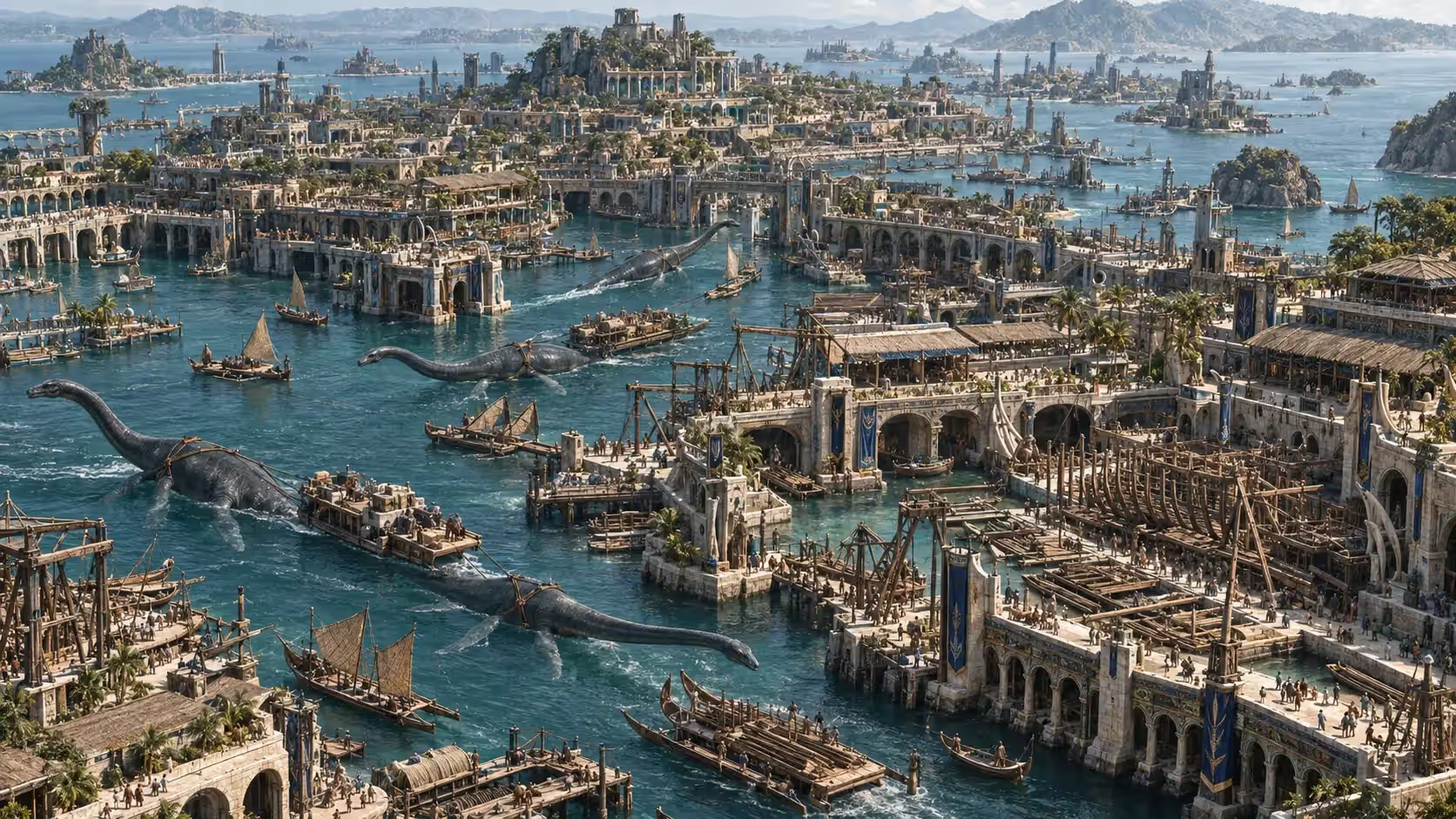
Volonia’s arsenal city: Great Hulls, shipyards, arsenals and plesiosaur breeding, at the heart of the trust-house that bears its name.
The arsenal city
Velasar is Volonia’s arsenal city, specialised in building the Great Hulls, fleet equipment and the upkeep of draught animals. Its large workplaces give it a massive, industrial character, distinct from the fashion districts and entertainment venues of the other ports. Its architecture is heavier and more metallic, less glamorous, and bears the mark of Orlantis.
Basins, quays and draught animals
Basins and quays must let through bulky hulls, laden barges and plesiosaur teams. Floating cages, harnesses and animal resting places have their place there; traction masters work with carpenters to move parts without mixing human and animal lanes. Repairs keep work going long after a ship is launched.
The arsenals gather timber, resins, rope, metal and weapon parts. Industrial breeding grounds prepare animals for towing, the open sea and specialised work. Velasar is one of the rare ports where a bastion ring — deep basin, separate channels, breakwaters and high refuges — may protect an arsenal; that arrangement remains an exception, never the plan of a whole city.
The trust-house
In Velasar, family, arsenals and city are tightly bound together. The Velasar trust-house runs the country’s leading private shipbuilding power and ranks among the five largest private enterprises of the known world; its traditions go back at least two thousand five hundred years. It brings together Great Hulls, arsenals, ocean fishing, industrial plesiosaur breeding and foreign orders, and its carpentry traditions extend those of Orlantis’s timber and construction.
What the arsenal depends on
The arsenal is not self-sufficient. The forests of Orlantis supply timber, resins, rope, varnish and fibres. Korath supplies metals, reinforcements and machines, and Korathi engineers work in Velasar itself. N’Goro sells glues, enzymes and anti-rot treatments that stabilise leathers, sinews and binders. Velasar builds for the fleets, for fishing and for foreign orders; a finished hull depends on the workshops for its whole life.
Places and place names
The arsenals of Velasar count named places, among them the Doubles-Carènes and the Cages de Velasar.
An island arsenal city
Velasar does not touch the continent. The arsenal city occupies a large island north of Port Volon and its surroundings; its most indented coast, that of the Doubles-Carènes, offers deep roadsteads where the largest hulls can anchor. A neighbouring island, covered in timber forest, supplies keel wood; another, the Forge Island, houses the forges where nails, rivets, chains and anchors are made from metal imported from Korath.
More than a third of Velasar’s workers are employed in the shipyards, refit docks, ropewalks, sail lofts and sawmills, and a notable share in the forges and mechanical workshops. The city lives to the sound of mallets, saws and the bells that mark the shift changes. The workers’ districts, packed around the slipways, house carpenters, smiths, masters of traction and a community of Korathi engineers settled there for generations, with its own workshops and its own customs.
The dry dock of the Great Hulls
The heart of the arsenal is the great dry dock, closed by watertight gates and long enough to take the largest hull ever launched, some hundred and fifty metres long. It is there that the multiple keels of the Great Hulls are assembled: a keel of this kind takes three seasons of work in the dock before the frames can be fixed to it. The articulated sections, the watertight compartments and the Korathi reinforcements come next, piece by piece.
Volonia’s giant ships must satisfy the insurers as much as the admirals. To cover such a vessel, the great insurance houses require a Korathi certification of its mechanisms: winches, articulated rudders, handling pulleys and war engines are checked by engineers from Korath before the launch. On the day a Great Hull leaves the dock, the whole city comes down to the quays, and the draught plesiosaurs take it out to the roadstead under the bells.
The marine stud
Velasar does not breed only hulls. On the coast of the Doubles-Carènes, closed basins form the plesiosaurs’ marine stud: young draught, construction and fishing animals are born, fed and trained there. The stud’s registers follow each lineage, its matings, its births and its working qualities, and a plesiosaur of good lineage sells for more than an average hull.
Training takes years. The young first learn to accept the side harness, then to pull in a team, to take turns, to answer the master of traction’s signals and to stay calm near hulls and quays. Construction animals learn to hold a cable still while a piece is fixed; fishing animals, to herd a shoal without scattering it. Velasar’s masters say a plesiosaur is trained by ear as much as by hand: every team knows its master’s voice.
The Lamier, the only land beast
Volonia raises almost no large land beasts, but Velasar makes an exception. The Lamier of Velasar, a great herbivore with long arms ending in scythe-shaped claws, is bred and trained in wooded enclosures north of the arsenal, where it feeds on foliage and fruit. There are only a few dozen of them. Its claws are fitted with blade extensions forged in Korath, its harness carries an insurance policy sewn into the leather, and it marches into battle under the banner of the Calystrëa companies.
The Lamier does not pursue: it guards. Planted in a corridor, it cuts into every charge before it arrives, while pikemen and crossbowmen cover its flanks, which it does not protect. It is the only piece that allows Volonia to hold a passage on dry land, far from its sea beasts; it remains outclassed by the greatest living giants of the other powers, and no Volonian officer commits it alone.