

Places and landscapes
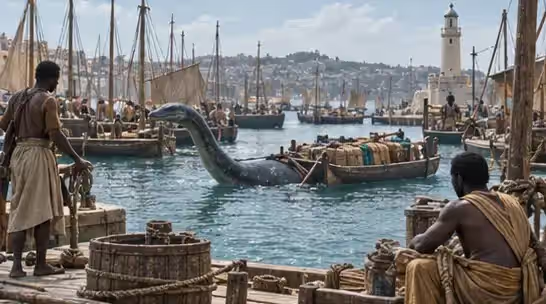
The Bay of a Thousand Masts
A great anchorage where convoys meet and the market can float.
The fleet forms a meeting place
The Bay of a Thousand Masts is a great anchorage, floating market and gathering place for Houses and convoys. The bay becomes a collective place through hulls and platforms meeting there, to the rhythm of arrivals and departures.
The channel is also a rhythm
Volonian routes change with season, current, cargo and draught animal. At anchor as on a journey, people, boats, Great Hulls, swimmers and plesiosaurs require distinct circulation. An arrival is also measured in tide and breath: proximity between two craft does not make their movements interchangeable.
Furniture follows the movement of water
Volonian material culture provides lockable tables, fixed benches, watertight chests, lockers, hooks and baskets protecting jars. In a floating market, this fastening gives objects positions that withstand moving water. It makes everyday exchange possible without assuming a perfectly still surface.
The floating market and the floating auction
At the heart of the bay, the floating market fills a maze of pontoons and platforms moored between the hulls. Everything a convoy can buy or sell before setting out again is traded there: whole cargoes or lots, shipboard animals, provisions, ropes, sails, repairs, places in a convoy. Platforms are rented by the season; merchants put up awnings, fix their lockable tables and hang their painted signs there.
The Exchange of Great Catches holds a floating auction there, where part of the fishing catches and of the materials brought up from the depths are sold when the Pêcheurs du Grand Océan return. Buyers move from one platform to another by boat or along movable gangways, and the price of the day is called out by criers standing on buoy-platforms. The auction breaks up at the next tide, and its pontoons are moved to wherever the hulls have gathered.
Forming a convoy
The bay is first of all the place where convoys are formed. Ships from several houses gather there before the great routes: policies are signed, escorts assigned, and the route pilot who will lead the whole is chosen, along with the hulls’ order of march. A convoy may wait several days for the window to open; its crews then live at anchor, between their ships and the market pontoons.
The convoy escorts and the Frégates d’Écume present themselves there to the captains they will protect, and the masters of traction compare their plesiosaur teams to decide who will tow in a flat calm. In wartime the bay changes its use: the houses’ fleets join their flags there after the Gathering, and the Admiralty of the United Fleets reviews its ships there before departure.
Rum, barges and nights at anchor
Thousands of waiting sailors keep an economy of waiting alive. Restaurant barges, towed by small ferry hadrosaurs, move between the ships serving grilled fish, crab stews and rum; floating taverns, gaming barges where sebi is played and raft theatres moor along the edges of the anchorage. A rum house has set up its cellars in the bay itself: there it turns the molasses of the Souths into rum, for the crews’ pay as for the palaces.
Night workers, musicians, sellers of fresh water and barbers go from hull to hull. Crews paid on departure often spend their advance before they have even weighed anchor, and the bay’s moneylenders know it: borrowing is easy there, at a heavier “salt” than at the Great Counting House.
Keeping order in a floating town
The bay has no walls, but it has a harbour master. His clerks allot the anchorages, numbered by buoys, keep the register of hulls present and collect the mooring dues. A port police, mounted on basin-bred marine reptiles, enforces the passage channels and separates crews that come to blows.
The main danger is fire. In a forest of tarred masts, a single burning hull can set twenty alight. After nightfall only closed lanterns are allowed; no cooking is done over an open flame outside the licensed barges, and watchmen go round by boat to make sure. A captain whose ship caught fire through negligence answers before the Merchants’ Court for every neighbouring hull that was damaged.