

Families and social ties
House Calaris
Protocol, arenas and seals: an imperial function at the heart of Calaron.
A name attached to a function
Calaris belongs to the Houses of Calaron entrusted with an imperial function. Its remit combines protocol, arenas and seals. This position distinguishes the House from production Lines: the same city houses those responsible for public recognition and those supplying the materials that recognition requires. The imperial centre thus brings together ceremonial functions, registry work and service trades.
A seal has a material basis
Egg paper, ink and the register form Calaron’s material foundation. The seals of Calaris belong to this world of scribes and manufactured supports. A visible act depends on work that comes before it: preparing material, writing and preserving. The prestigious functions of the centre remain connected to supplies and hands for which Lines bear responsibility.
Three Houses, three responsibilities
Calaris shares Calaron’s institutional landscape with Tewolde-Baran, associated with civil records, and Qoré-Mirhan, associated with the chancery. Protocol, the registration of people and administrative work therefore have distinct names. This division makes the centre more extensive than a court alone: the Empire must also preserve the records through which people, acts and functions can be recognised.
A court house
Calaris is an ancient ceremonial house of the imperial heart, about two thousand nine hundred years old. It keeps protocols, seals, arenas, coronation archives and the forms of legitimacy; its ceremonial hadrosaurs belong to this function. It does not have the mass of a duchy, but it can make a power visible or illegitimate.
The House often survives changes of dynasty, because it serves the throne rather than any particular family. Olyra Calaris, high provost, is its head; Nemer Calaris is master of the arenas. Its name carries the layer of the centre, with a hard C.
The coronation archives
House Calaris is older than the dynasty it serves: about two thousand nine hundred years, against two thousand four hundred for the Vael-Orûn, who have held the Crown for only three generations. It has therefore kept the protocol of several successive imperial families, and its coronation archives preserve the course of every crowning it has overseen: the order of the procession, the place of each duke, the words spoken, the animals that opened the march, the witnesses present.
These volumes are not keepsakes. They serve as model and as proof. A coronation must follow forms, and it is for the Calaris to say whether they were respected; a ceremony that departs from them can be challenged by a House that also challenges its outcome. The archives are kept in closed halls of the House, at the heart of the capital, and are opened only in the presence of the high provost or her heir, Veyr Calaris. Precedents are also consulted there when the Grand College must confirm an heir or settle a succession crisis.
The arenas of the capital
Nemer Calaris, master of the arenas, keeps the calendar and the rules of Urnok’s imperial arena, which can hold between fifty and eighty thousand spectators, and of the capital’s smaller arenas. A common seat costs about twelve hundredths of a Draco; the upper tiers are reserved for the Houses, the orders and foreign delegations, according to a plan the House sets and nobody changes without it.
Hadrosaur races, displays of training, parades of units returning from campaign and the Empire’s great festivals are held there. Imperial justice also carries out its heaviest sentences there, before the crowd, because a public penalty must be seen. The protocol of these days is the same for festival and for punishment: every entrance, every animal, every silence is settled in advance. The Calaris also hold the Fort of Calaris, the duchy’s fortress named after them, which houses part of the Guard and the crews of the arena animals.
The ceremonial hadrosaurs
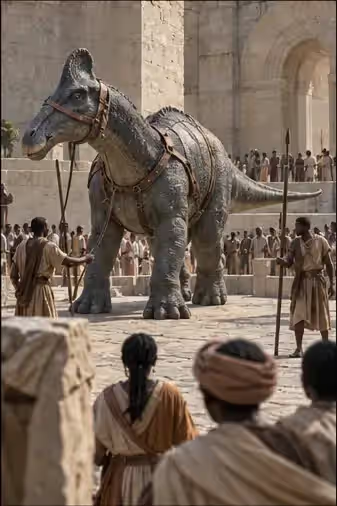
The House’s emblematic animal is the ceremonial hadrosaur. In their own enclosures the Calaris breed great-crested lambeosaurs, chosen generation after generation for their calm amid crowds, the clean colour of their hide and the reach of their call. The hollow crest of these animals resonates like a horn: a call sounded at the end of an avenue can be heard as far as the palace.
That call opens ceremonies. At coronations, state funerals and the opening of the College’s great sessions, two or four of the House’s hadrosaurs walk at the head, harnessed in pale leather and matt gold, and their call marks each stage. These animals never go to war: the army has its own rallying lambeosaurs, whose crests relay orders along the battle line. The House’s keepers are thought the most patient in the capital, and it is said a Calaris hadrosaur can stand still a whole morning without moving its head.