

Economy
Bralnor: from block to structure
Quarries, counterweights, winches and heavy haulage give stone its route.
The duchy of the block
Bralnor is the duchy of quarries, blocks, heavy stone and uplands. Its Lines include quarrying, counterweight, winch, heavy-haulage and stone-dust chains. The families holding them remain anonymous. The material already has a working chain without a dynasty ruling every stage.
The load needs support
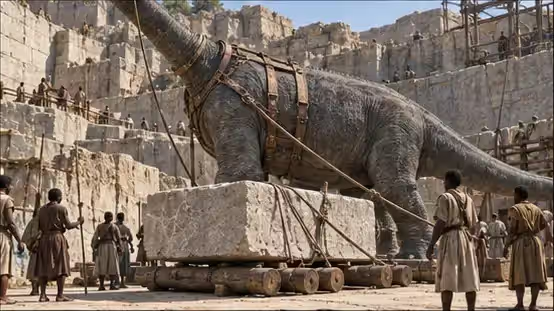
Tackles, capstans, counterweights and winches are common equipment. Sauropods support imperial construction and transport, but do not design structures instead of humans. A quarry therefore requires lifting points, supports, attachments and movement space as much as the spectacular presence of an animal.
Stone depends on other materials
From quarry face to sledge
A Bralnor quarry is opened in faces, vertical walls the quarrymen attack from the top. They mark out the block, cut its channels with bronze picks and cutting powder, then drive in wooden wedges that they soak so that the swelling splits the stone free. The freed block is lifted by winch and counterweight or, when too heavy, by a quarry brachiosaur able to lift what a hundred men could not move. It is then set on a sledge at the heavy haulage yard, from which trains drawn by draught diplodocuses and hadrosaurs leave for Calaron and Sarnor.
The quarry yields far more than blocks: veined marble, noble limestone, basalt, gravel for road beds, and gizzard stones that sauropods all over the Empire swallow to digest. The spoil is sorted, and even the garnets with which scribes adorn their rings are picked out of it.
The counterweight hall
Bralnor supplies the Empire with an invisible material: measured weight. In the counterweight hall, basalt blocks are cut, weighed against the master weight and engraved with their mass: half-tonne ballasts for cranes and fodder hoists, five-tonne counterweights for lifting towers and siege engines. A counterweight engraved in Bralnor is accepted without reweighing on every worksite in the Empire.
These stones also go to war. The Crown’s counterweight towers, carried in pieces by sauropod trains, make it possible to run a siege to a planned timetable, and the imperial corps in charge of siege engines draws its ballast from the hall. In Bralnor they say a siege is first won in the hall, at the scales.
The quarry road
Stone leaves the duchy by the quarry road, a load-bearing road with slabs designed against crushing, leading to Calaron and Sarnor. It is one of the heaviest roads in the Empire: brachiosaurs carry massive stone, marble and limestone along it, and Karûm-Brakh runs its worksites under the Chancellery’s control. Its dangers are well known: the roadway collapsing under loads, winter freezing the passages, and the tribes of the wild North attacking isolated convoys.
At the great stages convoy masters have the sledges’ fastenings and runners checked, and the marker-stone setters note the stretches that are sinking. A closed quarry road is soon felt in the capital: worksites stop, stonecutters wait, and walls under repair stay open.
The Empire’s stone
Bralnor stone can be recognised everywhere. Noble limestone gave the last generation of cathedral silos their walls pierced with air ducts; basalt makes millstones, paving stones and counterweights; veined marble faces the capital’s palaces and is used for the brachiosaur statuettes sold to visitors. The forts of the marches and the walls of the towns are built of it, and their stones often carry the mark of their quarry of origin.
The people of Bralnor take a dry pride in this. They complain about their winters, their roads and the price of the fodder that has to be brought up for their great animals, but they like to point out that no road in the Empire holds without their gravel.