

People
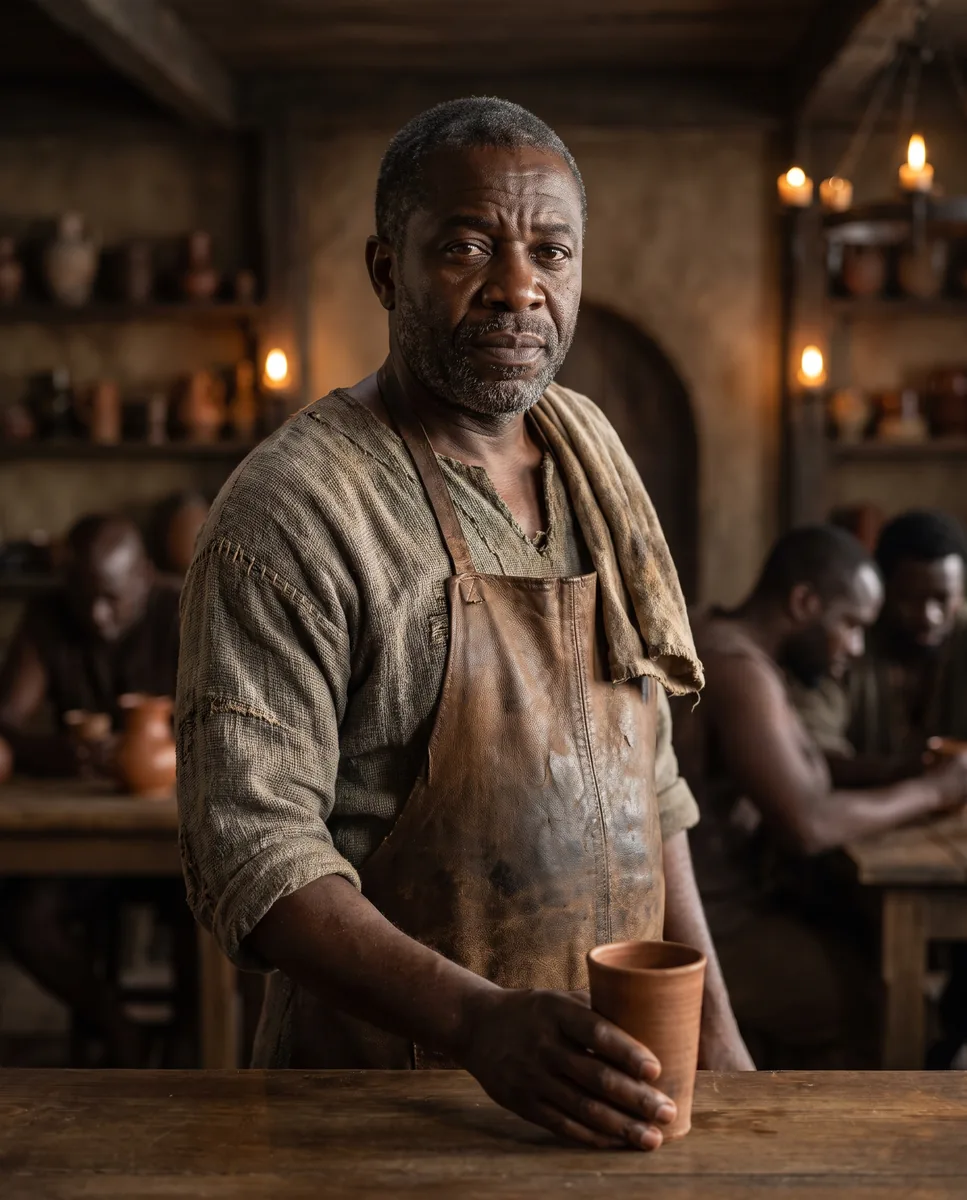
Mako Bel-Teren
Keeper of the Croc Fendu, where trades, prices and ordinary lives meet.
The Croc Fendu
Mako keeps the Croc Fendu, a tavern through which soldiers, clerks and merchants pass. The room gives the Empire a human scale: distant decisions are heard as fatigue, expenses and conversations. Keeping it requires serving, listening and accommodating the people who return.
A discreet memory
He has a considerable memory but often presents himself as a man who has seen nothing. This declared forgetfulness is a way of protecting the peace of his room. It does not make every customer a spy or every conversation an affair of state.
The price of daily life
What is said at the Croc Fendu
Soldiers, clerks, merchants and workers cross paths at the Croc Fendu; news from the port, the roads and the markets travels there with the rounds. The price of fodder matters at once to anyone who feeds an animal or lives off a convoy. Mako’s jokes make it possible to talk about the court and its decisions in the words of those who bear their costs.
The tavern also hosts Nala Vey, a healer from N’Goro who offers her remedies there. A student looks for an audience, an official for rest, a wounded man for a dose: the Empire’s life meets at table height.
Keeping a tavern in the lower city
The Croc Fendu is a low room with thick walls, at the foot of an avenue where the great animals pass. When a very large animal crosses overhead, the tankards tremble on the tables and dust falls from the beams; the regulars no longer look up. The room is lit with oil, warmed by a hearth that also serves for cooking, and furnished with long tables where one sits next to strangers.
It serves what the lower city drinks: a grain beer from Sarnor, fermented fruit wines, infusions for those going back on duty. The food is simple: stews, flatbreads, cereal porridges, meat from small farmed dinosaurs, table eggs hardened in brine, lawful and everyday even if an old shame hangs over every egg. Prices are written in chalk and change with those of fodder, which set everything else. Mako has kept the place long enough for people to say “at Mako’s” more often than the name on the sign.
Counter humour
Mako speaks in prices and jokes. His room translates geopolitics into rounds and weariness: a rise in fodder becomes a dearer tankard, a distant campaign soldiers who drink faster, a court decision a joke that makes some laugh and others fall silent. One of his lines travels beyond the neighbourhood: “A sect is ten fellows howling at the Sun. A religion is a thousand soldiers.”
These jokes have a function. They let people talk about the court and the powerful in the words of those who carry the costs, without anyone having to sign what was said. Mako chooses them according to the room: he does not tell the same joke to relay hands and to Chancellery clerks, and he keeps a few for the evenings when the tension at a table has to come down.
“I saw nothing”
Mako’s best-known line is also the most useful: “I saw nothing.” He says it to guards looking for a man, to husbands looking for a wife, to creditors looking for a debtor. In this way he erases more evidence than any spy, through a deliberate forgetting that is both his form of tenderness and his insurance.
Behind the forgetting stands a considerable memory. Mako knows who drank with whom, which soldier came back alone from a campaign, which clerk pays with money that is not his own. He does not say it. Everyone also knows his neutrality has a price and can be paid for, and that is exactly what makes it credible. With Nala Vey, the N’Goro healer who doses her remedies in his room, he forms what the neighbourhood calls the duo of forgetting and dosing: he erases, she measures.
Bouchon and the rounds
Mako makes and receives deliveries with Bouchon, a delivery hadrosaur with beer-brown hide and silent bells. In the morning the animal fetches barrels and sacks from the neighbourhood suppliers, including Zaya Meron’s fodder; in the afternoon it carries orders to nearby workshops that cannot leave their work. The neighbourhood children know it by name and know it does not bite, but does not back away either.
At closing time, Bouchon lies down in front of the door, and nobody else gets in. Mako keeps his place the way his animal keeps the entrance: by weight and habit. When he is asked to make the animal get up for one last customer, he answers that after closing he does not give orders to Bouchon, and nobody has ever tried to check whether that is true.