

Religion and rites
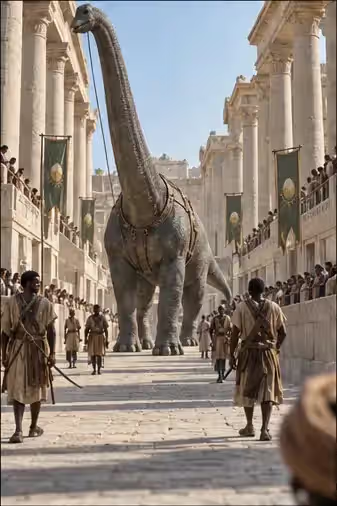
The Procession of the Colossi
A ceremonial parade of Urnok’s great working animals along a load-bearing road, watched by the whole capital.
The tread of the colossi
The Procession of the Colossi (Procession des Colosses) parades the working sauropods along a load-bearing road. Their tread makes the avenue shake; at the turning circles the animals pivot to cheers while their drivers salute from the harnesses. The whole city crowds onto the terraces, ring by ring, from the dirty districts to the clean ones. The imperial court, Orûs III and Sahina among them, watches from the balcony of the last gate.
A festival of discipline
The spectacle rests on the skills of everyday convoys. The avenue must stay passable, intervals must be kept and the sweep of the tail left clear. Residents watch the living beings on which part of imperial power depends pass by, escorted by those who know how to drive them. The procession’s grandeur depends on this discipline: it honours human cooperation as much as the animals’ mass.
The order of the procession
The procession follows an order set by the capital’s protocol. It opens with ceremonial hadrosaurs with great crests, whose call announces the start of the festival. Then come the working sauropods, grouped by duchy and by trade: quarry brachiosaurs from Bralnor still marked with the white dust of the quarry faces, Silo Dreadnoughtus from Sarnor, relay and worksite sauropods of the capital, animals of the great public works. Each group walks behind the banner of its Line or order, and the handlers are named aloud as they pass the last gate. The Crown’s great living beasts close the procession.
Orlantis parades without its emblematic animals. A stegosaurid does not cross a city, it goes around it: the rule holds on festival days too, and the Lomvar handlers walk on foot behind their banner, applauded by a crowd that knows the reason.
Preparing a procession
A procession is prepared weeks in advance. The Chancellery certifies the route: load-bearing of the paving, width of the passages, turning radii at the manoeuvring rounds. The most fragile bridges are closed, the avenue’s troughs filled, and the heavy-sanitation office posts its collection teams every hundred paces, because a column of colossi leaves tonnes of droppings behind it. The animals themselves are accustomed to crowds: they are walked in the manoeuvring rounds to the sound of shouts and drums, so that none takes fright on the day.
On the day itself the side streets are barred, the human refuges cleared and the buffer pens opened. Colossus whisperers walk beside the youngest animals. A successful procession is one that leaves no incident in the register; handlers say they remember the festivals where nothing happened better than those where a colossus took fright.
The city in rings
The whole capital wants to see the colossi go by. Families from the upper quarters rent places on the terraces, those from the lower quarters crowd onto the service ramps and along the canals, and sellers of flatbreads, candied fruit and beer push through the crowd with their baskets. Children count the animals aloud and learn their names; an old titan is recognised by its scars, and the crowd cheers it louder than the young ones.
The most awaited moment is the pivot. On a manoeuvring round packed with people, a sauropod turns slowly on the spot, its tail sweeping a circle no one may cross. Guards hold the crowd behind a line painted on the ground. When the animal has finished turning without a hitch, a great cry rises from the terraces, and the handlers wave from the harnesses.
Honouring those who carry
The procession is an act of civic religion. No god is prayed to: what is shown are the animals that carry the Empire and those who know how to drive them. Very-large animals about to leave service parade one last time, and their years of work are read out as they pass the court. At the same moment the names of the animals that died during the year are recalled, carved on the stelae raised beside the roads they used to travel.
The duchies have their own, more modest processions. In Sarnor the Silo Dreadnoughtus walk a stretch of the fodder road; in Bralnor the quarry brachiosaurs come down towards the town to the sound of bells. Everywhere the principle is the same: to let everyone see that the Empire’s power walks, eats and tires, and must be cared for.
Gallery1 image
Calaron by night: a procession of lantern-bearing sauropods.