

Families and social ties
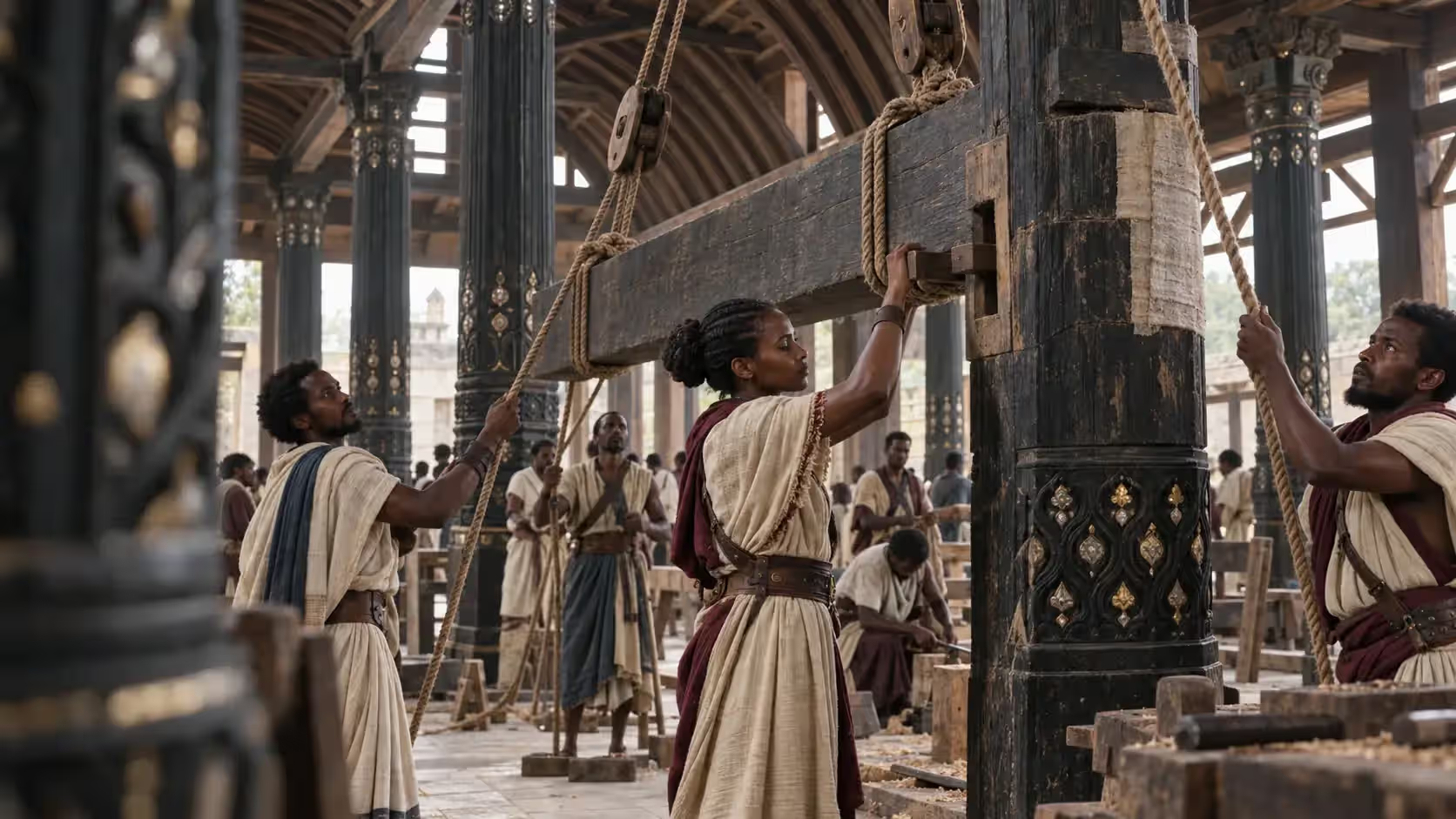
The Mirvane Line
The High Line of carpentry and construction in Orlantis: trusses, bridges, halls and scaffolds. It reads a forest in spans.
Reading a forest in spans
Mirvane holds carpentry and construction: trusses, bridges, halls and scaffolds. The Mirvane read a forest in spans. They give timber its architectural scale, and their workshops are tall because of what they assemble.
The quarter of tall spaces
In a town of Orlantis, the Mirvane quarter comes after the drying sheds, the steam rooms and the Tolmen quarter. Its tall spaces and cranes receive timber that has already passed through the upstream links: chosen by the Berlan, floated, then dried.
This position makes the Line dependent on its neighbours. What is missing from the drying sheds ends up missing from the carpenters: a riot in the drying sheds stops the carpentry three weeks later.
What holds a frame together
Choosing beams thirty years ahead
The Mirvane do not choose their timber at the yard. Their master carpenters walk the high forest with the Berlan and mark standing trees that will make the great pieces: straight trunks for posts, even-grained trees for tie-beams, curved main branches for certain bridge parts. A tree reserved for a hall truss may wait thirty years before being felled, and its mark is entered in the register like a promise.
This practice gives the Line a memory of the forest as long as the fellers’ own. A Mirvane carpenter can tell which plot a beam comes from, under which duke it was marked and which family felled it. To read a forest in spans is to see in a living tree the hall or bridge it will become, and to know how long one will have to wait for it. These promised trees also have a value as credit: a felling letter, a right to a tree the Berlan will fell in ten, twenty or thirty years, can be sold and inherited, and the duchy’s Lines fund lends against it.
Raising a truss
A great roof truss is prepared on the ground. The pieces are cut, trial-fitted, numbered and scribed, then taken apart and carried to the site. Raising is done by crane: great wooden wheels in which men walk wind the Nalen cables onto drums, and the Tolmen pulleys multiply the effort. For the heaviest pieces, a draught hadrosaur pulls the cable from a distance, guided by signals.
Raising is a moment of discipline. A raising master gives orders by voice and bone whistle, everyone knows his place, and nobody passes beneath a hanging piece. Once the truss is set and pegged, the crew fixes a green branch at its top to thank the forest it came from; the custom is so old that even Karûm-Brakh sites, hardly known for sentiment, respect it.
Building for the very large
Part of the Mirvane’s orders comes from the great animals themselves. Halls that shelter hadrosaurs and iguanodons, relay awnings, scaffolds that reach a sauropod’s back and the noble-timber platforms carried by the largest of them call for carpentry calculated for enormous, moving loads. A carried platform must be light, strong and dismountable; a care scaffold must hold men, jars and ladders across several storeys of height.
These works have made the Line’s reputation far beyond Orlantis. The orders of great animals, the Chancellery’s relays and the Empire’s building sites order Mirvane pieces, and vets such as Tesfa work on their scaffolds. In the duchy they say a carpenter who has never built for a very large animal has only ever built for men.
Carpentering war
The Empire’s wars consume carpentry. The temporary bridges that let a column cross a river, a camp’s palisades, watchtowers, siege scaffolds and the noble-timber frames of the imperial ballistae come in part from Mirvane workshops or their methods. The Line’s crews know how to prepare standard, numbered pieces that soldiers can assemble far from Orlantis from a simple plan.
On campaign, the Mirvane sometimes send master carpenters with the armies, to raise a bridge or repair a platform. Their site rule remains that of the town: nothing is raised that has not been fitted on the ground. Hurried officers find it slow, engineers have adopted it, and the bridges that respect it hold.