

Creatures
Volonia — Le vivant, des soins aux manœuvres
Observer les anatomies, entrer dans les enclos, suivre les équipes de soin puis les retrouver sur le terrain d’exercice : ces scènes rapprochent le bestiaire de la vie des civilisations.
Enclos, soins et circulation
This extended reading is currently available in French.
Le soin des vivants aquatiques engage les bassins, les viviers, les accès aux ports et les seuils sanitaires. Un animal peut être présent sans être prêt à circuler ou à coopérer. Les équipes doivent distinguer les besoins du vivant des contraintes d’un départ, d’une réception ou d’une activité de chantier. Les quarantaines et les métiers portuaires donnent une épaisseur quotidienne à la puissance maritime de Volonia.
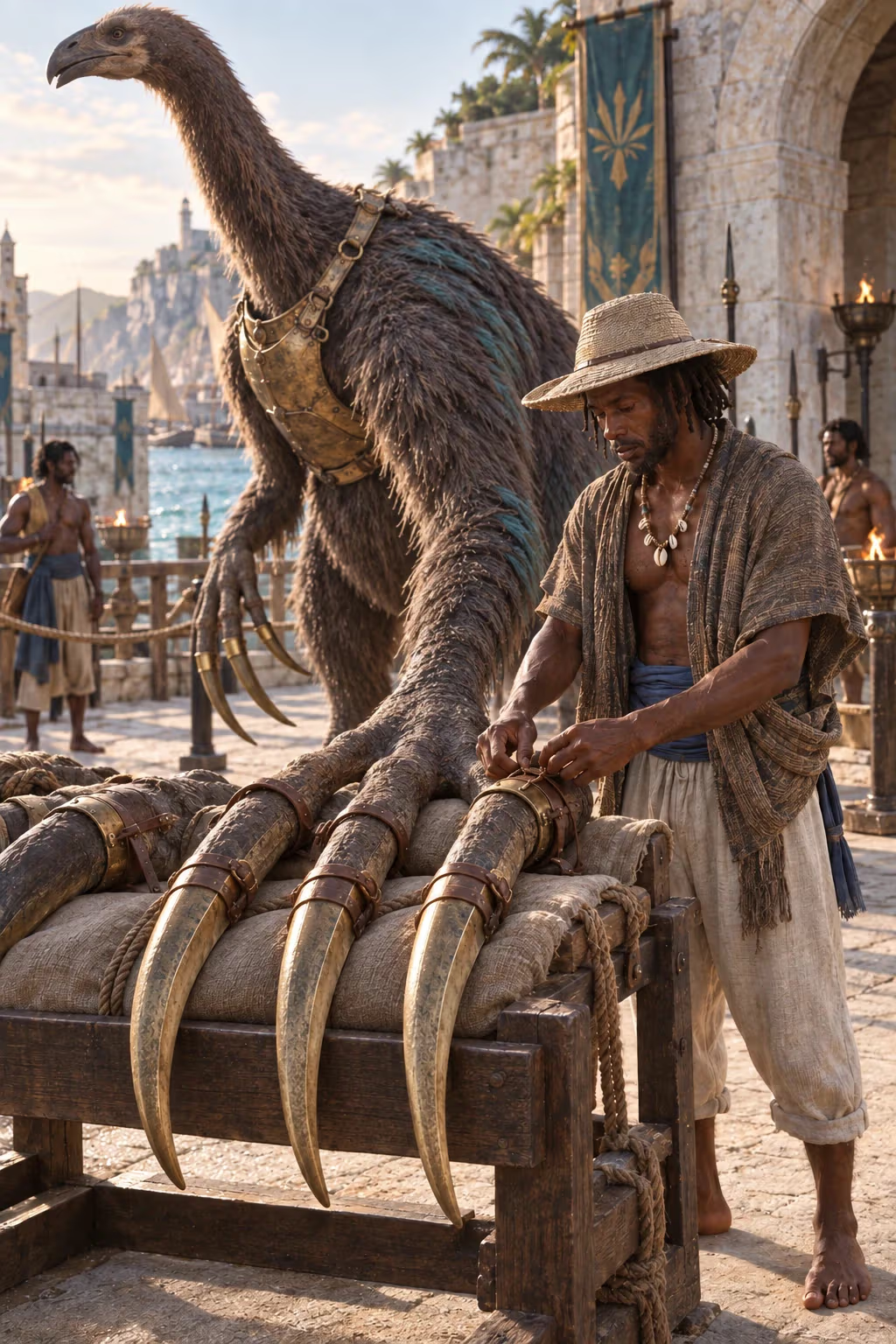
Le détail du vivant se découvre dans les gestes ordinaires : un harnais ajusté, un dégagement vérifié, un troupeau orienté.
L’animal au milieu des hommes
L’exercice donne à voir les distances entre formations, les signaux et les zones de rotation. Certains animaux travaillent avec une unité ; la faune sauvage croisée à l’exercice n’en est pas domestiquée pour autant.
The civilisation’s working animal
The plesiosaur tows, builds, fishes, rescues and transports. It also participates in racing and coastal warfare. These uses connect the same animal to port labour, commerce and popular entertainment.
Around the trunk
Heavy variants carry two platforms near the trunk for archers or light ballistae. Animal use belongs to a system of harnesses, hulls and trades. Productive capacity explains the plesiosaur’s daily importance in maritime society.
A port adapted to living animals
Lagoon terraces separate fresh, brackish and salt water, waste and animal basins. Ramps, high or movable bridges, drained floors and hanging harnesses facilitate service. A working marine reptile depends on this coastal infrastructure as much as on a crew.
Ports, basins and maritime rescue
Separate waters and uses
Ports organise service basins, ramps, quays and equipment spaces. Separating waters limits conflicts among circulation, work, rest and rescue. It also makes it possible to approach an animal or hull without putting an entire harbour at risk.
Ports, basins and maritime rescue
Marine harnessing is quay work
Towing or rescue depends on checked lines, protected fastenings and people able to read tension. Harnessing is a point of contact between hull, animal, water and the human body. Its maintenance conditions port use as much as a vessel’s condition.
Ports, basins and maritime rescue
Rescue belongs to infrastructure
The same installations serve transport, towing and rescue. Rescue rests on ramps, accessible basins, teams and recovery procedures. A port network must shift state without losing essential access.
Quarantine: deciding what may touch land
Distance is a practice
Quarantine maintains a distance between an arrival and the bodies, basins or animals that might suffer its consequences. It requires a place to wait, people authorised to observe and a stated decision. It does not promise absence of risk; it makes risk visible before it is shared.
Quarantine: deciding what may touch land
A departure must be explainable
Inspection, waiting and resumption of travel produce a chain of responsibility. Cargo, a living creature or a crew do not become safe by declaration. People authorising a movement must be able to state which condition was observed and what remained uncertain at departure.
Volonia : santé et passage portuaire
Entrer dans un port prend du temps
La quarantaine organise des zones fermées, des protocoles, des praticiens et une surveillance adaptée aux importations vivantes. Elle ne sert pas de décor pour rendre un port inquiétant : elle décide quand un humain, un animal ou une cargaison peut rejoindre des activités déjà vulnérables.
Volonia : santé et passage portuaire
La protection est une charge commune
À Vaesh, la sécurité portuaire repose sur des ressources partagées et sur des personnes capables de tenir une fermeture. L’eau, l’attente, l’inspection et le nettoyage organisent le passage des humains, des animaux et des cargaisons.
Volonia : santé et passage portuaire
Un contrôle ne remplace pas le soin
Cages sanitaires, inspection et isolement ne suffisent pas sans nettoyage, observation et continuité des équipes. Vaesh organise une fonction publique de soin, de nettoyage, d’observation et de reprise de circulation. La relation avec N’Goro reste celle d’une expertise biologique soumise au contrôle de passage.
Keeping living stock near the dock
Holding ponds, fishing waste and marine flesh enter animal feeding. These uses give the port a food reserve and maintenance role beyond landing cargo. They do not make a universal diet for every marine species.
The plesiosaur has a chain
Velasar has plesiosaur breeding facilities in Volonia. The plesiosaur serves construction, fishing, rescue, transport and towing. These uses require selection and maintenance; a civilian animal does not become a strategic mosasaur merely by occupying a large basin.
Different waters for different uses
Lagoon terraces separate fresh, brackish and salt water from waste and animal basins. Human channels, boats and great animals are not interchangeable. A holding pond belongs to this service organisation: access, circulation and neighbours matter as much as its apparent size.
A morning at the care basin
A morning at the care basin begins before the first relay. The keepers bring the animals back from campaign out of the water one after another; on the quay at water level they examine the harness attachments, the skin under the straps, the flippers and the mouth. One keeper records every wound in the basin register, another prepares the ointments of oil and salt.
Injured animals move to the resting basin; the others take their ration again and wait for the next team. A visitor who watches this inspection mostly sees slow movements, low voices and a great deal of waiting: nobody hurries a six-tonne animal coming out of the water.
A day of drill
On drill days the roadstead changes its face. Double-Fins rehearse their runs along a line of buoys, platforms crowded with archers shooting at target rafts; foam riders set off ahead, come back with a dispatch, set off again; Sénelles are released from the masts and recalled by whistle.
Traction masters rehearse the casting off and taking up of teams, which save a hull in battle, and the basin keepers count the animals at every return. Everything stops when an animal shows signs of fatigue: on the quays people like to repeat that no drill is worth an injured animal.
Learning to look
What one learns by watching the animals of Volonia comes down to a few signs. A plesiosaur that breathes short and lets a flipper trail is tired; a hadrosaur that sets down a foot and backs away distrusts what is under it; a pterosaur that circles for a long time before landing does not like the place.
People of the quays read these signs without thinking, and they judge foreigners by the way they ignore them. A visitor who approaches a basin shouting, or reaches out towards an animal without looking at it, is soon called to order by the first keeper who passes.