

Armies
Routes, relays and supply
Infrastructure that allows a column to move without destroying bodies or territory.
A road is maintained infrastructure
Slabs, drainage, turning zones and clearances distribute weight and keep a route usable. A heavy road remains shared space: human traffic, animal passage, water and emergency response must meet without blocking one another.
A relay has several functions
A relay provides water, rest, inspections, repairs and information on the next route segment. Human food, fodder, supervision and care do not move through the same chain. A column leaves only when these needs have been checked together.
Fodder determines reach
Stores of fodder, grain, water and mineral salts determine what can actually cross the territory. They govern routes, timing and the load a road can carry. A local shortage forces a plan to change even when arms and people are ready.
A day between two relays
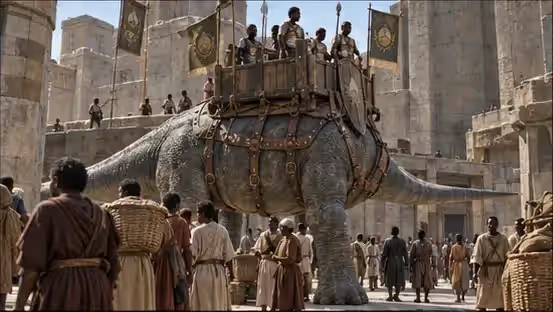
The imperial network is set to the animals’ pace. On the great roads an imperial relay stands every seven or eight leagues, roughly one day of convoy travel: a watering trough, fresh mounts for couriers, upkeep of the boundary stones, a few soldiers. On the corridors of the great sauropods, heavier stations are spaced about every twelve leagues, with fodder hoppers, basins and heaps of gizzard stones, which the titans swallow to grind their food. In between, private fodder posts sell a ration and water by the day’s march.
This grid decides everything. A convoy that leaves too late does not reach the next relay before nightfall and must camp at the roadside, without water or guard. A stage longer than usual is marked on the boundary stone, and convoy masters dread it. The Chancellery’s maps therefore do not only measure distances: they count stages.
Feeding an army on the march
The orders of magnitude are simple and relentless. A draught hadrosaur eats about a hundred and twenty-five kilos of fodder a day, a camarasaur nearly five hundred, a Dreadnoughtus more than a tonne; a brachiosaur drinks some three thousand litres of water. A tonne of compacted fodder bread, the kind sold at the posts, feeds a marching titan for one day. A legion taking a few hundred draught and riding animals and a handful of great living beasts therefore consumes several dozen tonnes of fodder every day, before the soldiers’ grain is even counted.
For this reason an imperial army never sets out first. Advance convoys fill the relays along the road, open campaign depots and lay in water at the difficult passages; the army then consumes what others have set down ahead of it. The very large also carry a campaign ration whose composition is a State secret, and which lets them hold out far from the silos.
When the road goes to war
In peacetime an imperial road serves everyone. When the Empire mobilises, the Chancellery designates the war axes: private convoys give way on them, relays come under the authority of the military commissariat, and relay masters receive written requisition orders stating what is taken, for how long and who will pay. The Empire’s first level of mobilisation, the Road Guard, does nothing else: protect the relays, escort the convoys, police the flows.
The road also becomes a target. On the march of Qor Zaï, Arkhan raiders burn a relay’s accounts first, and false relays, set up to mislead or trap a column, are among the known dangers of the march road. The fortified relays of the frontier can hold alone for a day, long enough for the neighbouring fort to answer; their recognition signs change like passwords.
The pace of a column
A goods convoy covers six to nine leagues a day, an army five to six, and only three or four when it takes its great animals and its siege train. The day follows the animals. They are watered before dawn, the column sets out at daybreak, halts in the middle of the day for water and heat, and wants to reach the relay before the light fails. The very large do not march mixed in with the infantry: they advance in their own slot, at the head or the tail of the column depending on the ground, so that their halts and swerves block no one.
Column leaders hand down a rule of prudence: the march is set by the slowest animal, never the strongest. An order that asks more of the animals is paid for at the next relay, in lameness, broken straps and extra rations.