

Places and landscapes
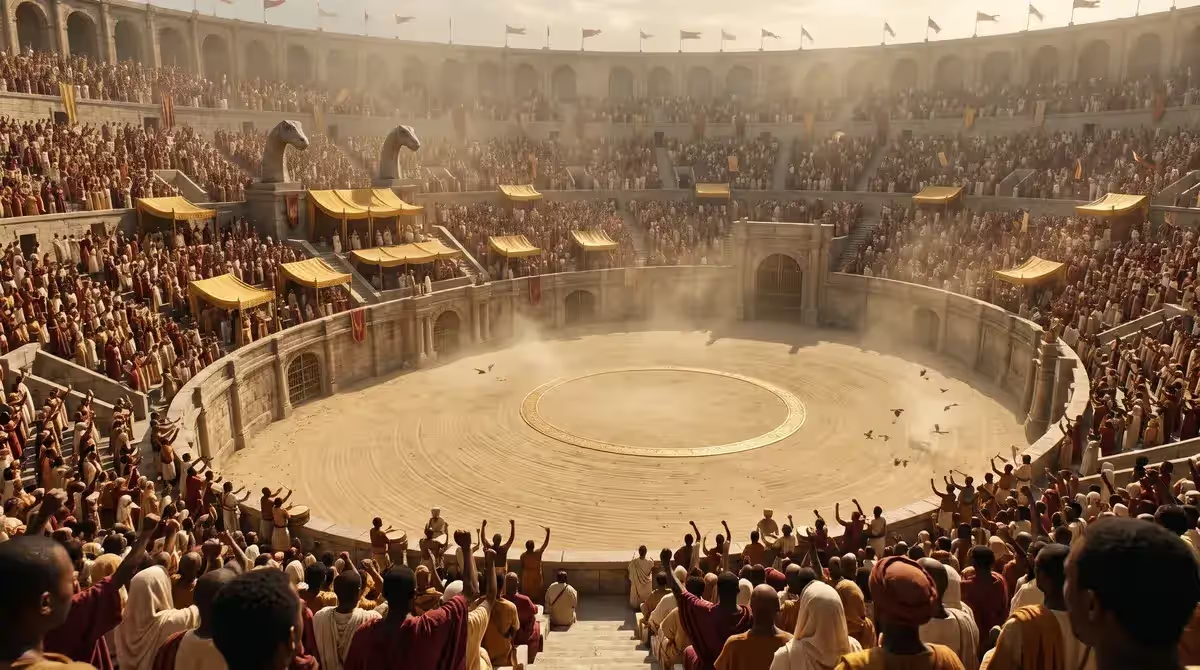
The imperial arena of Urnok
In the capital, a single ring of tiers can hold several tens of thousands of people. Beneath the sand, the colossus’s ways and the human passages never cross; House Calaris holds the protocol, the seals and the hour there.
A ring for the crowd, a way for the colossus
The tiers form a single ring around a track of pale sand, with upper sectors, galleries and walkways. Four crowd gates count what they swallow: a passage keeper per door leaf, a notch per ten, a tally at every bell. Escape corridors must stay empty, as their craft requires, and absorption squares take the overflow of the crowd. A great gate also opens onto the track.
L’arène impériale d’Urnok, pleine de foule.
L’arène impériale d’Urnok, pleine de foule.
Beneath the sand, two networks run side by side without crossing. The colossus’s way follows the far side of the load-bearing wall: it takes the height, the wide curves and the straight gates. The human passages get the corners, the low ceilings and niches deep enough to let a straying mass go by. The two leaves of an airlock can never open together: one bar drops before the other is even touched. Sloping drains carry water away, and a side basin serves for the colossus’s care; its foot is washed and its nail checked after each passage.
The Calaris protocol
House Calaris holds protocol, arenas and seals at the imperial centre. In the arena, its stewardship holds the protocol, the seals and the hour. The law of accidents applies there as elsewhere in the Empire: an animal does not become at fault because humans have badly allotted the space.
An arena as a tool
Urnok’s arena is not only a place of spectacle: it is a tool of training and politics. Parade circuits link it to the avenues; its tiers also serve as a means of control; test tracks there try out harnesses and armour; it connects with the arsenals and the court. Tiers for people and heavy tracks for animals make two worlds coexist there in a single choreography.
The arena’s calendar
The arena is not used only for great sessions. The master of arenas of House Calaris keeps its calendar and rules, for the imperial arena as for the capital’s smaller arenas. Here one sees hadrosaur races, where the stud lines measure themselves on the track; dressage trials, where the riding schools present their pupils; parades of legions before they leave on campaign; the Crown’s festivals; and, rarely, executions pronounced by imperial justice.
Each session has its register: number of entries, beasts engaged, incidents, care given. The seating plan, fixed by the House, assigns each sector its public. The upper sectors are open to all; the galleries go to the houses, the bodies of state and foreign delegations; the imperial tribune faces the great gate, so that everything entering the track first advances towards the Crown.
The sand and those who keep it
The track is as carefully built as the stands. Beneath the pale sand lies a bed of gravel and then of draining stone, which drinks a storm’s water in a few hours. The sand itself comes from the riverbanks; it is sieved twice, because a sharp pebble can injure a colossus’s sole, and whole loads are brought in before each great session.
A team of rakers lives from this work. At the dawn of a session they rake the track in tight lines, then walk it barefoot to feel what the eye cannot see. After a great beast has passed, they fill in the footprints, gather the dung for the lower canals and water the ground to lay the dust. Their chief signs the state of the track in the register before the first gate opens: if a beast is hurt on badly prepared ground, his signature is the one that will be read.
Learning the noise of a crowd
For the beasts, the arena is also a school. A colossus that has never heard tens of thousands of voices may panic on the day it crosses a city in festival or a battlefield. Young animals from the Crown’s stables and the legions are therefore brought in by stages: first the empty track, then the track with a few hundred people in the stands, then ordinary sessions, before they appear at a great festival.
During these sessions the beast-masters watch the animal’s breathing, tail, neck and feet, and note what unsettles it: a bell, a flag, a sharp cry. A beast that tolerates a full arena receives a mark in its register, and that mark counts when animals are chosen for a parade or a campaign. Regulars say you can tell a colossus “born in the arena” by the way it turns its head towards the crowd without stopping.
The other arenas
The imperial arena is not the only one in the Empire. Every ducal capital has its own, smaller, where the duchy’s races, dressage and festivals are held; Velmor’s is said to be the most severe, Orlantis’s the most elegant, with its lacquered wooden galleries. In the marches, Arenna owes its fame to its games, which draw the neighbouring garrisons on relief days.
All these arenas follow the same building rules: separate ways for beasts and humans, double-leaf airlocks, escape corridors kept empty. The capital’s engineers inspect them as they inspect bridges. An arena that no longer meets the standard loses the right to host the Crown’s great beasts, which for a duchy is a public humiliation.
Part of this article covers events of season 1. Turn spoilers on in the menu to read it.