

Power and institutions
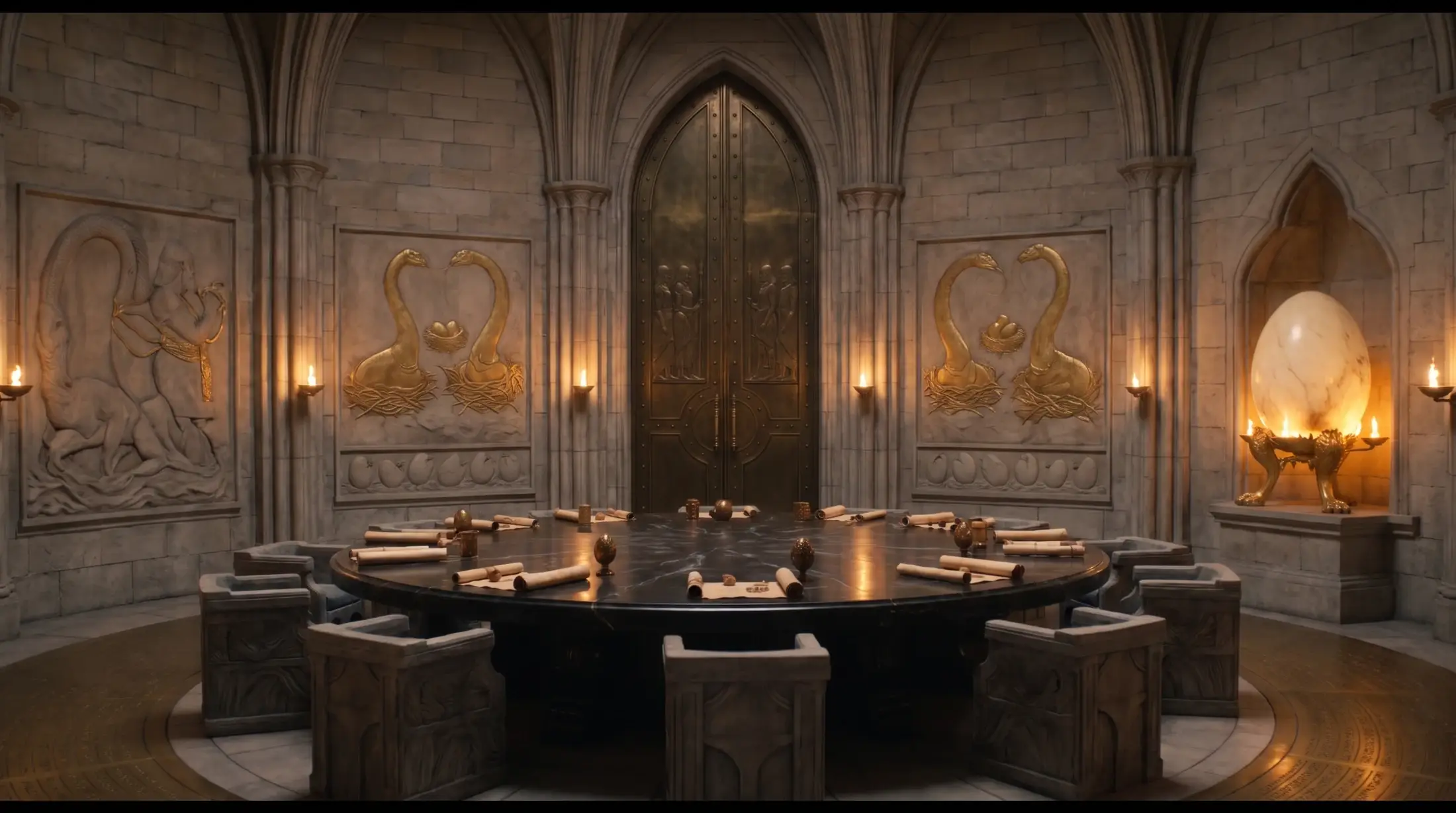
The factions of the Pangaean marches
Sixty road towns, fortified granaries, tolls, workshops and registers on the fringes of Urnok. They already speak the counters’ dialect, but live under the threat of raids.
The fringes of Urnok
The Pangaean marches are the fringe of the Empire: road towns, fortified granaries, tolls and registers. The counters’ dialect is already spoken there, but life goes on under the threat of raids. Within the Empire, free towns, marches and relays are held by local governors; they live off tolls, silos, arsenals, river ports and quarantine gates, serve as buffers between the Houses and remain zones of friction subject to imperial arbitration.
Sixty factions are on record there. Six of them, which hold war or its means, have their own article: the Marche de Serr’Ur, the Marche de Veyk, Haut-Grenier, the Bastion des Harnais, Masse-Ronde and Herse-Croc.
Garrisons, forts and war workshops
Two marches hold the frontier: the Marche de Serr’Ur keeps garrisons of patrol raptors, the Marche de Veyk leads counter-raids against Arkhan. Herse-Croc is a small fort armed with anti-charge traps, Garde-Lacs a fort watching over laying grounds. Roche-Rang is a barracks where legionaries are trained, Croc-Haut a martial school of light cavalry.
The workshops follow. The Bastion des Harnais, a fort-workshop, makes ceratopsian armour; Masse-Ronde prepares ankylosaurs as living battering rams; Brise-Char builds ceratopsian chariots; Courbe-Silex makes weapons of teeth and bone. Porte-Silex, a mining suburb, produces dinosaur dental tools, Tour-Étain draws the metal for nails and chains from its mine, and Morne-Foyer forges to the metal standard. Bourg-Chaudron distils oils and fats.
Granaries, rations and water
Kavrel is a granary city with tiered fodder silos, Haut-Grenier the citadel of an imperial reserve. Tertre-Foin, a farming commune, pays its tax in kind; Vallée-Meule mills grain and fodder; Trame-Orge keeps granaries and the grain market; Croisée-Silos, a road junction, a fodder market. Côte-Ration guards the warehouses of imperial rationing, Tour-Ration administers the censuses and Puits-Droit, a tax post, checks the rations. At the Hameau des Quatre-Puits, a roadside halt, water is controlled. Kors-Foin breeds draught animals.
Roads, tolls and relays
Veyr-Cintre, a town built on a bridge, levies a toll on its arch; Portique-Rouge lives off road taxes and Porte-Miel off taxes paid in wax. Rang-Épine lines up caravanserais, Morne-Corde is a caravan relay that spins ropes, Ligne-Corde a team relay. Ovale-Mur is a corridor town planned against escapes, and Palissade-Mousse makes dampers against animal panic. Colline-Rumeur sends pterosaur couriers, Haut-Rumeur carries imperial propaganda on its public square, and Cité-Palanquin, a town of nobles, organises ceremonial transport. Soute-Bleue is an inland port of hadrosaur barges.
Floods, dykes and building works
Orbe-Vanne, a sluice town, controls the floods; Douve-Boue, a town of dykes, tames them; Serr’Vane, a weather post, announces them. Dôme-Brique, a clay town, makes its bricks by the river, Arc-Dôme raises domes against storms, Pente-Cendre draws quick mortars from its quarry and Vigie-Cendre, a volcanic post, supplies pozzolana bricks. Porte-Urnok, a suburb of the capital, houses building guilds. Rivage-Corde fishes with heavy nets.
Writing, seals, sanctuaries and trades
Lysaire is a town of scribes with standard writing workshops; Sable-Écrit, a school of writing on tablets; Fosse-Registre, an office of engraved archives. Rive-Sceau holds a river court for cargo contracts, Serr’Rôle an itinerant justice. Serrure-Noire is a house of strongboxes locked with lodestone, Nid-Bourse a marketplace where eggs are sold at auction. Brèche-Temple, a sanctuary city, plays ritual politics.
Tisserand-Vert is a textile city working plant fibres, Voûte-Fibre a workshop for ropes and sails, Ruche-Forte a beekeeping town producing wax and varnish. Falaise-Tonne makes wine and exports it to Ishtir. Graille-Haute, a hunting hamlet, lives off claw trophies.
Living under the threat of raids
In the marches every town is a possible target: a toll to seize, a granary to burn, a herd to drive off. Raids come from Arkhan bands moving along the border, from the tribes of the wild lands and sometimes from looters out of the Empire itself. They strike fast, in the season when the stores are full, and leave before a garrison can arrive.
The towns organise themselves accordingly. A watchtower overlooks almost every one, with a smoke signal by day and fire by night; at the alarm, the animals are brought into a fortified pen and the granary’s single gate is shut. Reserves are calculated to withstand a siege of a few weeks, long enough for reinforcements to come. Families of the marches often count their generations in raids endured rather than in years.
Braknor, the march that stopped obeying
Not all the marches have stayed obedient. North of Bralnor, the March of Braknor was an imperial march of Pangean culture; it stopped obeying Calaron and now lives as free land, on tolls and road guarding. Its people speak the same language as their imperial neighbours and practise the same cult; only their allegiance has changed.
Braknor sells Bralnor and Velmor the hay of the moors, escorts for northern convoys and the wax of its hives; it buys pressed fern from Sarnor and leather and metal from Velmor. The Empire tolerates it because it guards a useful road and because reconquest would cost more than the lost tolls. In the other marches Braknor serves as an example both ways: what can be gained by moving away from the centre, and what is lost in protection.
Names that tell the trade
The names of the marches can be understood almost without explanation. They combine a landmark, a work or an institution, and the resource the place lives on: Porte-Miel lives on wax, Tertre-Foin on fodder, Rive-Sceau on its contracts, Tour-Étain on its metal. These are working names, given by convoy drivers and scribes rather than by founders, and they sometimes change when the activity changes.
The Pangean language adds its own sounds, Val-, Pont- or Ferr- at the start, -aron or -mar at the end, and Urnâk its suffixes, -og for what is colossal, -ka for a title. Some towns have an unexpected speciality: Arenna, for instance, is known throughout the region for its games, which draw the neighbouring garrisons on relief days.