

Families and social ties
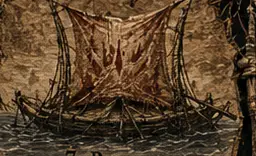
The Peaux de Marée
The most recent of the seven great khanates, born from pilots, floaters and carcass craftsmen, shows that Arkhan can build a new power.
A new power
The Peaux de Marée are the most recent of the seven great khanates, at about 900 years. The khanate was born from pilots, floaters and carcass craftsmen, on the dry coasts and in mobile workshops. Hides, sinew, rafts and pilots make up its power.
Une flotte de coques d'os à l'ancre près d'une côte.
Its existence proves that Arkhan can create a new power outside its old traditions: beside thousand-year-old trails, a khanate of coast and workshops has taken its rank among the great.
Born of the coast’s carcasses
The Peaux de Marée (Tide Skins) are the youngest of the great khanates: about nine hundred years old, when the Première Piste claims three thousand eight hundred years of ritual continuity. The khanate was born on the dry coasts of northern Arkhan, among people the old trails looked down on: pilots of fords and estuaries, makers of floats and above all carcass craftsmen, who lived on what the sea and the lagoons cast up.
The khanate’s own stories place its origin in that shoreline work. Stranded marine reptiles, giant fish and carcasses brought in by storms supplied hides, sinew, bone and fat to camps of flayers who followed the coast. Little by little these camps bound themselves by oaths, learned to build rafts and floats to go further afield, and in the end gathered enough beasts, pilots and workshops to take rank among the great. On those coasts people still say that a khanate born of a carcass knows what it owes the sea.
Workshops that follow the coast
The power of the Peaux de Marée rests on mobile workshops. Their shore tanneries salt and scrape hides on pebble beaches, then load them onto rafts to go up the estuaries; their cutters separate sinew from flesh the same day, before the heat spoils it. These workshops come apart in a few days and go up again further along, following the carcasses, the seasons and the markets.
Their most envied speciality is the float. Double-stitched skin bags, dried and inflated bladders, coated with N’Goro anti-rot glue and lashed with sinew to frames of wood and bone: these floats carry rafts, temporary fords and loads moved from one bank to the other. The same workshops supply part of the roofing membranes that the Great Cleaning replaces in the shell-cities, so that a city of the interior may sleep under a hide tanned on a beach none of its inhabitants has ever seen.
Reading water like a trail
The khanate’s pilots apply to water the Arkhan rule that every landform becomes a trail. They read currents, sandbanks, the colour of water hiding a shoal, and the wind that drives a raft faster than oars. Along the coasts they run the coastal traffic towards Port de Sable; inland they take beasts and caravans across estuaries, lagoons and wadis in spate, where a herd can drown in moments.
The knowledge is handed down like a tracker’s, by eye and by trace: a pilot says what he has seen and what the water has left, not what people tell. The khanate’s elders like to recall that the sea is a trail that keeps no tracks, and must therefore be read again every morning. The other khanates call on their pilots as soon as a river rises across their road, and gladly pay them in beasts, for no rider knows how much a raptor weighs on a raft.
The youngest of the seven
The standing of the Peaux de Marée is still argued over. The old trails reproach the khanate for not marching as they do: its people spend part of the year on the water or on the shore, and its workshops count for more than its saddles. Its defenders answer that it proves precisely that Arkhan can build a new power outside its old traditions, and that a country living by trails cannot stop at the water’s edge.
Like every great khanate it keeps its own Apex, some ten tarbosaurs of a coastal lineage whose most famous member is called Krog-Madr, the Salt Fang, and shore beasts close to those the coastal clans of Port de Sable feed on fish waste and carcasses to deter pirates. Its ties to Port de Sable and to the merchants of Volonia are close: many Arkhan cargoes reach the quays by its pilots and rafts. The khanate does little to put its chief forward; in Port de Sable one deals with its pilots rather than its khan.
Shalvak, Vessar and the mixed coast
The khanate’s lands come down to two coastal countries. Shalvak, its seat, is the port of the slipways: floats are sewn there, flotation bladders prepared, hides tanned and pilots trained. Vessar, the other country of the coast, lives on fishing and salt pans. The rest is a long dry steppe running down to the sea, with a few wet meadows and two lakes.
Several clans work under the khanate’s banner. The Piques-Mouillées, people of the reeds, fish, salt the catch and weave capture nets; the Salt-Makers of the Salt Lakes cut salt into blocks that caravans carry inland. Many of the bladders come from hadrosaur carcasses, and there are never enough. The coast is mixed: families of Ishtiri speech have lived there for generations among the trail people, and both languages can be heard on the same quays.
Part of this article covers events of season 1. Turn spoilers on in the menu to read it.