

Economy
Velasar: building the fleet
Great Hulls, arsenals and breeding connect the sea to Orlantis and Korath expertise.
A productive naval power
Velasar is the great naval House-trust: Great Hulls, arsenals, ocean fishing, plesiosaur breeding and foreign orders. The chain brings together Korath engineers and Orlantis traditions. Vornëa’s reputation and luxury do not make it the leading naval complex: productive functions remain distinct.
A hull begins far from the sea
Flows connect Orlantis timber, resins and cordage to Volonia’s hulls and marine harnesses. The shipyards add hides, sinew and metals. This network explains the dock’s dependence on several land-based and animal-material workshops.
The shipyard works with an animal
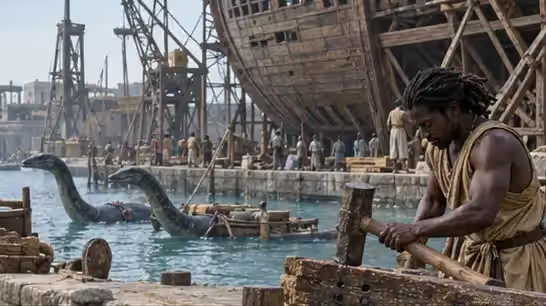
The plesiosaur works in construction and towing. Its channels are distinct from human routes and boats; floating docks, passages, refuges and moorings belong to the port vocabulary. The animal does not replace the shipyard: people, harness, hull and water work together.
Rincer et suspendre le harnais marin
La zone d’attente permet d’observer l’animal et de retirer son matériel. Le service du bassin accompagne celui du harnais.
From trunk to hull
A Velasar hull begins in the forests of Orlantis. There, trade families share the chain: the lines that fell and float the trees decide which trunks will fall this year and which will wait thirty years, those that tap the resins prepare the pitch and varnishes, those that twist ropes supply the rigging, and the lines of the downstream ports ship everything to the sea. The greatest masts, of a single trunk, are chosen standing and bought years in advance.
To these woods from afar Velasar adds the archipelago wood of its own islands, conifers and araucarias steeped in salt, from which planking, piles and frames are made. The finest araucarias, straight for thirty metres, are entered in the register before being cut, and the Great Hulls compete for their felling. The metal comes from Korath: nails, rivets, chains and anchors are forged on the Forge Island with imported iron, and every delay of a metal convoy shows on the slipways.
What Velasar knows how to do
The Great Hulls rest on techniques Velasar guards jealously. Their multiple keels are assembled on the slip over three seasons; their articulated hulls withstand the Great Ocean swells without breaking; their watertight bulkheads divide the hull into compartments, so that a ship gutted by a pliosaur can stay afloat. The frames are steam-bent and numbered before assembly, and the articulated rudder, with bronze hinges and pulley returns, can be worked by two men on a ship a hundred and fifty metres long.
The Great Hull builder is the master of this chain: he designs the hull, calculates its keels and compartments, and follows the yard from the laying of the keel to the launch. Beside him work the engineers from Korath, who adapt the deck ballistae, their tension and the damping of their recoil to Volonian hulls. This imported technique is very expensive, and insurers often require its certification before covering an armed Great Hull.
Building for others
Velasar does not build for Volonia alone. Foreign orders make up a large share of its work: barge hulls for Urnok’s great river, merchant ships for foreign shipowners, repairs of hulls from every port. A rule of the League nonetheless limits this trade: warship hulls and the technique of watertight bulkheads are sold only to houses of the League, and a yard that ceded them to a foreign power would expose itself to prosecution before the Court.
In war, the yards never stop. The dry docks take in damaged hulls in the order set by the Admiralty, the workshop ships leave to refit Great Hulls at anchor, and the forges of the Forge Island run day and night as long as metal arrives. Velasar’s dependence on the wood of Orlantis and the iron of Korath then becomes its most closely watched weakness: cutting those routes condemns the fleet to wear itself out without being able to rebuild.
A day in the yard
The yard opens at the dawn bell. On land, labour iguanodons and draught hadrosaurs drag the trunks from the soaking ponds to the saw pits; in the water, the construction plesiosaurs lift the heavy pieces and present them to the carpenters. Teams of ropemakers, smiths, caulkers and sailmakers take turns around each hull, and the beating of mallets can be heard from afar.
More than a third of Velasar’s workers live from the yards, and their districts spread around the slipways. Children learn there to recognise the woods by the scent of the sawdust, apprentices begin by carrying water and greasing the pulleys, and a whole family can work on the same hull for its three seasons of construction.