
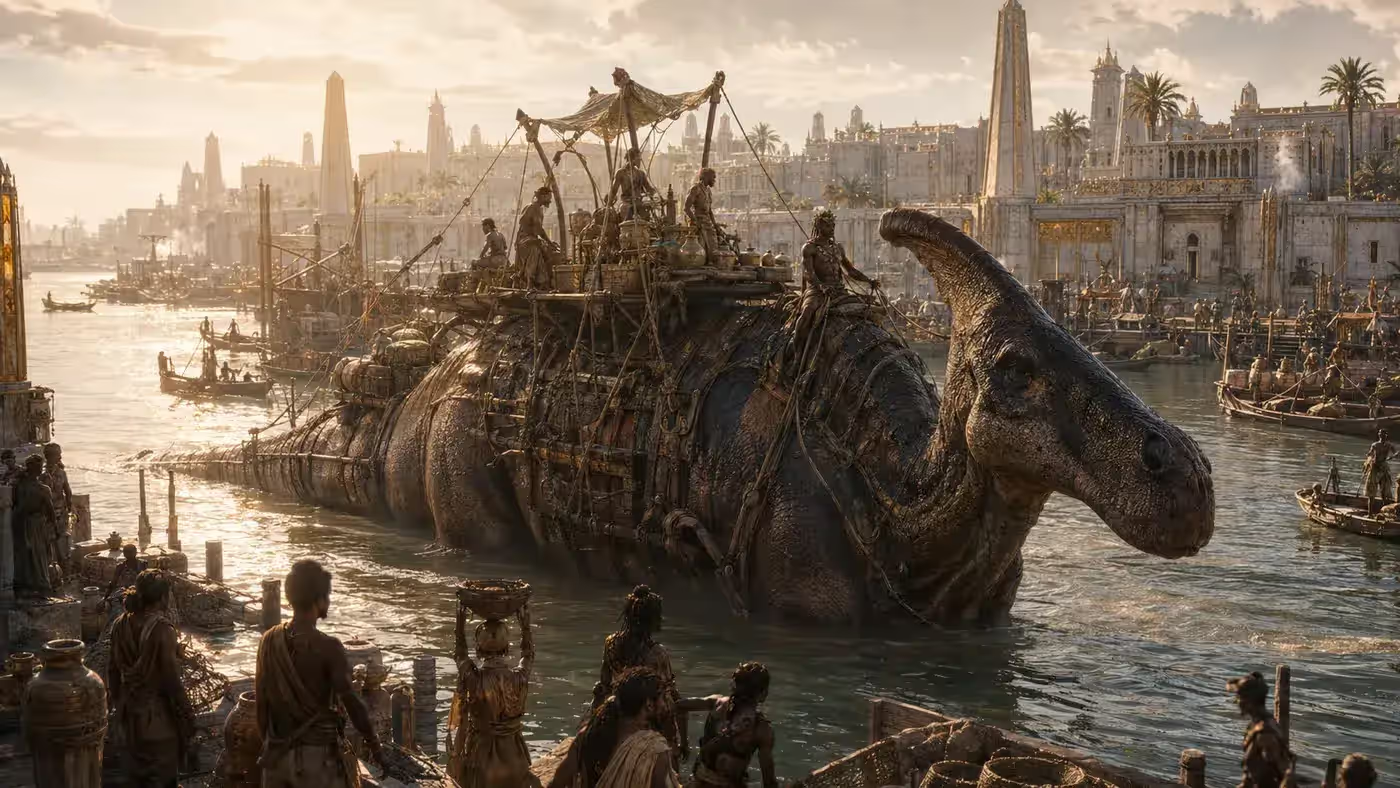
Living engines
In a world without industrial machinery, the strength of great animals drives the works: living cranes, norias and chain pumps, road rollers, back platforms, floating cranes, mills turned by walking. Humans design, harness, count and repair; the animal provides the strength.
The strength of the living
The world knows no industry. Hoists, capstans, counterweights, winches and funiculars exist, with an ancient appearance; a chain, a small forged part or a specialised transmission are possible, and Korath’s workshops patent gears, transmissions and mechanisms. But no factory crane and no omnipresent mechanism does without labour. For very large loads, strength therefore comes from animals: living engines are the devices harnessed to a body to lift, pull, pump, pack or carry.
The harness links machine and animal. It spreads the effort and keeps the fastenings inspectable; it belongs to the harness trades, which the wheel never erased. No mammal enters these teams: ordinary traction falls to hadrosaurs and iguanodons, colossal loads to sauropods, work at sea to plesiosaurs.
Living cranes
Sauropods are the backbone of public works. As living cranes, they lift and set monoliths, beams and arches on continuous worksites; they also carry the modules of the city being built: scaffold towers, observation platforms, temporary site bridges. In the quarries, the chain runs from extraction to lifting by the living crane, then to cutting, haulage and storage: the blocks arrive ready to lay. Bralnor’s quarry brachiosaur is its emblem.
These cranes need their own tools: heavy winches and harnesses of thick leather, braided tendon, greased bone pulleys and bronze or iron parts, proven by traction tests before serving in ports, quarries and worksites. At war, the same worksite sauropods become living cranes able to carry, demolish and sustain a campaign.
Drawing water, packing the ground
The same animals pull norias and work chain pumps to raise water up to the giant troughs. They compact dykes and embankments, drain marshy ground, pull up stumps to open farming corridors and fodder roads. Road works owe them their rollers and shifted paving slabs: sauropods thus repair the damage of their own steps, in a loop that makes the upkeep of priority roads a matter of state.
Even the tax office walks: sauropod caravans collect taxes in kind, grain and hay, because the state levies to keep its public animals.
Carrying on the back
A back platform turns an animal into a vehicle. Convoys of goods and crews — craftspeople, militia, workers — travel on harness pontoons, and the great imperial processions ride on imposing beasts. On rivers and canals, amphibious hadrosaurs serve as living barges; in inland ports, niches along the quays are set aside for them.
Volonia’s floating cranes
At sea, the plesiosaur plays the same part. Volonia’s civilisational animal, it tows, rescues and transports; worksite plesiosaurs serve as floating cranes, move blocks, lay domes and tension cables. Specialised crews and traction masters lead them on naval and urban worksites.
Mills that walk
The smallest living engine fits in a harness. The mobile mill hangs a millstone from the harness of a small draught herbivore, a protoceratops or a dryosaur: along the way, its steps drive the stone, and the grain is ground on the move. At the other end, war harnesses forges, silos and towers to the largest bodies; these campaign harnesses have their own article.
The neck lifts nothing
People speak of living cranes, but the phrase misleads. A sauropod’s neck never serves as a crane jib: no animal lifts a block with its head. On a building site the great animal carries on its back a guyed platform, eight or ten metres above the ground, where independent winches lift loads of one to three tonnes; or else it turns, on the ground, the winch that hoists the block. The strength is the animal’s, the precision that of the people working the cables.
The trades share the task. The mahout walks the animal and halts it on the signal; the winchman sets the cables and brakes on the platform; the lifting chief watches the block and gives the orders. The longest-necked sauropods are sometimes used to pass the head of a cable over a pylon or from one side of a ravine to the other, but they carry only that head: the taut cable rests on the winches and pylons.
Treadwheels and capstans
Most living engines do not move from place to place. In the workshops a hadrosaur walks inside a great wheel eight to ten metres across, and the wheel turns a shaft which, through belts and wooden wheels, drives saws, millstones, pumps or presses. The animal works in four-hour shifts, then another takes its place; a brake lets the machines be stopped without stopping the animal, which dislikes being halted in mid-stride.
Each use has its rules. At the mill, one pair of millstones is enough for a hadrosaur, and the grinding is set so that it keeps its pace; at the sawmill, a partition separates the animal from the blade, and the noise tires it so quickly that it is relieved more often. Piston pumps raise water from wells, mines and cisterns. The largest workshops couple several wheels on a single shaft and set sauropods walking in them together, taking turns to drive a whole hall.
Striking true
Some animals do not pull: they strike. In the mines, the ankylosaur finishes with blows of its tail club rock that people have already cracked, a few dozen blows a day at most, always in a closed pit where the workers are sheltered from flying chips. On roadworks, the pachycephalosaur pushes with its shoulder the jointed arm of a wood-and-stone rammer, which drops twenty or thirty times a minute to pack the embankments; it never strikes the stone with its skull.
These engines call for calm animals and short spells. An animal that strikes for too long injures itself, grows agitated or loses the precision expected of it, and the pit masters withdraw it at the first sign of fatigue. Foreigners who see a mine ankylosaur at work for the first time are often surprised by its slowness: it waits for the signal, strikes once, and waits again.