

Economy
The Empire’s trade roads
Six great axes carry Urnok’s stone, timber, fodder, metal and animals; each has its relays, its keepers and its own way of breaking.
The road feeds
The Empire’s thesis fits in one sentence: the road feeds, the register assigns blame, the titan makes the Empire possible. A load-bearing road is not just a roadway: it combines paving, drains, relays, fodder, resting places and a rotation of animals. Its weakness is Urnok’s own weakness: broken roads, fodder, relays and registers. Cutting a road can be worth more than a battle.
Six axes
The Route des carrières runs from Bralnor to Calaron and Sarnor. A load-bearing road with crush-proof paving, it carries massive stone, marble and limestone on brachiosaurs; Karûm-Brakh works on it under the Chancellery’s oversight. Its risks are collapse, the tribes of the wild North and winter; it serves building sites and walls.
The Route des résines leaves Orlantis for imperial Qor Zaï, Calaron and Volonia. Its forest relays carry timber, resins, ropes and fibres; it reaches the Îles Brisées and the seafaring diasporas, and its own risk is smuggling by sea. The Route du fourrage links Sarnor to Calaron and to the Long-Pas: supply markers, silos and basins move compacted fodder, grain and water along it. Sarnor Trois-Saisons operates on it under the eye of the Diet of Great Silos; it is called the belly of the Empire, and its risks are speculation and famine.
The Route noire links Velmor, Korath and Calaron through the passes. A privileged trade route controlled by the Bank and the Crown, it carries black stone, rivets, chains and unique parts by draught ankylosaurs and armoured convoys, for the Living Armouries and the forges of the passes. Its risk is industrial strangulation. Finally, the march road joins imperial Qor Zaï to Arkhan along fortified tracks: harnesses, weapons, fast mounts and transit taxes move along it, under a march command, facing raids, sabotage and false relays. Rivers and canals complete the network between Calaron, Sarnor and Orlantis: barges, hadrosaurs and aqueduct-troughs move grain, fodder, water and waste, under threat of floods and contamination.
Who holds the road
The High Chancellery of Living Ways certifies the compliance of roads, bridges, relays, troughs and markers. Karûm-Brakh builds roads, bridges, aqueduct-troughs and feeding towers in the Empire and beyond, and the conflict between inspector and builder is constant: a compliant bridge is not always the bridge that holds. Repairing a major road involves the Chancellery, the company, the local duke and the Bank, which backs its guarantees with roads as well as silos.
The price of transport
Not all transport costs the same. The cheapest is the living barge, drawn by a hadrosaur on the great river or along the canals: it carries a great deal, slowly, for little fodder. Next come the corridors of the great sauropods, where a train of sledges drawn by a titan moves heavy freight at a price per tonne well below that of ordinary caravans, provided it stays on a road able to carry it. The caravan of wagons and draught animals, which goes everywhere, costs three to four times as much as the barge.
These gaps draw the Empire’s economic map. Heavy, cheap materials — grain, stone, fodder — follow the water and the corridors; expensive, light goods — worked metal, seals, remedies — travel by caravan or courier. A town far from water and corridors pays more for everything, and its inhabitants know it.
Tolls, customs and passages
The roads earn money for the Crown. Tolls on the great roads and bridges are an imperial revenue; regular convoys buy a sealed passage right, valid for a month on a corridor, which they show at the relays. At the borders, customs weigh, gauge and seal cargoes before levying their duty. On the black road at the passes of Korath, as on the march road facing Arkhan, border brokers place cargoes between Urnok merchants, Korathi forges and Arkhan clans, guarantee the contracts and speak the languages.
Fraud exists on every road: false seals, misdeclared cargoes, detours along smugglers’ trails. In the marches, counter-trail posts read the tracks of smugglers as they read those of raiders, and keep maps of the passes that never leave the forts.
The people of the road
The imperial roads have their own population. Convoy drivers and their families live from relay to relay; couriers change mounts every few hours; Chancellery inspectors ride their stretches on light, fast cure hadrosaurs. Whole families move house with a convoy hadrosaur loaded with a double-pannier pack, soldiers join their garrisons, students walk to the Synod, foreign merchants follow the convoys speaking Road-Cant.
The relays are their villages. There one learns the state of the next stretch of road from a tablet by the gate, listens in the evening to the reading of the Petit Fourrage, and swaps news that travels faster than orders. A traveller who knows the relays well knows the Empire well.
Gallery1 image
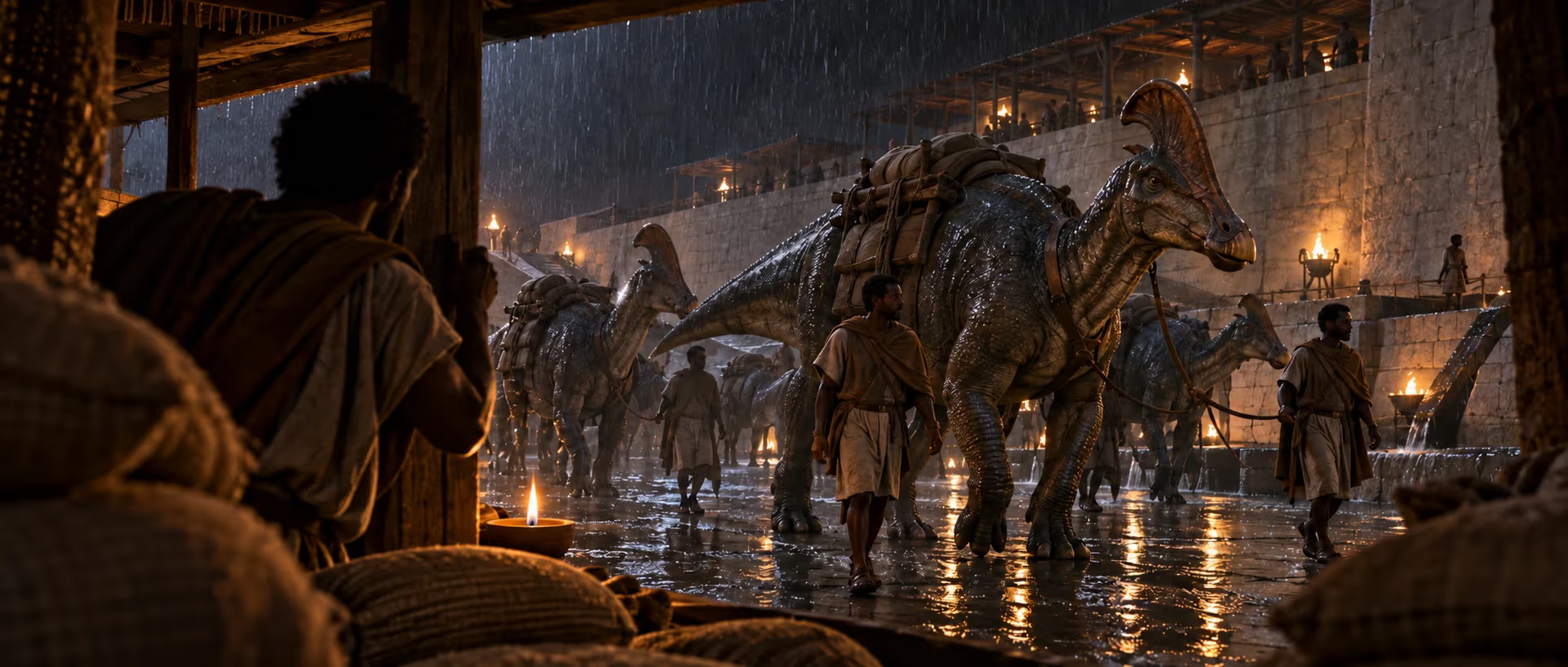
Sahina before a caravan of pack sauropods.